
Of William Shakespeare’s comedies, Love’s Labour’s Love doesn’t get a whole lot of—ahem, love. Written in the mid-1590s when the young Bard was learning his powers, the oft-ignored play centers on three men and their king who make an oath to forswear women for three years so they can devote themselves to study. Beth Wolf directs Midsommer Flight's production, performed outdoors at several Chicago parks this summer. Most of the actors are impressive, though a few poor performances, changes to the text, and complications inherent to an outdoor show made for a less-than-perfect night.
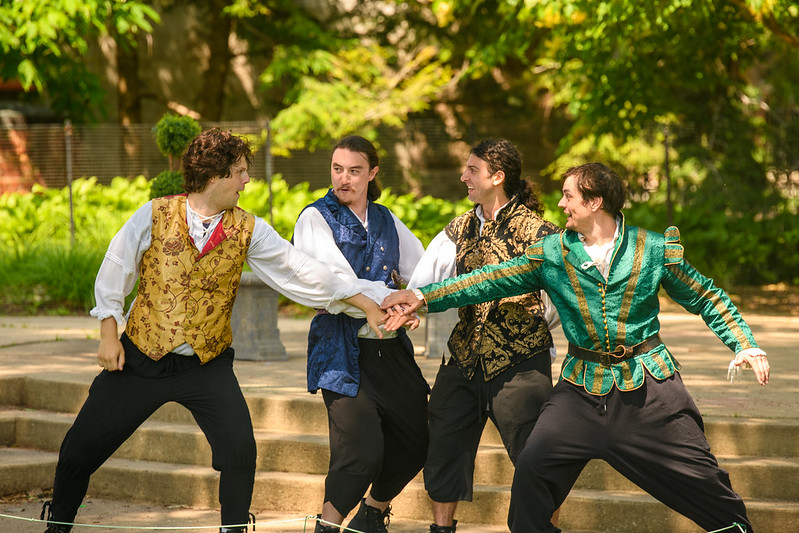
In the beginning the King of Navarre (Joshua Pennington) and his men Berowne (Brandon Beach), Longaville (Dane Brandon), and Dumaine (Travis Ascione) agree to an oath to forswear women for three years. Unlike A Midsummer Night’s Dream or Macbeth, not a single character in Love’s Labour’s Lost has a place in pop culture’s memory, and there’s a good reason for that: none of them are all that memorable, especially the leads.
The King is kingly and Berowne, our protagonist, stands apart as the most hesitant of the signatories, but beside that it’s difficult or impossible to gauge in the reading how the personalities of these characters differ. It’s left to the actor to spin the text so that his character, if not the winner of a congeniality contest, at least has a consistent, discernable disposition. Our four leads accomplish this to varying degrees of success.
Beach presents Berowne's love-soaked soliloquies with a whiny affectation that, I think, tarnishes his leading man potential. Ascione as Dumaine adopts a mugging, cheesy soap-opera-actor approach, which is funny and distinct, if a little out of left field. But Brandon's Longaville, unfortunately, doesn’t have a personality. He grins a lot, sort of like a golden retriever, but never did I feel the actor decided on a way to portray the character.
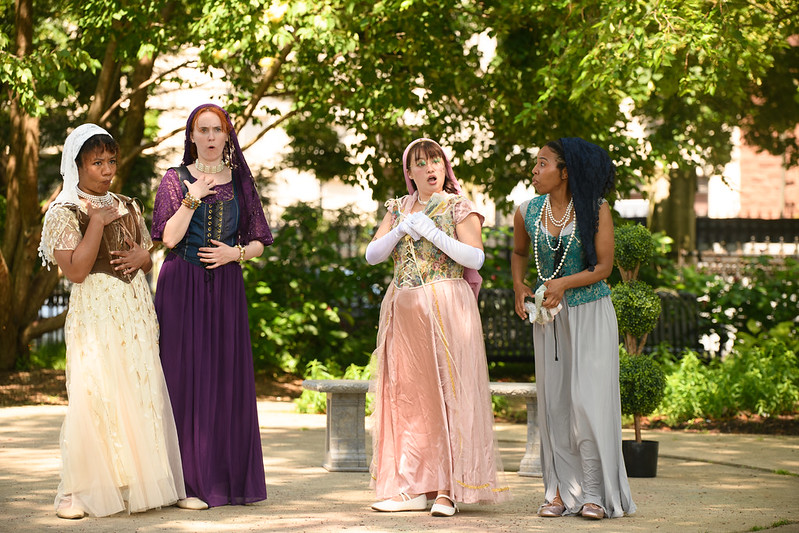
Since this is a comedy, immediately the men break their oaths so that they can receive the Princess of France (Vanessa Copeland) and her ladies, who are so beautiful each man falls for one. How the men and the women love or misdirect one another propels the action and comedy of the show. One of the finest performances in the main cast comes from the Princess’ lady Maria (Juliet Kang Huneke). Maybe it’s not the most elegant metric, but Huneke shines simply by virtue of being the loudest. These outdoor actors, God bless them, compete against obnoxious drivers, airplanes, and the wind, so loudness can’t be discarded. Huneke, who plays the character as girlish and therefore reasonably noisy, is always discernible.
The same could not be said for Danielle Kerr as Rosaline, Berowne’s love interest, whose voice can never compete against the wind. This is not for lack of trying, by the way. It’s clear Kerr wants to reach us; it sounds like she’s screaming, just very quietly. Something about her speaking voice is held back, subdued. She may be right for the role, but ill-equipped for the theater. A character who is supposed to impress us with her wit and seductiveness, once muffled, loses some of her legitimacy.
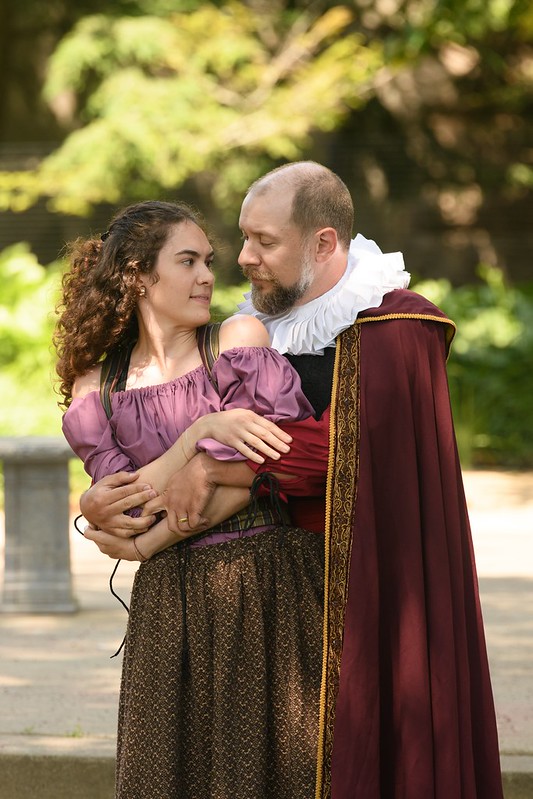
Surrounding the main characters, the Bard provides a retinue of silly secondary parts based on tropes very common in his time and only slightly less common in ours. With these side characters the production departs the most from the original text. For example, in the play the Spanish braggart Armado (Drew Longo) arrives in town with his page Mote. The two discuss Armado’s love for a peasant woman named Jaquenetta (Ruby Sevcik), while Mote, in Shakespearean fashion, insults his master with clever puns.
In this production, however, the characters Mote and Jaquenetta are wrapped into one. Now there is no Mote, Jaquenetta takes his lines, so the conversations Armado has with Mote about Jaquenetta are instead with Jaquenetta herself. This alteration makes the scenes between Armado and Mote (now Jaquenetta) incomprehensible. He’s talking to his love about his love as though she weren’t his love, then something switches and the two are lovers. Furthermore, the joke at the end wherein Jaquenetta convinces Armado he sired a baby with her two months before they met, doesn’t work at all if we’re now supposed to believe Armado and Jaquenetta have an ongoing page and master relationship. The play already challenges theatergoers with its difficult language and deception-centered plot; adding to this confusion is a total misstep.
The real star of Love’s Labour’s Lost is, of course, the language. It’s difficult to imagine reading the play without heavily consulting its endnotes and glossaries. Any page of Love’s Labour’s Lost is full of puns and malapropisms, allusions and extended metaphors. Many of the jokes come from references totally divorced from today’s English, which creates an interesting challenge for an actor: how to stress the word play when it’s not readily apparent to the audience.
While most of the actors spoke through the jokes, letting them pass without notice, Travis Shanahan as Costard, probably the funniest character, attempts to translate the meaning through motion. At certain times he adds a hip thrust or some other obscene gesture when delivering language with sexual innuendos. That may seem beneath Shakespeare, but I appreciate his attempts to highlight portions that would have otherwise gone unnoticed.
Love’s Labour’s Lost by Midsommer Flight continues on weekends at six parks around Chicago, thru August 3; no performance on Friday, July 4. Running time is just 110 minutes with no intermission. Admission is free. Details here.
For more information on this and other productions, see theatreinchicago.com.
If you enjoyed this post, please consider supporting Third Coast Review’s arts and culture coverage by making a donation. Choose the amount that works best for you, and know how much we appreciate your support!
