

Kokandy Productions kicks off its 2025 season with the Chicago premiere of the musical adaptation of the 2001 French film, Amélie. The play is directed and choreographed by Derek Van Barham with music direction by T. J. Anderson and Anna Wegener, book by Craig Lucas, music by Daniel Messé and lyrics by Nathan Tysen and Daniel Messé.
Adapting a film classic into a musical is no easy feat, especially one as beloved and quirky as Amélie, which starred the singular Audrey Tautou in the title role. Fortunately, for Chicago audiences, Kokandy has found the perfect actor to bring the altruistic do-gooder to the stage.

The wonderful Aurora Penepacker—a winning presence with a powerful voice--in the titular role leads an excellent ensemble that includes Joe Giovannetti as Nino, Sam Hook as Lucien, Sonia Goldberg as Gina, and Samantha Ringor as Suzanne. Other members of the large and talented cast include Todd Aulwurm, Lucas Burr, Rachel Carreras, Mizha Lee Overn, Jon Patrick Penick, Quinn Rigg, and Kelan M. Smith. All do double duty as musicians, playing such instruments as accordion, violin, cello, guitar, ukelele, mandolin, piano, trombone, clarinet, and flute.
The mood is set straightaway in the opening scene: An accordion player dons the traditional French beret with a cigarette hanging from his lip. When Penepacker enters as Amélie dressed in a checked skirt, red sweater, short black boots, and wearing the character’s familiar black bob, the audience breaks out into applause.
Amélie is a dreamer. Raised by emotionally distant parents, she turns to her imagination and a rich inner life for solace. Her only contact with her physician father is the monthly checkup she receives. She acts so excitedly when she sees him that he believes she has a heart condition and decides to homeschool her. Her best friend is Blubber, a goldfish. When her mother dies a tragic although absurd death—a Canadian tourist jumps from the roof of Notre Dame and lands on top of her––Amélie feels truly alone in the world.
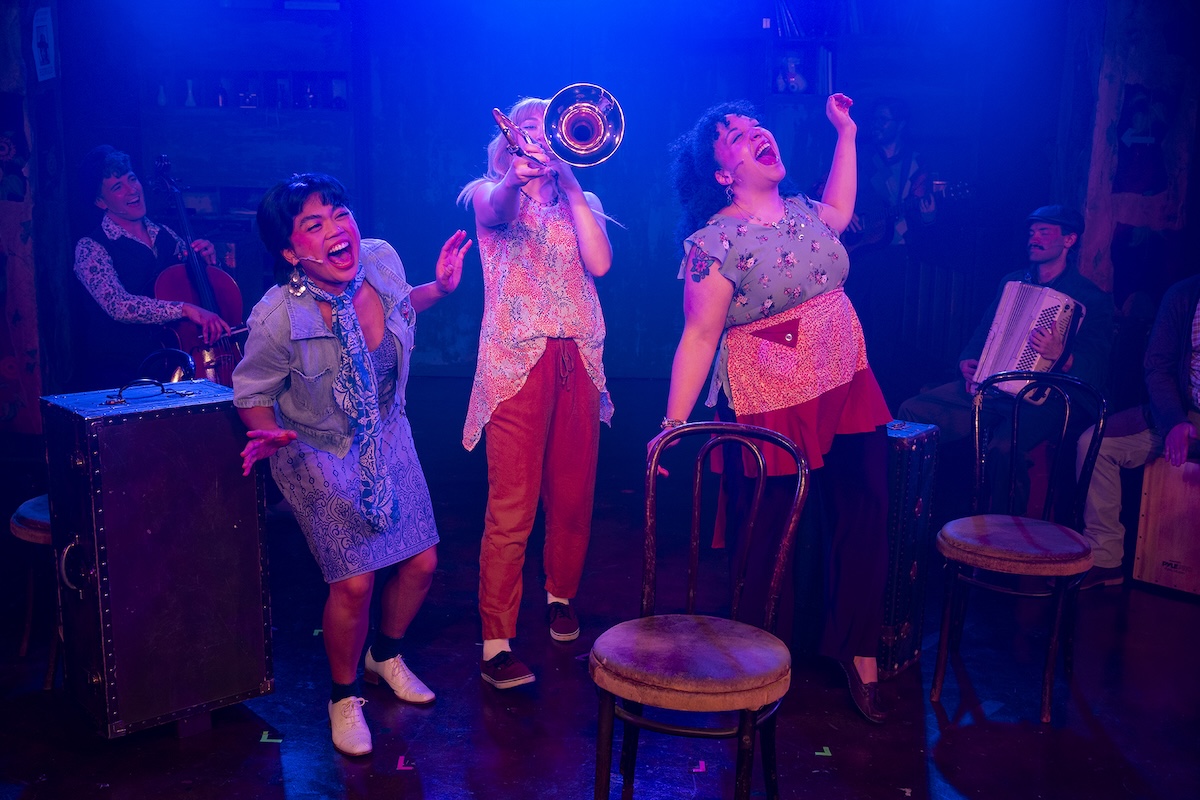
Years later, as a young adult, she moves to the famous Parisian neighborhood of Montmartre where she works as a waitress in a café called, in a nod to the Moulin Rouge, the Two Windmills. The co-workers consist of Suzanne, the café owner and a former circus performer, Georgette, a hypochondriac, and Gina, another waitress. The plot takes a crucial turn when, on the night Princess Diana dies in 1997, Amélie discovers a mysterious box that contains childhood objects that belonged to a man who once lived in her flat. She decides she will find the owner and anonymously deliver the treasure trove to him with the simple and altruistic goal of making someone else happy. “I could be like Lady Di,” she reasons.
Those not familiar with the movie may find the various twists and turns of the plot hard to follow—there’s a lot going on here––but the core of the film’s message remains the same and forms the heart and soul of the show: Kindness and goodwill win the day. And beloved objects—the garden gnome that travels around the world and is such an important presence in the movie––are also here. Like the movie, the musical is whimsical and full of eccentric touches. Unlike the movie, which had a solo narrator, the play uses several narrators, a theatrical device that works since it helps emphasize the communal nature of the play while also foreshadowing to the audience what is to come (“In 48 hours her life would change forever”). Indeed, the adaptation often pulls dialogue directly from the film.
The entire basement of the theater is taken over by the show, immersing the audience in the sights and sounds of Paris, including the noises and announcements of the Metro (a nice touch). Scenic design and lighting by G “Max” Maxin IV with sound design by Matt Reich and sound engineering by Lynsy Folckomer and Mackenzie Hahn. Rachel Sypniewski is the costume designer. Kendyl Meyer is stage manager.

The cast works wonders in the small, but inviting, space, using every inch to its advantage whether standing among the audience or navigating the narrow aisles. The complicated choreography and lighting replicate as best as possible the fast cutting and vibrant color scheme of the film. Small details also add to the overall exuberant, and at times, goofy atmosphere: the sign “Home Sweet Gnome!” appears on a cupboard shelf during the song “Postmortem.” A door doubles as Renoir’s famous 1881 impressionistic painting "Luncheon of the Boating Party." Other times, though, the silliness goes a bit too far as when the gnome appears in human form.
The songs are melodic if not always memorable (it’s not the kind of score that you will likely whistle after you leave). Among the best are “Commute Home,” a poignant ballad that refers to Amélie’s love of simple pleasures such as skipping stones on water or cracking crème brúlée with a spoon as fiddle and flute waggishly play off each other or “The Girl with the Glass,” a lovely duet between Amélie and her reclusive neighbor who suffers from a rare bone disease. In “Goodbye, Amélie,” a clever riff on Elton John’s “Candle in the Wind,” Amélie dreams about her own funeral—a funeral that even Diana would envy––when Elton John himself suddenly appears. Dressed all in white, from glasses to shoes, he places a tiara on the top of Amélie’s head before being joined by the rest of the company. Perhaps the strongest song of the bunch is the jaunty “A Better Haircut,” as Suzanne, Georgette, and Gina wonder if Nino is worthy of someone as special as Amélie.
Amélie captures the film’s essence while standing on its own merits. It’s a thoroughly joyful musical romp through Montmartre—garden gnome or no garden gnome.
Amélie by Kokandy Productions has been extended to October 19; it's playing in Chopin Theatre’s downstairs studio, 1543 W Division St. Running time is 130 minutes. Tickets, $45 general admission, $55 reserved seating. Students/seniors $35. There will be a limited number of $15 tickets (with code ARTIST) available to artists for each performance. Tickets and more information (including the digital program) at kokandyproductions.com.
For more information on this and other productions, see theatreinchicago.com.
If you enjoyed this post, please consider supporting Third Coast Review’s arts and culture coverage by making a donation. Choose the amount that works best for you, and know how much we appreciate your support!
