
Buddha’s Birthday by Lucid Theater is a little slip of a play, a story of family relationships and conflicts—husband/wife, mother/daughter, aunt/niece. One character in each of those pairs is played by Kristie Berger in a warm, naturalistic performance that glues the whole story together. Iris Sowlat directs the four-person cast—five, if you count the raccoon. The play is mostly well written with some humor, although it’s marred by production flaws.
Amy Crider, Lucid’s founder, artistic director and playwright, uses an underlying theme based on the conflict between the rational and the emotional—the classic and the romantic in artistic terms. Think of the cerebral history paintings by Jacques-Louis David (The Death of Socrates) or the emotional storytelling in paintings by Théodore Géricault (The Raft of the Medusa) or Eugène Delacroix (Liberty Leading the People).
The main storyline is the party planned by Pamela (Berger) for her mother’s 80th birthday—plans fraught with angst because Pamela believes her mother is fonder of her sister Ellen, a corporate lawyer, than she is of her, a mere college history professor with a PhD. Her husband Lawrence (Christopher Hainsworth), is a philosophy professor with a classic view and a harder edge than his wife. (“When we stopped requiring Latin, that’s when it all went to hell,” he observes.)
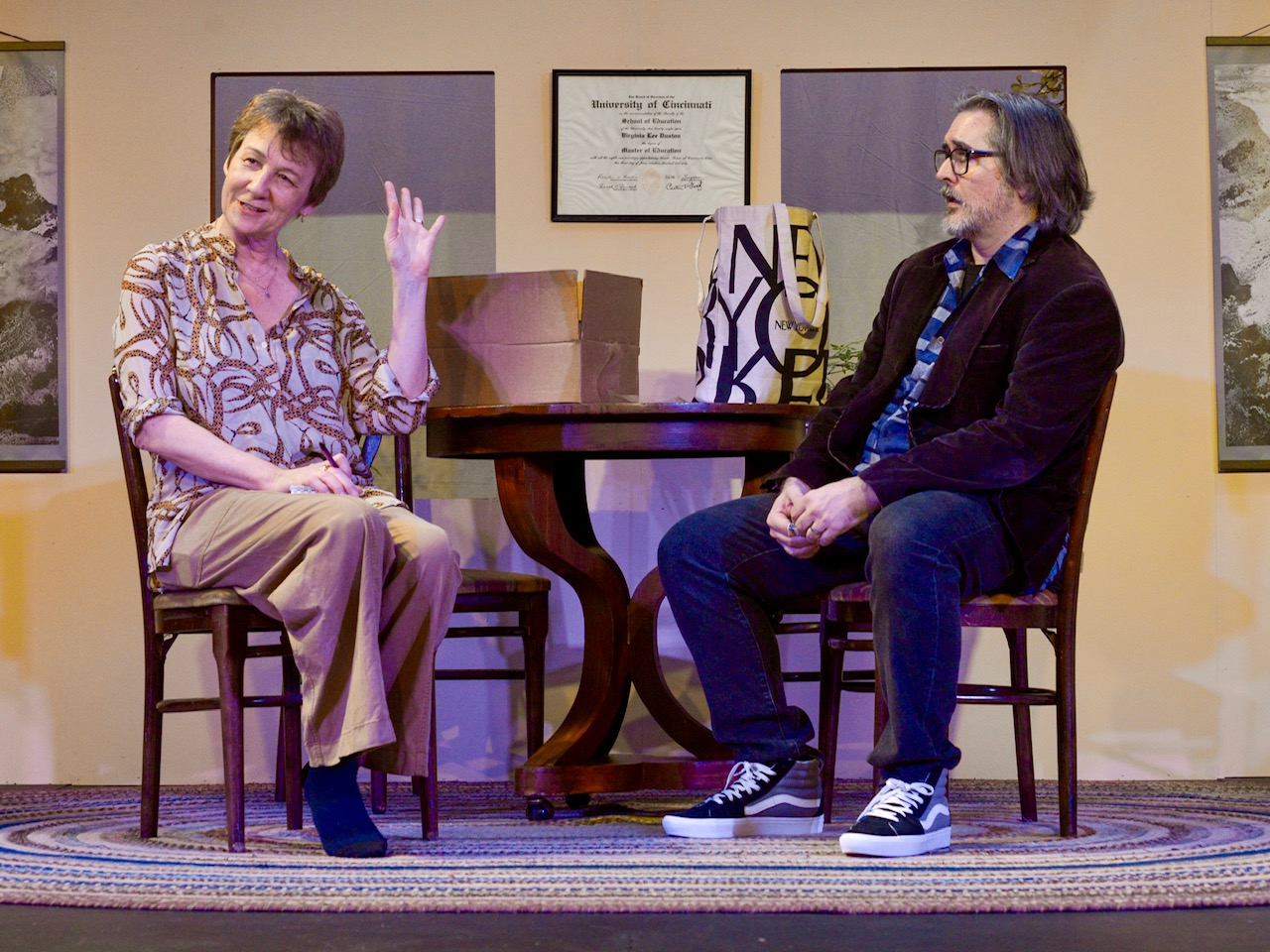
Their differences are displayed in the opening scene, as each professor ends their semester. Pamela offers some words about the legacy of western civ—the class that is ending—and begs her students to hand their final papers in soon. Lawrence also offers some philosophy in his departing words and reminds his students that their papers are due by 5pm that day—“or it’s an automatic fail.”
Pamela and Lawrence have a dispute over a controversy that has broken out on campus over the importance of the western canon. A student group refuses to read anything by straight white men until “we feel seen for who we are, the descendants of those whose invisible labor created the wealth and power of those who oppress us.” Lawrence is writing a strident letter of disagreement while Pamela thinks it’s an opportunity for opening up a discussion.
Pamela has begun a meditation practice after attending an overnight retreat; she hopes meditation will help her avoid taking anti-anxiety medication.
Pamela’s rough-edged mother, Roberta (Kathleen Ruhl) likes to talk about the intellectual achievements of “we Webster women” especially those of her lawyer-daughter. She expresses disappointment and even anger to Pamela because Ellen’s daughter Jennifer is going to beauty school rather than pursuing the intellectual path that her grandmother advocates. “Brains matter” is her motto.
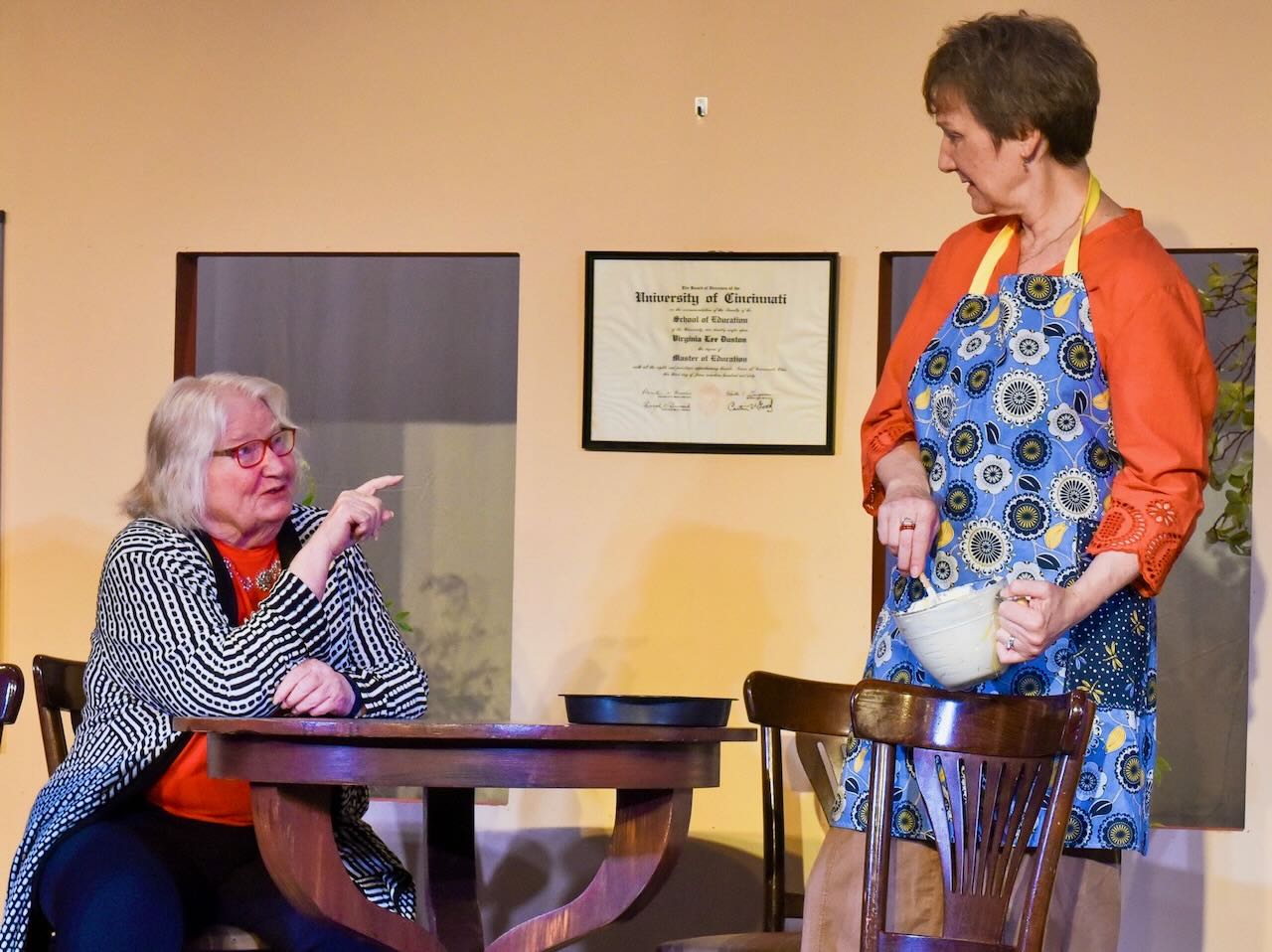
The script does not make clear why Roberta values Ellen and her law practice over Pamela with her university career. Obviously both take brains and advanced degrees. But Roberta says Ellen is strong. “Not emotional or weak.” Roberta denigrates the academic book Pamela is writing because “it won’t get you many talk show interviews” and she mocks Pamela’s meditation practice as pop psychology.
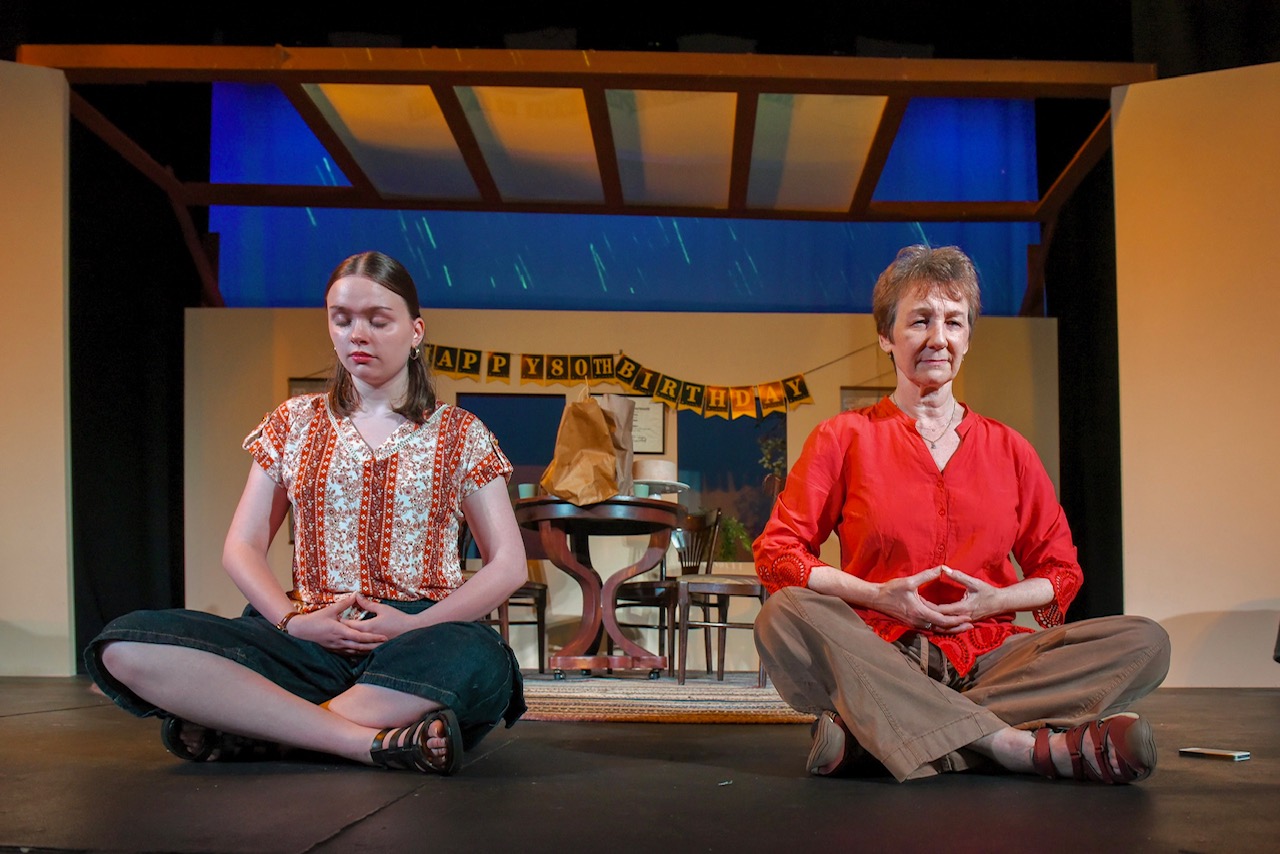
We meet Jennifer (Ada Grey) later in the play as she arrives for her grandmother’s birthday celebration. Pamela introduces Jennifer to meditation (and Buddha’s birthday) and the two sit in quiet meditation. Jennifer apparently has some kind of experiential moment but it’s never very clear what has happened to her.
And then there’s the raccoon, a stuffed creature created and handled by puppeteer Emilie-Helene Wingate. The raccoon peers in the window, gets into the garbage and finally breaks into the house, where the creature causes an uproar. Does the raccoon add anything to the plot? Hardly. It just adds comic moments.
Berger and Hainsworth display a believable chemistry as Pamela and Lawrence, the husband-wife pair. The scenes with Pamela and Jennifer are amicable although Jennifer’s character scripting needs additional definition. Ruhl’s performance as Pamela’s mother lacks the presence it needs, partly because her voice does not have the volume and resonance that the other actors have. I would not recommend mic’ing one actor and not all; perhaps the director could give some attention to Roberta’s positioning on the stage as well as her voice.
The impressive thunder and rain effects are the work of light and sound designer Alvaro Ledesma. Anna Zaczek is stage manager.
Buddha’s Birthday by Lucid Theater continues through August 17 at the Edge Theater, 5451 N. Broadway. Running time is two hours with no intermission. Tickets and more information here
For more information on this and other productions, see theatreinchicago.com.
Support arts and culture journalism today. This work doesn't happen without your support. Contribute today and ensure we can continue to share the latest reviews, essays, and previews of the most anticipated arts and culture events across the city.
