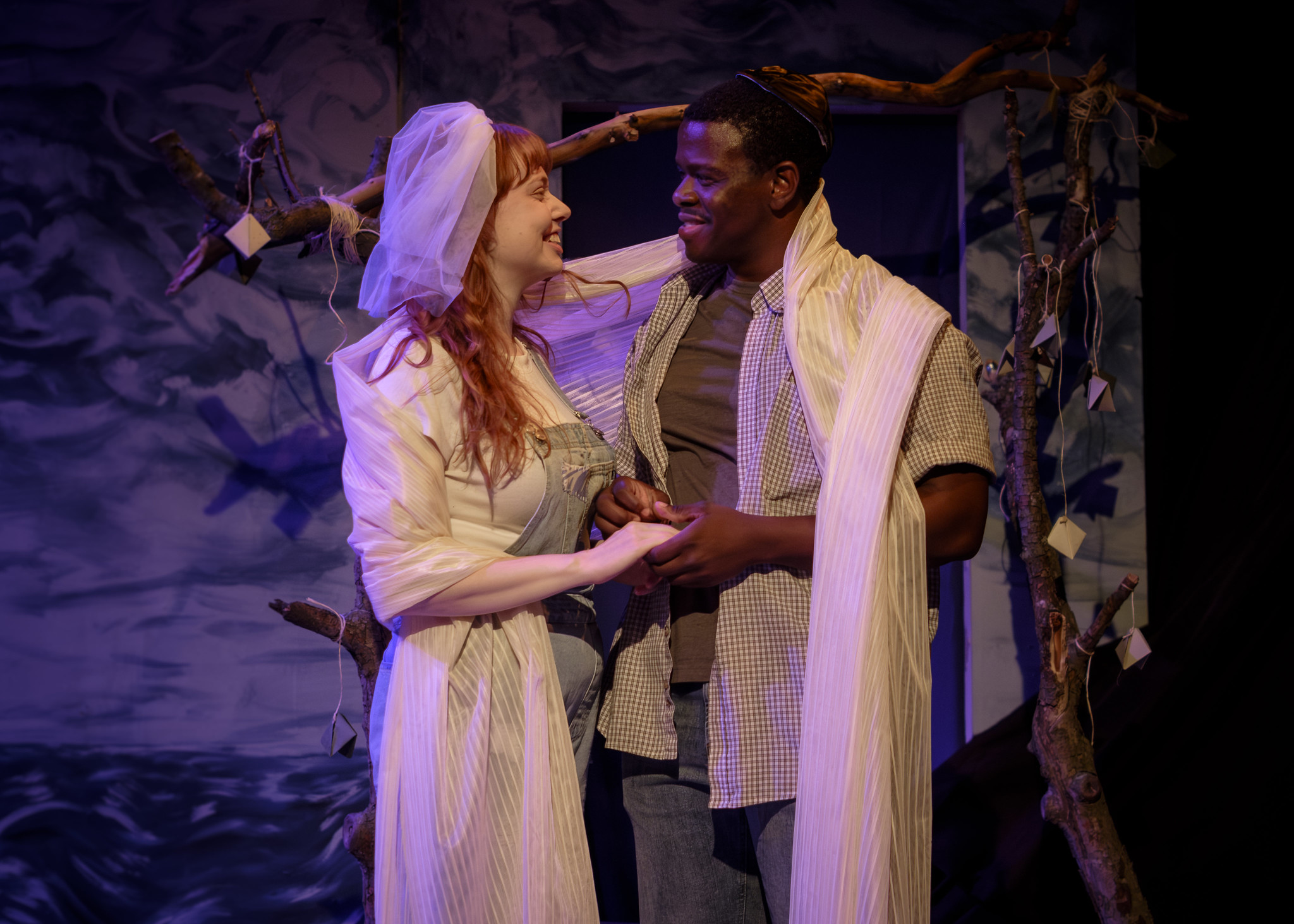

This oddly named play is a love story as well as the drama of a serious health risk faced by many women. Rather than treating it in documentary style, its creators use an original musical background and choreographed movement to dramatize the story and alert us to the risks it describes.
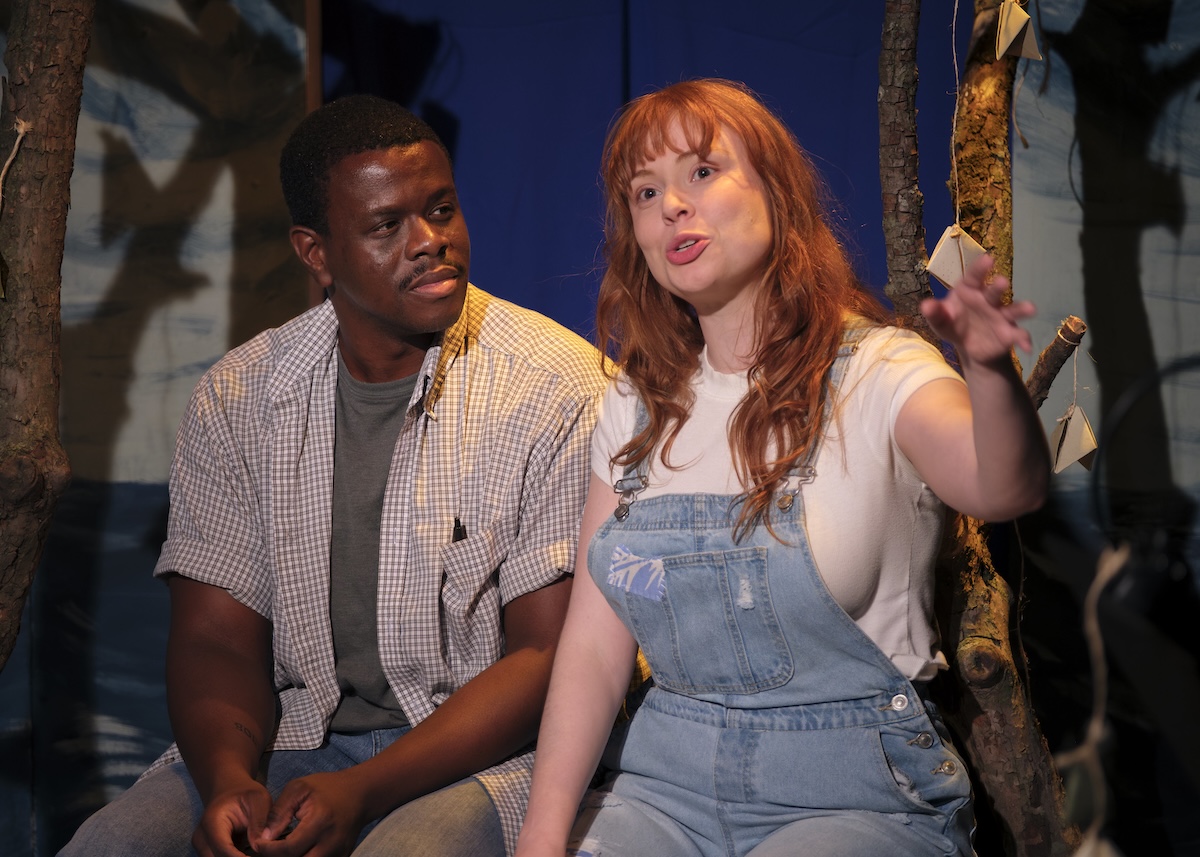
Female, Ashkenazi With a Sewing Machine, written by Jamie Greenblatt, is now being staged by Arts Judaica in a tiny theater tucked into the charming Berger Park on the far north side. Izadorius Tortuga directs the story of Anna, an adopted young woman, who meets, falls in love with and marries Benjamin, a Jewish man. Anna is played by Haley Basil and Benjamin by Keith Surney and their love story is at the heart of this unusual but lovely play.
Venus Fu, at stage right, performs on violin throughout the play. The original music by Richard Jennings is finely tuned to Greenblatt’s story. Fu’s performance enhances dramatic scenes and adds sweet undertones to Anna and Benjamin’s romance. Her music also underscores the play’s theme of “roots and wings,” suggesting the importance of both heritage and dreams.
As Anna’s relationship with Benjamin deepens, she meets his family and learns about the Jewish foods and traditions that are an important part of his life. When he asks about her family, she tells him she was adopted and has never met a blood relative.
The word Ashkenazi, which identifies people of Jewish heritage from central and eastern Europe, has a specific meaning for the story. One out of every forty Ashkenazi women has the BRCA gene mutation, indicating a propensity for breast and ovarian cancer. Ashkenazi men carry the gene too and it increases their risk of prostate cancer.
Surrounding and supporting Anna and Benjamin throughout the play is the Foundress, an actor who serves sometimes as a chorus, and plays many roles including a rabbi, a symbolic blue heron and a health practitioner. Margo Chervony uses a few simple costume add-ons, such as a tallit, or Jewish prayer shawl, when she’s a rabbi or hospital scrubs when she performs surgery. Her powerful voice and performance add depth to the story of the two young lovers.
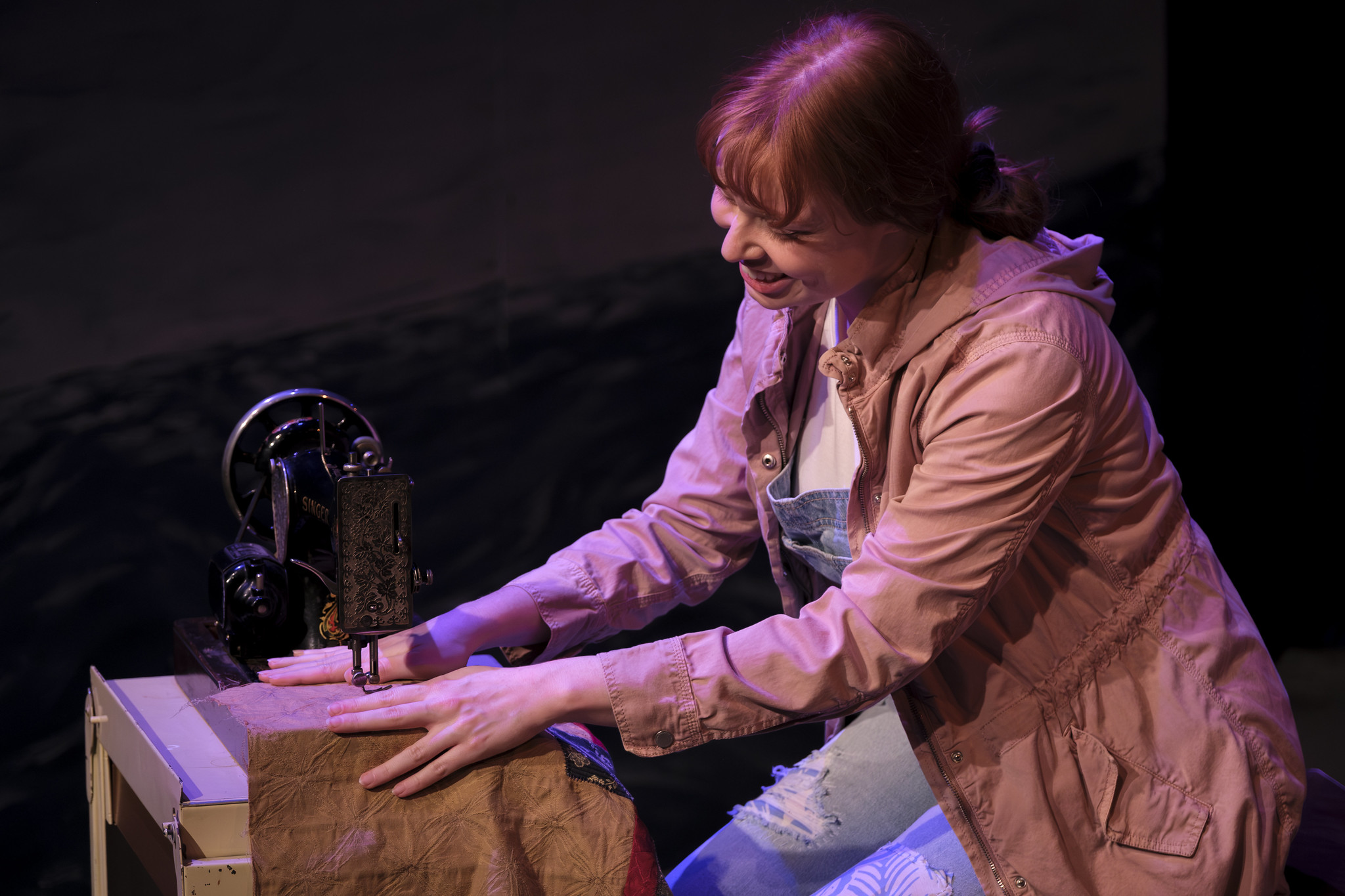
Anna knows little about her birth mother, only that she probably was a stitcher because she left Anna a sewing machine (a Singer model 301, black with gold trim, dated 1951). Anna treasures this machine with anthropomorphic affection; her current sewing project is a quilt.
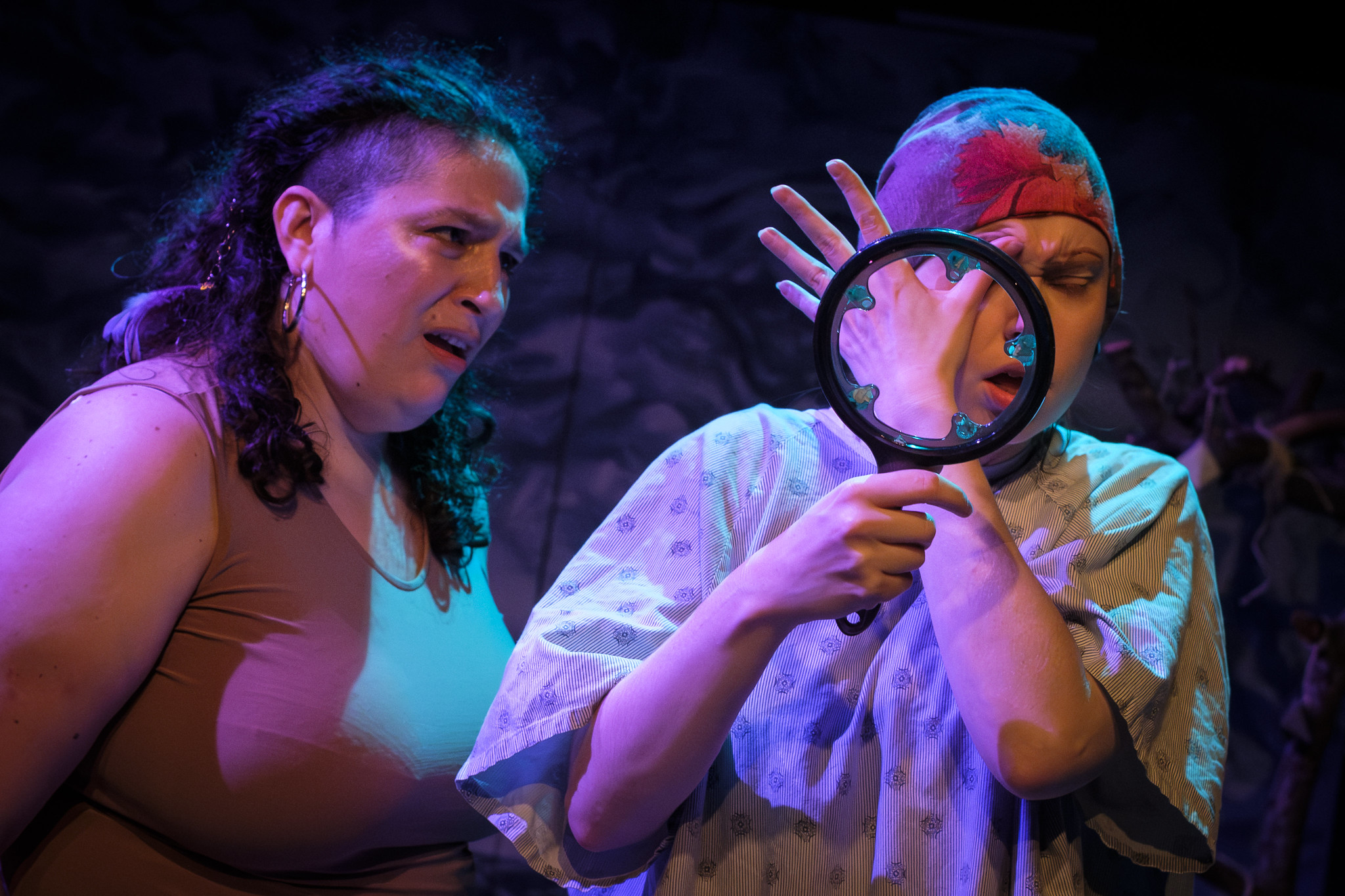
After Anna and Benjamin marry, she has a pregnancy that ends in miscarriage. When Anna has more health problems, she’s diagnosed with ovarian cancer, and goes through the radical treatments required, with Benjamin’s support, although he sometimes worries that he is losing her emotionally.
Anna’s cancer leads her to become intensely curious about her heritage. With DNA analysis, she learns that she’s an Ashkenazi Jew.
The simple set features a few pieces of furniture and a tree that serves many purposes, such as a climbing place for Anna and Benjamin and branches for hanging clothing or messages. Set design is by Viscaya Wilson with lighting by Julie Adams. Costume design is by Ashley E. Benson. Katie Mae Ryan is stage manager.
Director Tortuga (The Berlin Diaries) has a sure hand and a creative style in staging. The three actors are excellent performers, with Chervony’s voice adding both information and emotion to the story.
Female Ashkenazi With a Sewing Machine is presented by Arts Judaica, a theater company that explores Jewish history and culture. The play continues through August 23 at the Berger Park Coach House, 6205 N Sheridan Rd. Running time is about 80 minutes with no intermission. Tickets and more information available here.
On the evening that my guest and I saw the play, a Q&A afterwards was led by genetic counselor Scott Weissman of the Sarnoff Center for Jewish Genetics. I had a personal interest in the play and his discussion; after both of my parents and other relatives died from cancer, including ovarian cancer, I had genetic testing done and learned that I have the BRCA2 gene.
If you are interested in learning about your own genetic background, you can consult your health care provider or contact the Chicago-based Sarnoff Center at Jewishgenetics.org.
For more information on this and other productions, see theatreinchicago.com.
Did you enjoy this post? Please consider supporting Third Coast Review’s arts and culture coverage by making a donation. Choose the amount that works best for you, and know how much we appreciate your support!
