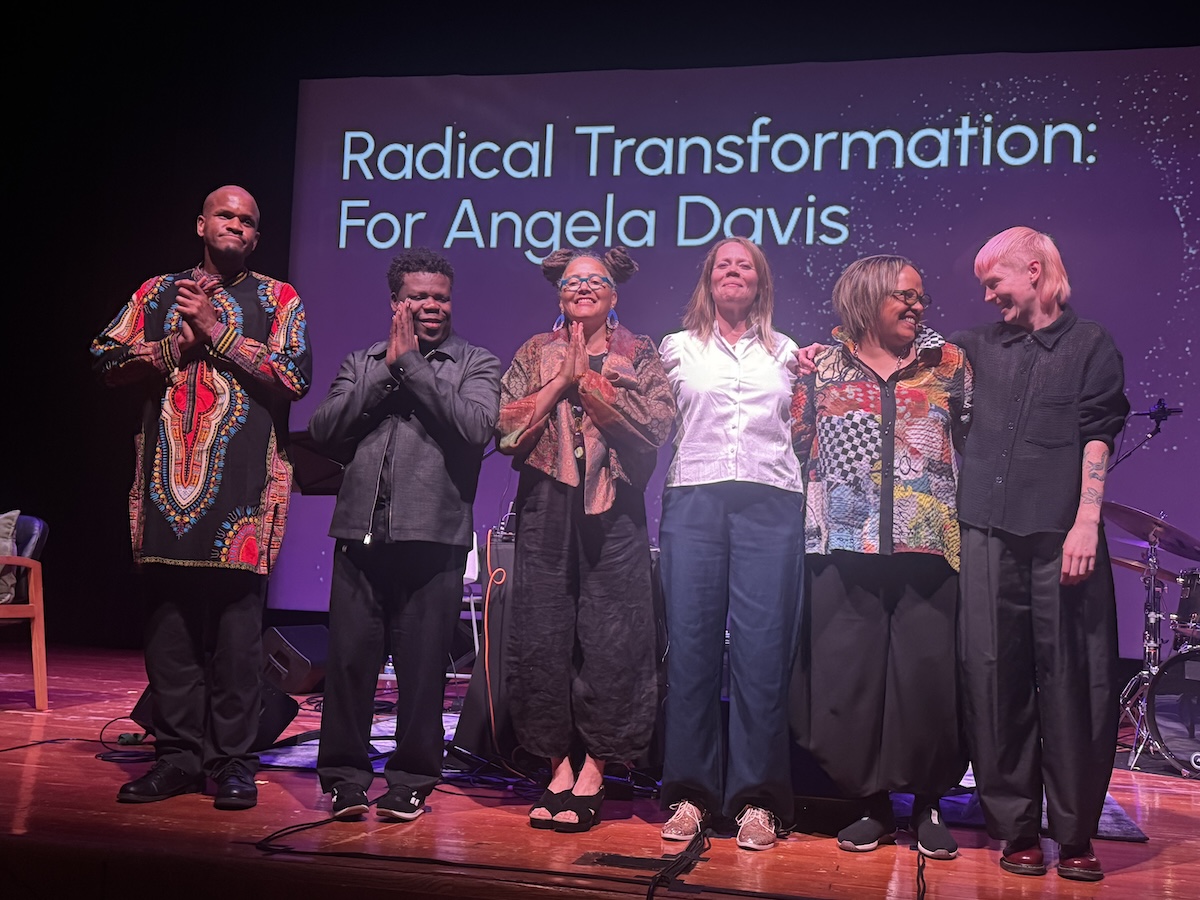
Last Saturday, I had the privilege of seeing activist, educator, and feminist symbol of resistance, Angela Davis, in person. She participated in a conversation with world-renowned musician and Guggenheim Fellow Nicole Mitchell, followed by music by the Black Earth Ensemble. This Chicago Humanities Festival event took place at the Hermann Hall Conference Center on the Illinois Tech campus. Davis is an admirer of Mitchell and the Black Earth Ensemble and spoke about their music as a source of hope, unity, and collective courage.
Mitchell wrote a special composition for Davis, who expressed a special affection for Chicago. Radical Transformation for Angela Davis was a musical journey that reflected the beauty and power of a collective consciousness that was and still is the Black Liberation Movement. The Black Earth Ensemble was joined by Chicago's Poet Laureate, avery r. young, who read his own poetry inspired by Davis's work to address the prison industrial complex and the latest war in the Middle East over Gaza.
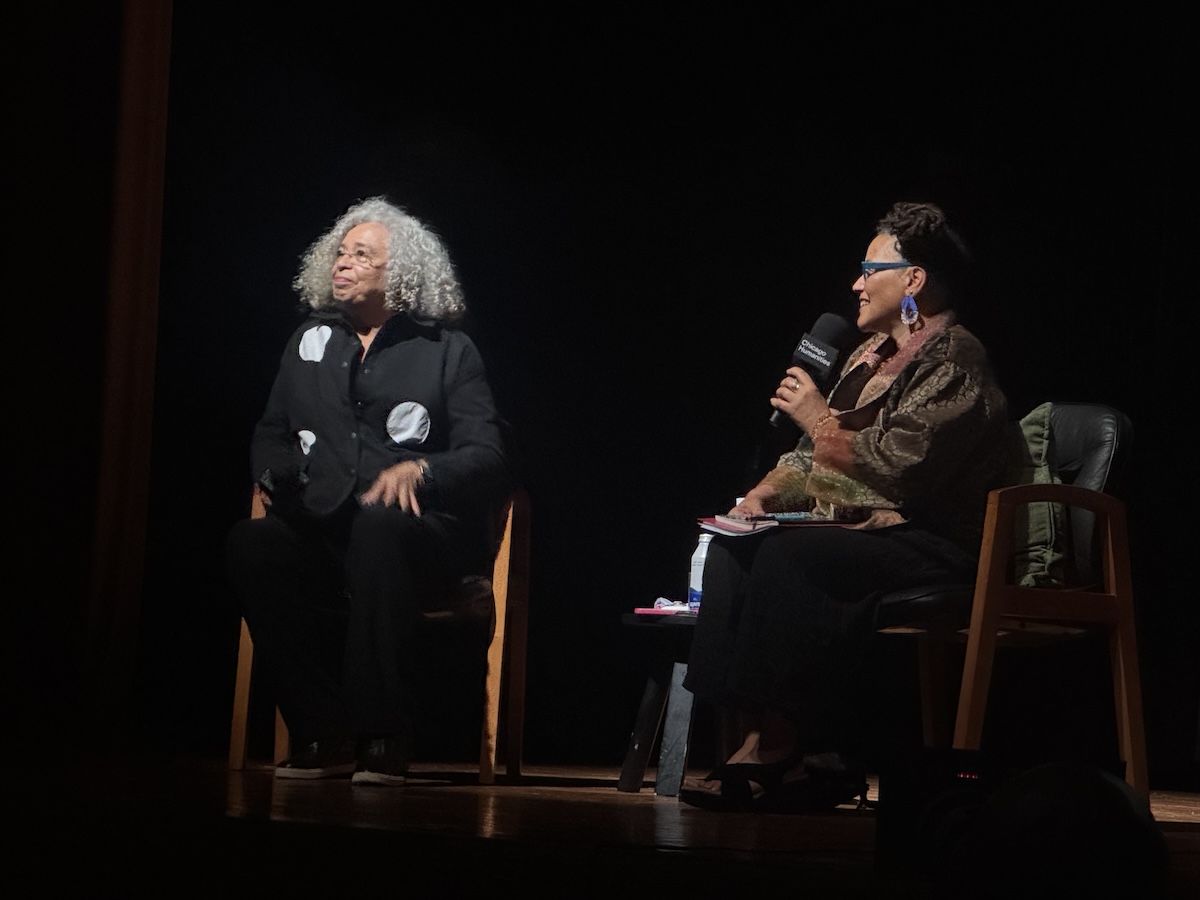
Mitchell introduced Davis by saying it was time for her to receive her flowers, a phrase in Black parlance that means due recognition and acknowledgment. She gave Davis a beautiful bouquet while the audience stood to applaud. Mitchell asked what can be done in these times of authoritarianism and inflamed racial and ethnic hatred. How can we move forward, considering the extremist tactics? How can we come together to navigate these uneasy times?
Angela Davis recounted the time when she was arrested for allegedly supplying guns for an armed takeover of a courtroom in 1970. Two of her weapons for self-defense were used without her consent. Davis spoke of being 26 years old, terrified and shaking, not knowing what was going to happen to her. It was only nine months earlier that Fred Hampton and Mark Clark were gunned down in Hampton's apartment on Chicago's West Side. She said that when she heard thousands of people were on her side, she felt a sense of hope and strength in numbers that lifted her.
Davis also mentioned that slavery did not end in 1863. It continued through domestic terrorism from the racist groups with government support. It continues with the American prison system, which provides free labor, which is essentially enslavement. She also mentioned the enslavement of Palestine, and a couple of people shouted, "Free the hostages!" That was quickly rebutted with louder and longer chants of, "Free Palestine!"
The conversation ended with Davis pointing to Mitchell's music as a healing force that unites people. This time around, beauty and unity can heal the chasm of hatred. Davis is no less radical than she was back in the late 1960s. She is saying the same things with more power behind her words. There is a respect for what she endured and her work as an educator.
The concert followed the conversation. Davis was sitting in the same row as I was, and yes, I was fangirl geeked. Nicole Mitchell was a member of the Association for the Advancement of Creative Musicians (AACM) and its first female president. The AACM is a revered institution in Chicago, recognized for its significant contributions to music and education. Several AACM musicians were featured at the Chicago Jazz Festival 2025. Mitchell's compositions and flute virtuosity have been lauded by many fellow musicians and others she has inspired.
The Black Earth Ensemble concert lineup featured Mitchell on flutes, Caroline Davis on saxophone, Anna Butters on stand-up bass, Joshua White on keyboards, Terri Lyne Carrington on drums, and avery r. young singing and reciting poetry. The group reflects the equitable world of which Davis has been an advocate for over 50 years. All of the musicians are at the top of their game. They have played all over the world, won Grammys, and fellowships. Radical Transformation for Angela Davis was an Afro-Futurist, gospel, and jazz jam.
I have heard young's poetry but had no idea that he could sing like a preacher on Sunday morning. He worked himself up and went into a got-the-spirit dance. He mentioned the four little girls murdered in the 16th Street Baptist Church in Birmingham, Alabama. Segments of speeches by Angela Davis were played in between the music. Hearing her voice saying, "I want to express concern that history in this country is seriously flawed," struck me. "Individual memories are not as long as institutional memories" was also deeply felt. All of the quotes and young's poetry laid bare the trauma in the DNA of all oppressed people. It was an emotional and uplifting evening. There was crying and hugs from strangers. I felt some hope despite Chicago being made a militarized zone by the current sitting government.
I recall the "Free Angela" poster, positioned right next to the portrait of Huey P. Newton, seated in a wicker throne, with a spear in one hand and a rifle in the other. They were on the wall of my best friend's older sister, Susie. She raged about "the pigs" and refused to answer to her former "slave name." That was a tumultuous and violent period in American history. It was two years after Dr. King was assassinated, and the West Side of Chicago was still smoldering. Like most Black girls from that time, and today, I had to grow up quicker than I should have, and I looked up to Angela Davis as a symbol of strength. She still stands tall, carrying the banner of resistance and courage.
The Chicago Humanities Festival continues until November 13 at various locations throughout Chicago. The schedule includes Margaret Atwood, Salman Rushdie, Roxane Gay, and Sally Mann, with many more. The festival began in 1989 and produces events year-round. For more information, please visit chicagohumanities.org.
If you enjoyed this post, please consider supporting Third Coast Review’s arts and culture coverage by making a donation. Choose the amount that works best for you, and know how much we appreciate your support!
