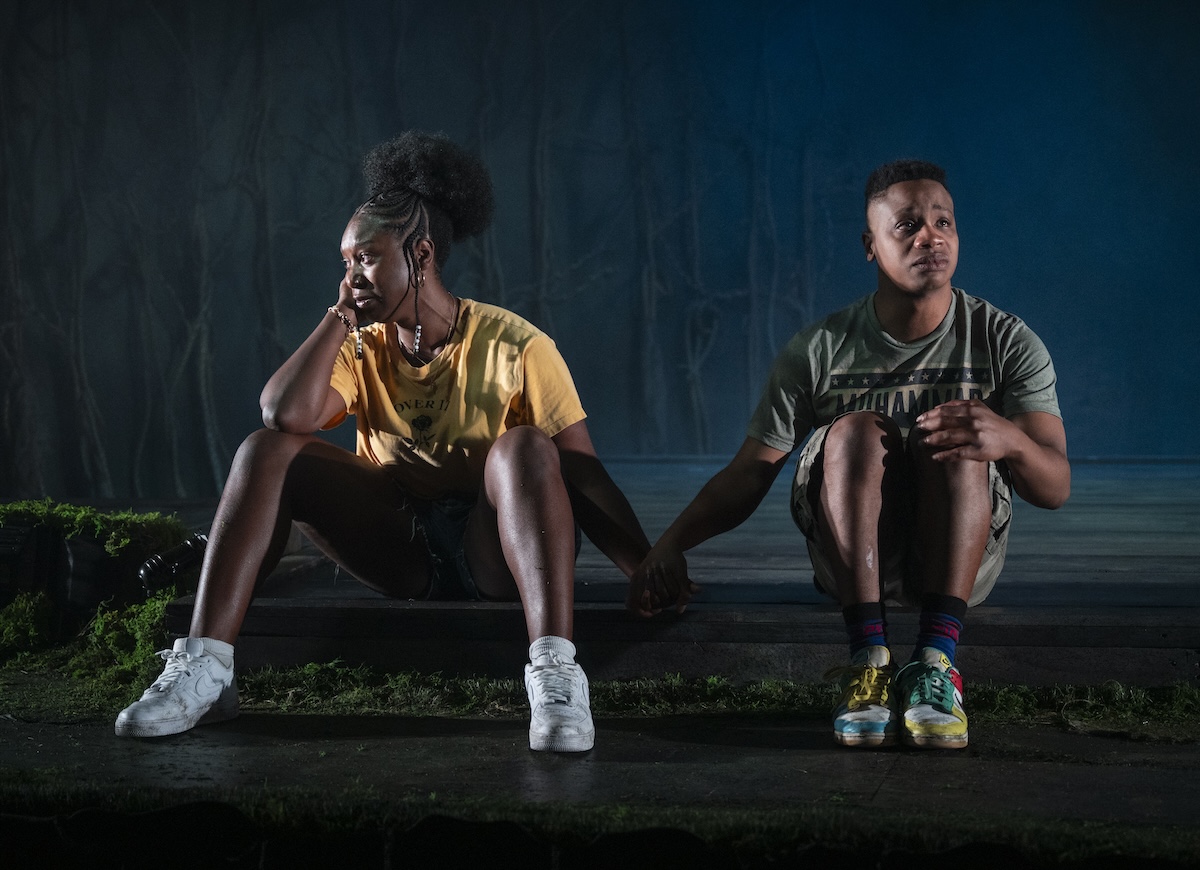

Oak is my third experience with the work of playwright Terry Guest. His work reveals the visceral aspects of the Black experience in America with stark realism, some magical realism, and, as seen in Marie Antoinette and the Magical Negroes, a fearless dive into the surreal. Guest has a gift for creating characters that almost every Black person recognizes in their family or themselves. Oak features people I know and crimes I have been aware of in the South and in Chicago. I feel lucky to have mostly been an observer. Mikael Burke directs Oak as a multi-dimensional experience, including the sound before the show begins at Raven Theatre.
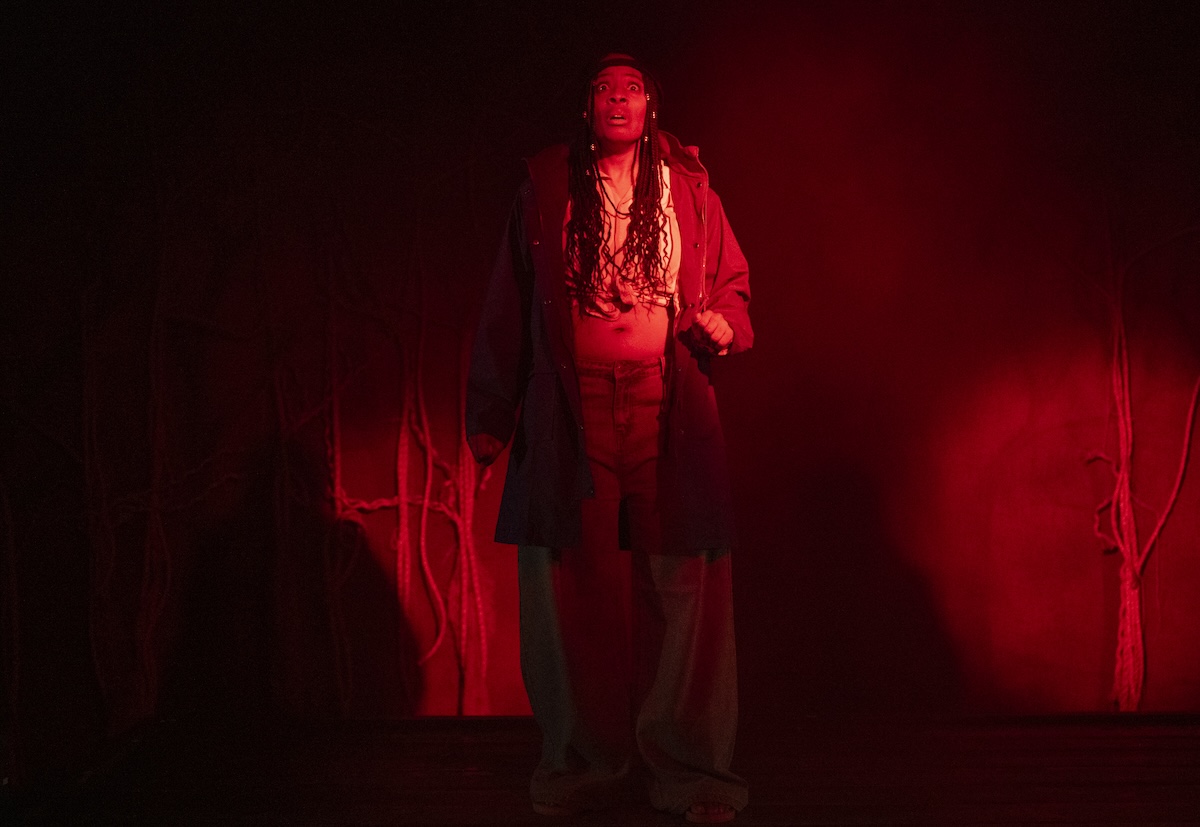
The walk-in audio features sound clips from horror movies, spanning from the 1930s to the present. The play opens with an announcement on a television about a missing white girl named Amber and a warning about child-snatching season. Then the lights flash, and the audience is introduced to Pickle, played by Jazzy Rush in a brilliant performance as a teen trapped in a rainy Georgia town. Pickle sits in the middle of the swampy creek area with a flashlight shining on her face. She tells an ominous "true" story of an escaped slave named Odella who left her baby behind as she made her way to freedom. Dogs and slave hunters chased Odella, and she found herself on the edge of a creek with no choice but to dive in. People say that her song to her abandoned baby can be heard on quiet nights, and her eyes glow red in the dense and damp woods.
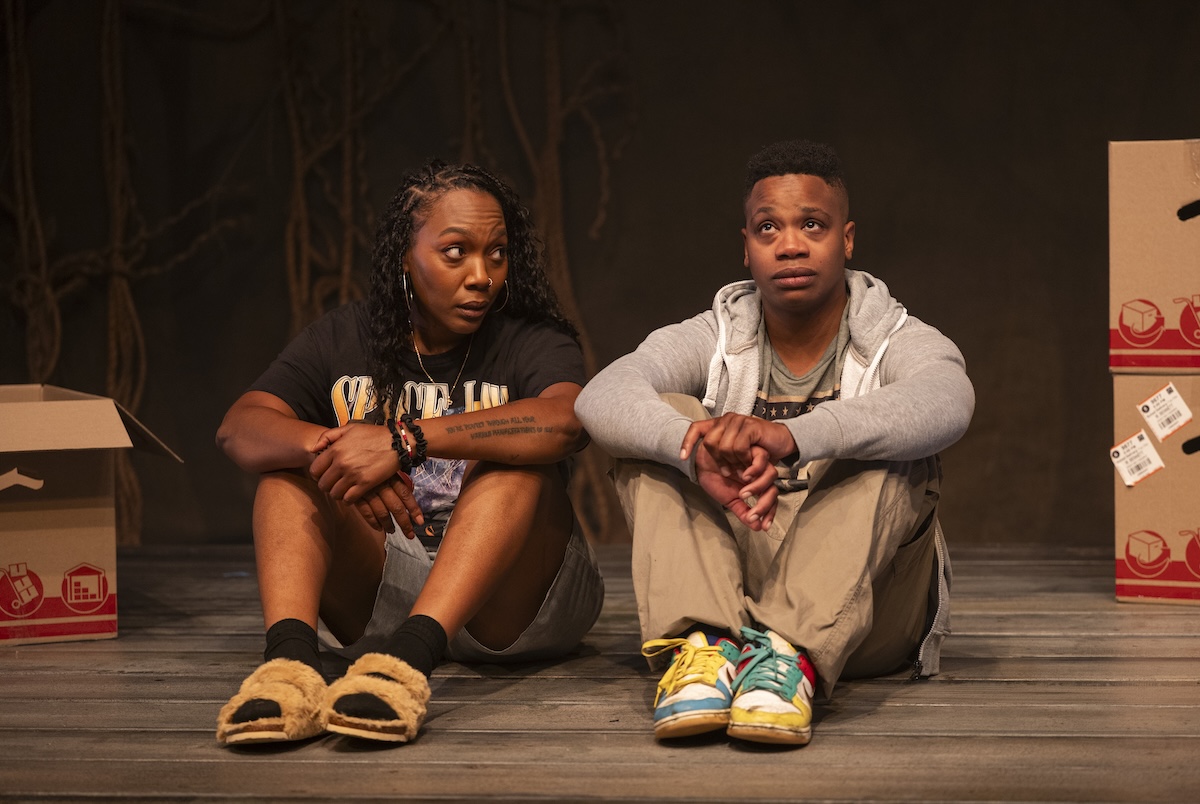
Pickle is interrupted by her younger brother Darnell, aka Big Man (Donovan Session), and her cousin Suga (Stephanie Mattos). The chemistry among the three is hilarious. Session plays the role of the younger brother perfectly, using the body language of a preteen and petulant expressions that are hilarious but also caused some people in the audience to cry. Guest's dialogue is meticulous in capturing the way Black teenagers talk, and the rap/dance displays a pretense of being grown. If you have ever heard a double-dutch jumprope song, you know what I mean. Their rap/dance is a sassy version of the pinky swear shared by Pickle and Big Man.
Rush shines as the young woman who wants to escape the small town she considers "nothing." As with many teenage girls, Pickle has a conflicted relationship with her mother, Peaches (Brianna Buckley). Pickle resents that her mother has not always been there for her or protected her from abusive relatives, but now is overprotective because of a child-snatching epidemic plaguing the town. There is a 7pm curfew, and frequent announcements say, "It is 7pm, do you know where your children are?" I remember that announcement as a PSA when I was a kid in the '60s. We had to be in the yard with the gate closed when the street lights flickered on. At least 12 Black children have disappeared in Oak, but there are no television announcements or awards offered.
Amber's smiling face is all over the news. She is pronounced as blonde and beautiful, with her weeping parents begging for her return. I like the connection that the playwright makes with how enslaved mothers were separated from their children without the power or funds to get them returned. A simple announcement is made when Suga disappears, leaving the family to agonize in powerlessness. After Suga's disappearance, another creepy and kooky character is introduced, named Miss Temple (Brianna Buckley again). She sits on the porch of her house, seemingly 24 hours a day, with a shotgun and a spit cup. In Oak, Miss Temple spits sunflower seeds, but in my corner of Benton, Louisiana, it was snuff and a coffee can. Pickle believes that Miss Temple can tell her the secret of how to overpower Odella.
It is a comic zenith when Pickle and Big Man meet Miss Temple. Buckley is dressed in First Lady of the Church attire—a white flying buttress hat, with matching white everything, including the stockings. The dialogue brought the house down. She babbled on about the color of the shutters on her home and changed the color every time, just like how long the house had been in her family. First, it was when slavery ended, then Reconstruction, and the '60s or '70s.
Oak tackles a lot of subjects, but there are no jumbled or mixed meanings. The metaphor of a sexual predator is a scary wolf puppet with glowing red eyes and fearsome fangs. Caitlin McCleod designed the menacing wolf puppet as well as the naive princess. Peaches' character is beating herself up for ignoring an egregious act by a trusted relative. Buckley's Peaches is award-worthy as the mother who agonizes over the trajectory of her life, having had a child at 16. She desperately wanted to leave town, but got pregnant at 16 and did not want to abandon Pickle. The scenes between her and Rush are explosive and impeccably timed.
Director Burke does an outstanding job with the transitions between scenes and the changes in the temperature of the dialogue. Every scene is meticulous down to each action, even climbing through an invisible window to Suga's room. Scenic designer Sidney Lynne's inspired Southern Gothic set is reminiscent of Terry Guest's At The Wake Of A Dead Drag Queen. The scenery projects heat, humidity, and sinister forces with dark green moss. The quality was further enhanced with original music and sound design by Ethan Korvne.
None of this would have happened without the writing and vision of Terry Guest. His unique perspective continues to garner acknowledgment from diverse audiences. His work is unapologetically Black and does not tiptoe around political correctness. I heard this dialogue growing up and learned to code-switch to make myself presentable in a very white world. I highly recommend that you see Oak during the spooky season. It's a hair-raiser that will also give you some laughs, and make you sway to the music.
Oak has been extended through November 15 at Raven Theatre, 6157 N. Clark St. Running time is 85 minutes. For tickets and more information, please visit www.raventheatre.com.
If you found this post interesting, please consider supporting Third Coast Review’s arts and culture coverage by making a donation. Select the amount that works best for you, and know that we appreciate your support.
