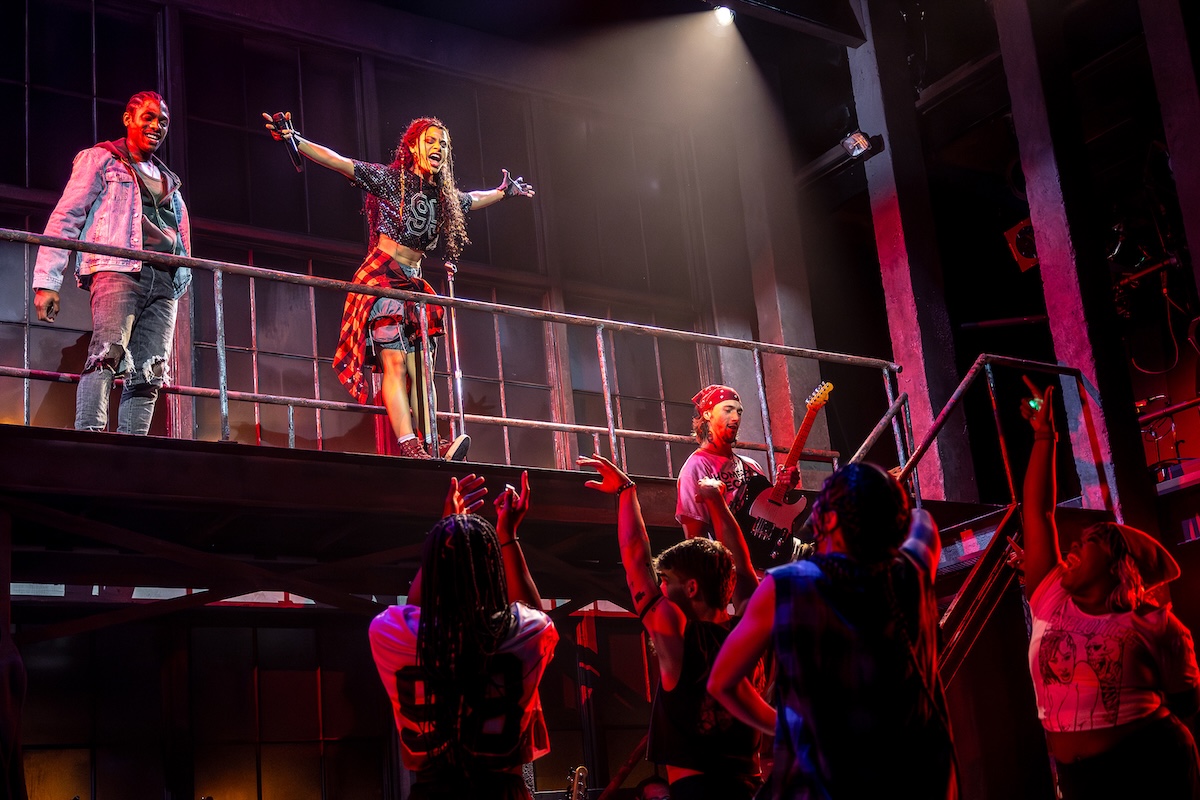

Something unusual happened Monday night as we entered Goodman’s Owen Theatre. We were offered ear plugs. And I thought to myself, yes, this is going to be good—and loud. The musical play Revolution(s), with book by Zayd Ayers Dohrn and music and lyrics by Tom Morello, is the story of two military veterans for whom the wars 25 years apart didn’t end when they returned home. Steve H. Broadnax III directs with Jason Michael Webb as music supervisor (leading an on-stage band of five musicians) and choreography by Millicent Johnnie.
Revolution(s) is an exciting play, set in Chicago and fueled with the political activism and musical spirit of Morello, cofounder of Rage Against the Machine, and the writing talent of Dohrn, son of 1960s Chicago radicals. The play is brilliantly staged on an industrial-looking multilevel stage set (design by Derek McLane). The levels serve as someone’s apartment, a band’s practice spot, or a place for two lovers to meet.
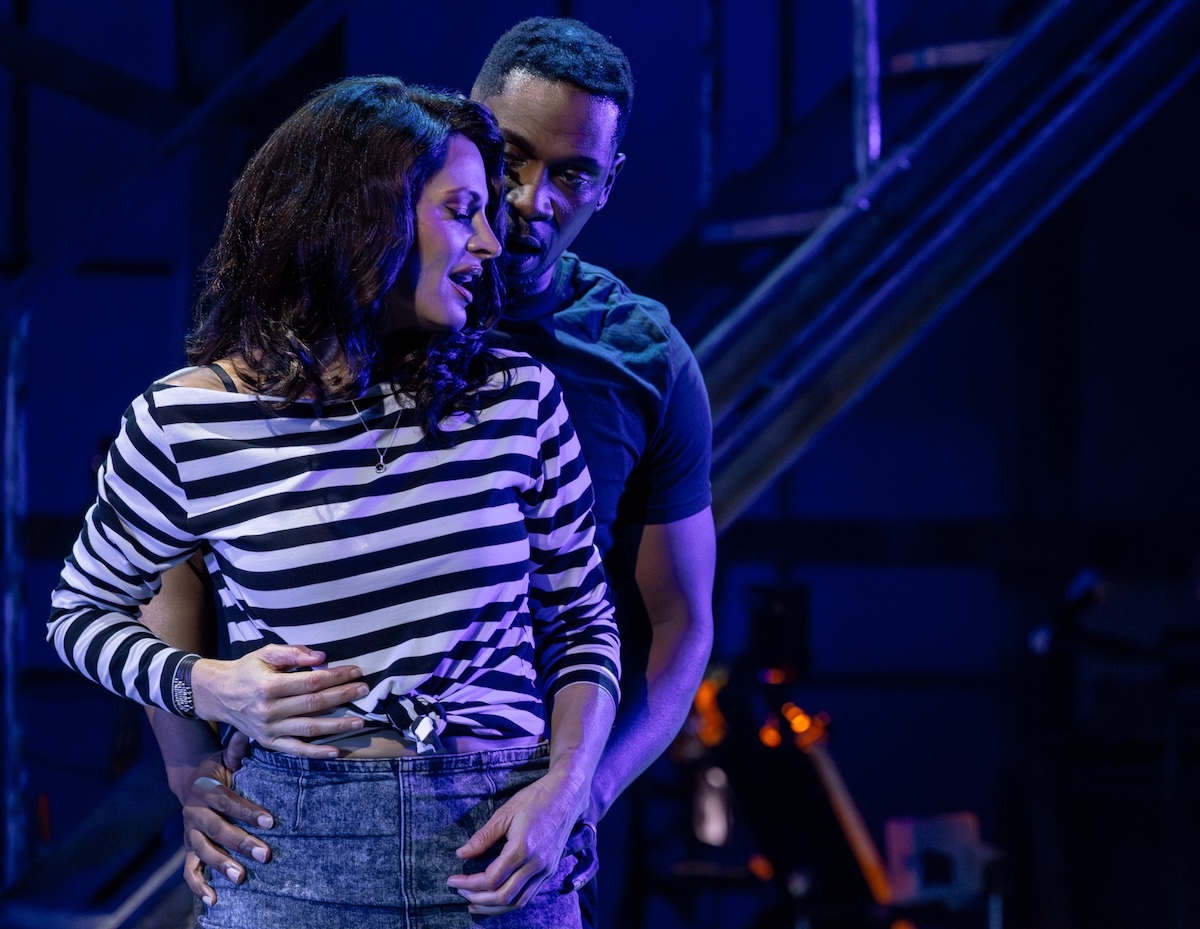
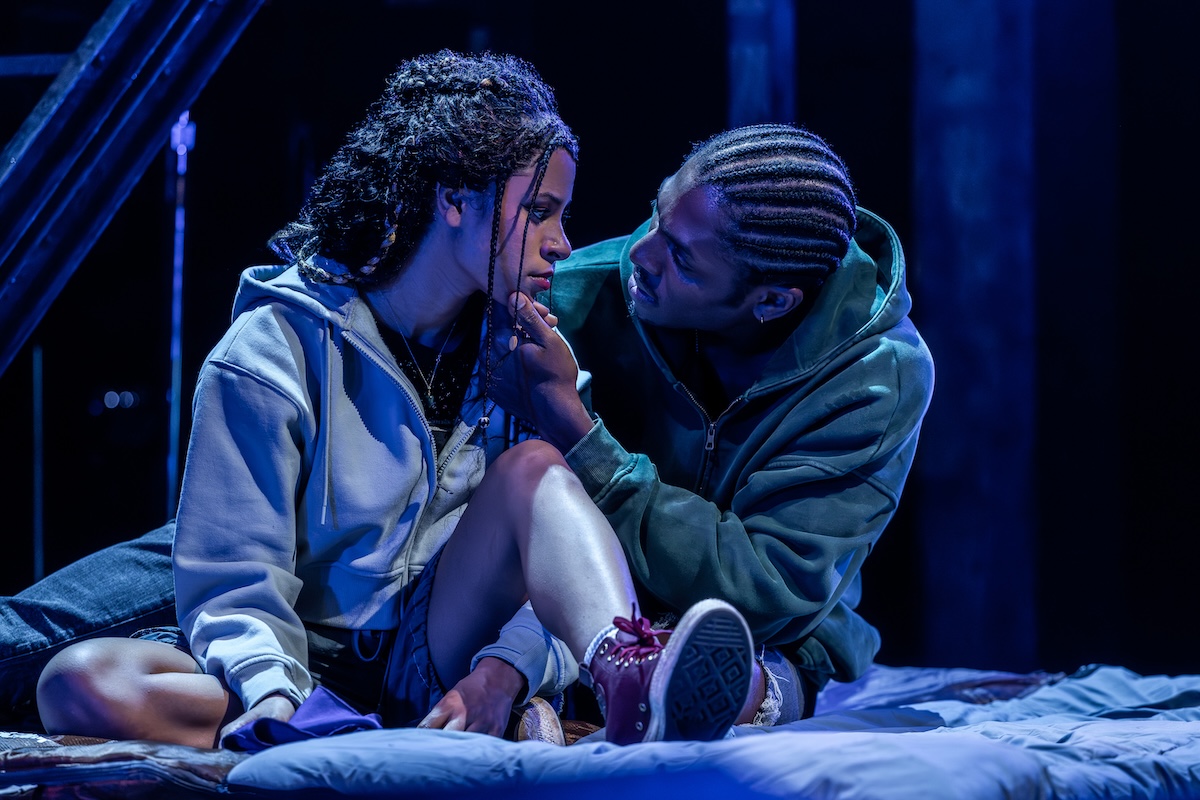
The story of Revolution(s) is told through action during two different time periods. In 1989, Emma (Jackie Burns) and Leon (Al’Jaleel McGhee) meet, flirt and fall in love. They later have twin sons, Hampton (named after their dead hero, Fred Hampton) and Ernesto (probably named after Che Guevara). Their scenes are paired with those set in 2016, when Hampton (Aaron James McKenzie) returns from service, reunites with his friends, former bandmates, his brother Ernie (Jakeim Hart) and his girl Lucia (Alysia Velez).
Playwright Dohrn (the son of 1960s radicals Bernadette Dohrn and Bill Ayers, who founded the Weather Underground) tells Leon’s and Emma’s story with warmth. The two meet and make a connection in the usual romantic way, but also through politics. Emma’s parents were activists. She tells Leon that her grandfather went to Spain to fight against fascism with the Lincoln Brigade. She was a red diaper baby, he says, and her interest in activism continues. She’s a public school history teacher with a Swarthmore degree. Leon, an ex-con who has problems getting regular citizen’s benefits, is joined by Emma in a Robin Hood-like campaign to steal money and help the poor.
Hampton returns from service in Afghanistan to find his home neighborhood on the south side to be occupied territory. (The play may be written about the past but it certainly reflects the horrors we face in our streets today with federal agents patrolling and assailing neighborhood folks trying to go about their lives.)
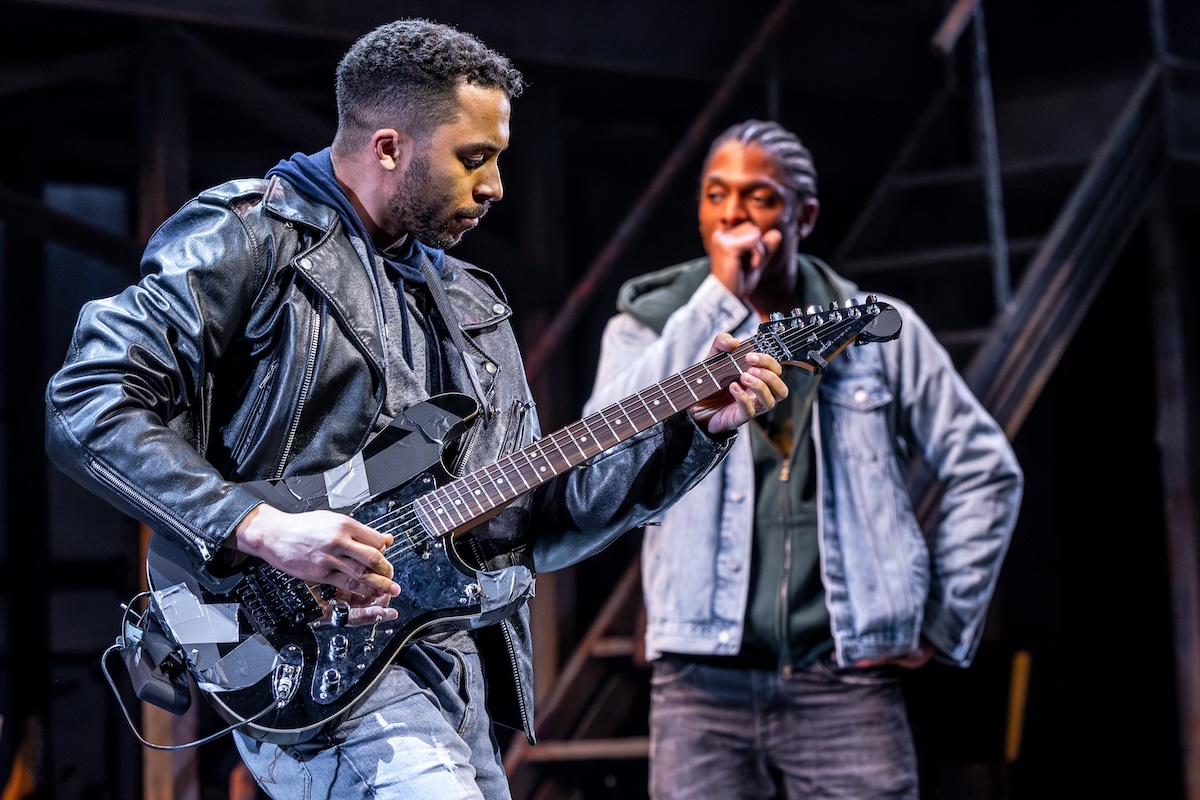
Hampton and his brother Ernie (a softer, gentler soul than his twin) and their friend and bandmate Sean (Billy Rude), who wears a t-shirt emblazoned with “Homeland Security: Fighting Terrorism since 1492,” want to make music that will make a difference. Hampton’s girlfriend Lucia (warmly sympathetic and outspoken) is a foil for his music and his anger.
The two stories are spun together smoothly, sometimes alternating and sometimes simultaneous and often punctuated by powerful hip-hop, punk, hard rock and metal performances with guitar work and vocals by Hampton, his bandmates and, from the past, by Leon and Emma (Burns has a great voice and Broadway credentials including a long run as Elphaba in Wicked). The ensemble of six dancers also play police and other roles.
Much of the story is told through song lyrics, such as the haunting opening number, “Keep Going,” with a chorus that’s reminiscent of a slave escaping to freedom. (“If you hear the dogs / Keep going / See the torches in the woods / Keep going / They’re shoutin’ after you / Keep going / You want a taste of freedom / Keep going…”
Unfortunately, it’s not always possible to understand the lyrics because of the volume of the music. (This is a problem at any rock concert if you go in not knowing the artist’s music. Fans of the band, of course, know all the lyrics and sing along. In this case, audience members didn’t have the chance to learn or even read the lyrics ahead of time, so some of the story is lost to the Goodman audience.) There’s no remedy for this, except possibly adding projected lyrics to the already busy wall of image and text projections. Turning down the volume isn’t an option with this kind of music.
Dohrn’s speech for Leon near the end of the play adds a note for the future. He tells his son, “There’s more than one way to change the world, Ernesto… More than one kind of resistance? Hear me? More than one kind of revolution…We each just gotta do what we can, okay? …. To pass something along. For the future. Make things a little better…. And then when we fall, someone else comes along. Picks it up. And carries it just a little bit further.”
“Hold the Line,” the final song in Revolution(s) confirms this. “You gotta stay steadfast / tread lightly / ‘Cause they’re looking for a reason / to knock you down / But you can’t ask too politely / IN THE TRENCHES YOU GOTTA GET LOUD / Hold the line! (woo!) / Hold the line (hah!) /Don’t pay ‘em no mind (oh!) / Hold the line!” BLACKOUT.
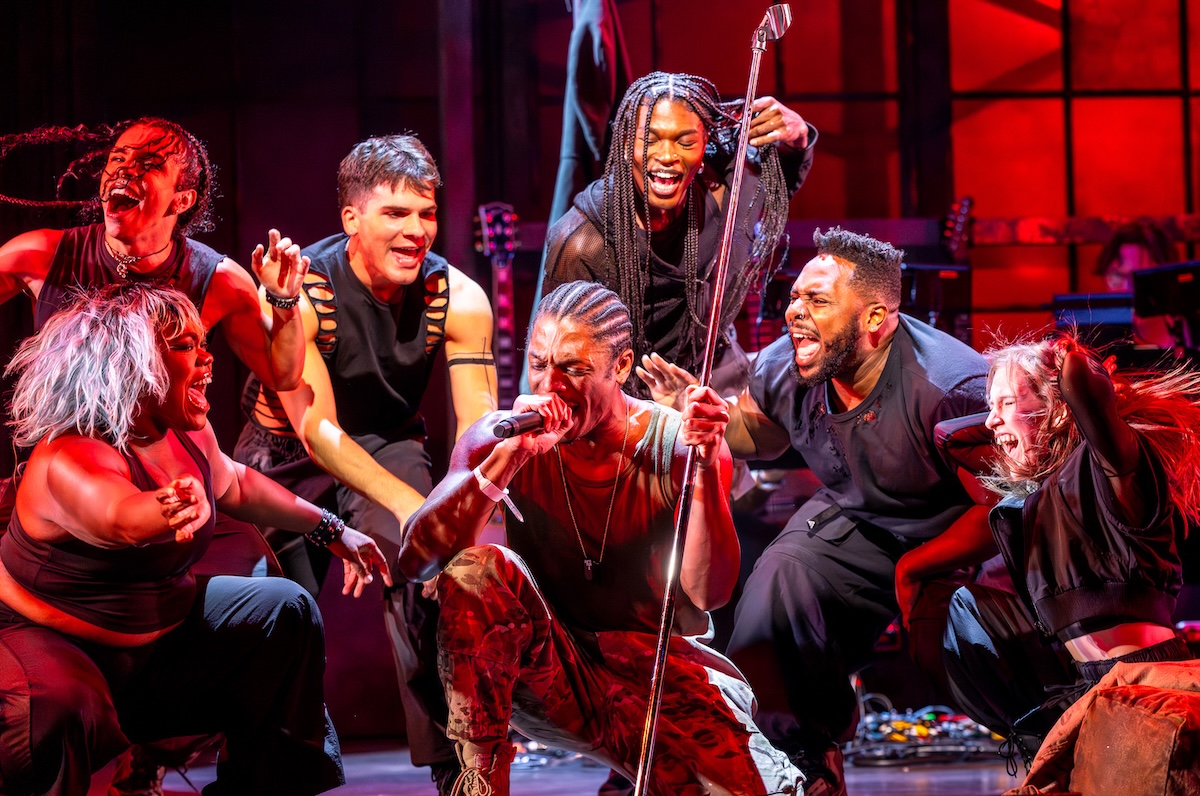
Before I conclude this review, I have to confess I’m a longtime fan of Tom Morello’s music and his political activism. I’ve seen him live several times, playing sizzling riffs on that guitar painted “Arm the homeless.” I’ve listened to his Night Watchman records over and over again. I’ve tried to be unbiased in my review, however. Seeing him live on stage during the curtain call and later in the crowd at the post-show reception was satisfying. Morello’s spirit and Dohrn’s activist history gives this production its heat, so that it deserves that plural title, Revolution(s).
Additional lyrics are by Boots Riley, Big Boi, Killer Mike, Knife Party, Grandson, Ryan Harvey, Matt Shultz, Chris Stapleton and Anne Preven, all Morello’s collaborators over the years. The on-stage band is made up of conductor Paul Mutzabaugh on basses, Jo Ann Daugherty on keys, Gary Guzman and Chris Siebold on guitar, and Dan Leali on percussion. Sound design is by Stephanie Farina. Rasean Davonte Johnson is projection designer and lighting is by Greg Hoffman. Costume design is by Raquel Adorno.
Revolution(s) has been extended through November 22 at Goodman Theatre, 170 N. Dearborn St. Running time is about 130 minutes including a 15-minute intermission. Tickets and more info available here.
For more information on this and other productions, see theatreinchicago.com.
If you found this post interesting, please consider supporting Third Coast Review’s arts and culture coverage by making a donation. Choose the amount that works best for you, and know how much we appreciate your support!
