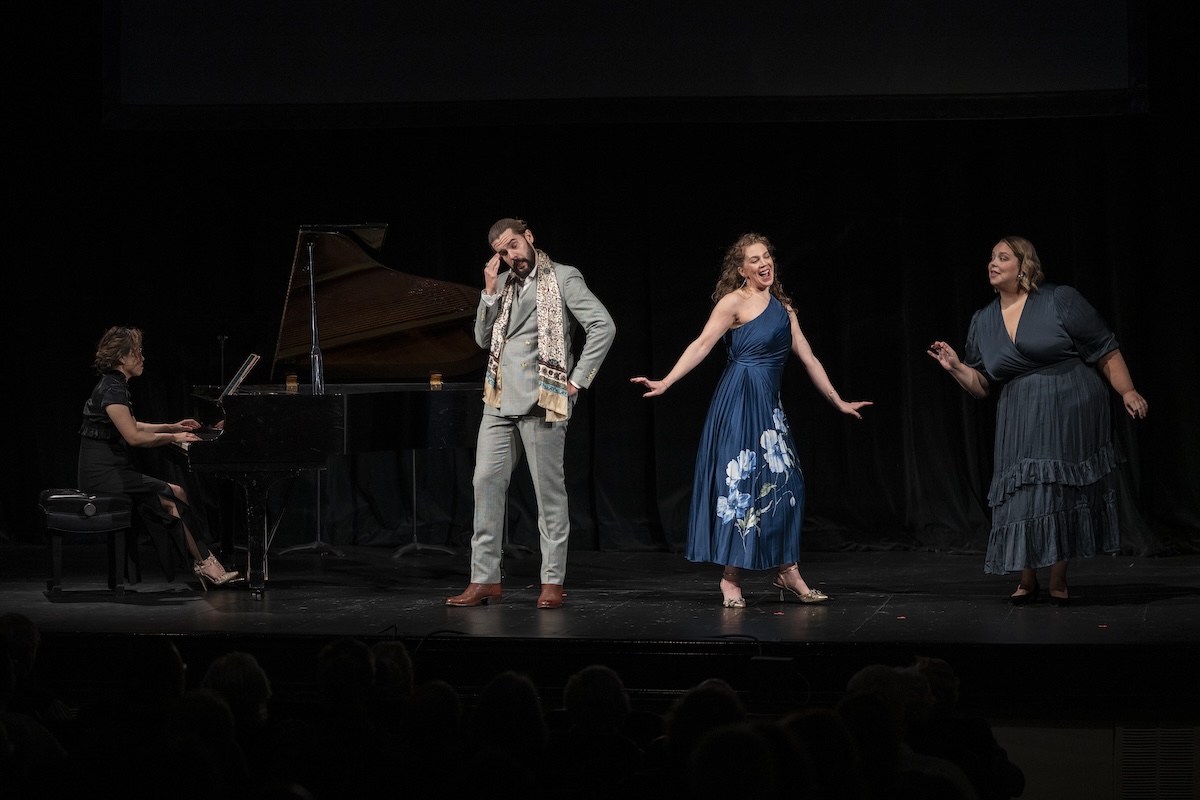

The Chicago Opera Theater (COT) presented Shakespeare Sings last weekend, an excellent concert of arias from operas by Verdi, Wagner, Britten, and other composers whose works are performed less frequently. All the works are based on the text from a Shakespearean play. This performance demonstrated how COT has introduced music beyond the traditional operatic repertoire, alongside some excellent new operas, such as She Who Dared and The Nose.
Shakespeare Sings featured four singers accompanied by pianist and musical director Yazuko Oura. The singers were soprano Meghan Kasanders, mezzosoprano Anna Laurenzo, tenor Yi Li, and baritone Peter Morgan. Emceeing the program was Lawrence Edelson, COT general director, who provided insights into the songs and background on the operas. Anna Laurenzo opened the program with an aria from Amleto/Hamlet. The aria is to be sung by Hamlet, but the gender switch was a great choice. Laurenzo sang the aria with the expressions of the melancholic Dane who was plotting revenge for his father's murder.
In another gender flip, Laurenzo sang "Se Romeo" from I Capuleti I Montecchi by Vincenzo Bellini, with libretto by Felice Romani. Laurenzo was excellent singing the part of Romeo in disguise, apologizing to Capulet for killing his son. It was beautiful and well-acted, lacking the sets, costumes, or makeup that give opera an extra zing.
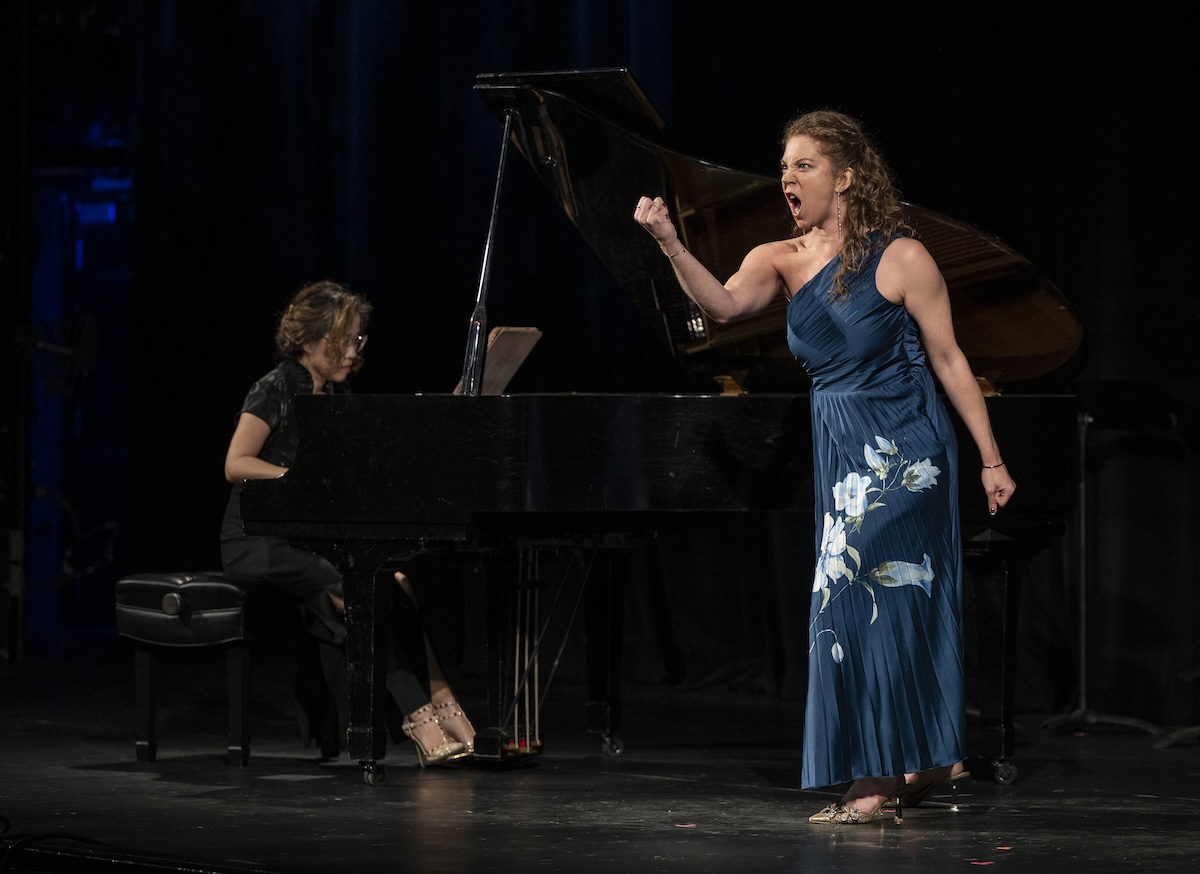
Next up was Peter Morgan singing a selection from Wagner's rarely performed comic opera, Das Liebesverbot (The Ban on Love). I didn't know that he did anything other than sturm und drang, but the music was lovely and sung beautifully. Morgan took on another comic aria from A Midsummer Night's Dream by Benjamin Britten with libretto by Peter Pears. Morgan sang "Bottom's Dream," where he finds himself transformed into a comic mutant with a donkey's head. Morgan is fun to watch with an expressive face for comedy and a glorious baritone. He hits both high and low notes with ease and no tremolo on either end of the scale.
Shakespeare Sings presented five Falstaff arias from four different composers. The first was a rarity from 1929, titled "Sir John in Love," sung by Morgan, from the opera of the same name composed by Ralph Vaughan Williams. It was really cool to learn about all of the different versions of Falstaff. Morgan sang on three out of the four adaptations with both sopranos, Laurenzo and Meghan Kasanders. He sang Giuseppe Verdi's "Alfin t'ho colto raggiante flor," with Kasanders as the very married Lady Ford. It is such a salacious seduction translated as "I finally picked you, radiant flower." Morgan, Kasanders, and Laurenzo sang "Die Glocke schlug von Mitternacht" from Die lustigen Weiber von Windsor (The Merry Wives of Windsor), by Otto Nicolai, with libretto by Salomon Hermann Mosenthal. Falstaff would be labeled a "dog" in today's parlance for pursuing two married women. It would be a comic dog, but a canine nonetheless.
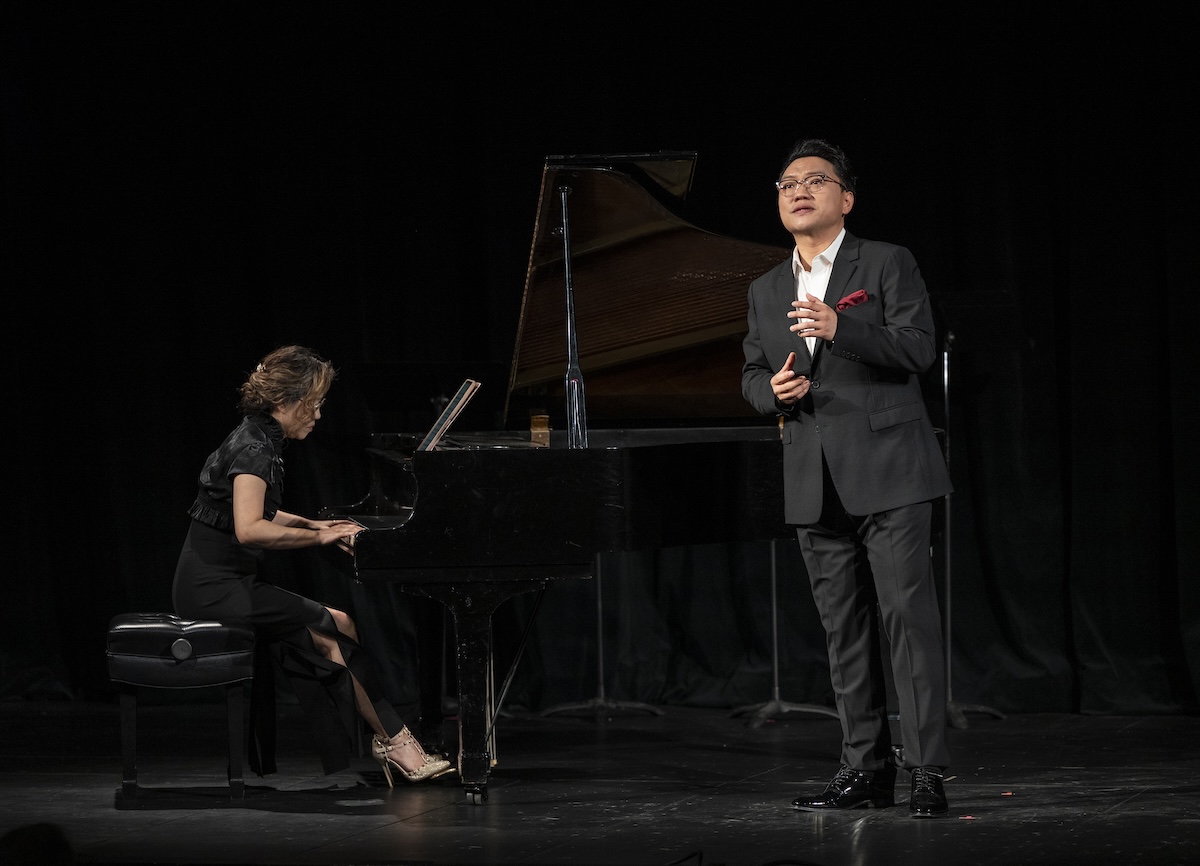
Tenor Yi Li sang a beautiful "Horch die Lerche singt im Hain" from Nicolai's rendition of Shakespeare's Merry Wives of Windsor. Li is an extraordinary tenor with a powerful and emotive voice. The aria is from the character of Fenton, who is pursuing an available young lass whose father disapproves. The song invokes a lark singing, which is symbolic of love and joy. Li also sings "Ah, leve-toi, soleil" from Roméo et Juliette by Charles Gounod with libretto by Jules Barbier and Michel Carré. This song is from the Romantic era of music, poetry, and theater. Li would make an excellent Romeo in a full-scale production.
Li sings in a quartet with Kasanders, Morgan, and Laurenzo from Romeo und Juliet by Heinrich Suttermeister. Li is once again Romeo, with Kasanders as Juliet, Morgan as the Friar, and Laurenzo as Juliet's faithful nurse. "O Wunderkraft Natur" is from the scene where Romeo and Juliet are secretly married by the Friar. Their voices blend beautifully and project the fraught situation of a forbidden love between the warring families.
Two selections in the program represent the Othello tragedy. Kasanders sings a gorgeous "Ave Maria" from Otello by Giuseppe Verdi with libretto by Arrigo Boito. There are literally thousands of versions of "Ave Maria" in song, as it is the primary prayer to the Blessed Virgin Mary. Kasanders' performance is electric as the doomed Desdemona, who has been manipulated by one of Shakespeare's most evil villains, Iago. Laurenzo also shines as Desdemona in Otello by Gioachino Rossini with libretto by Francesco Berio di Salsa. "Deh calma, o Ciel" is a prayer as Desdemona prays for the heavens to soothe her to sleep.
A duet was performed from a operatic work in progress called Working for the Macbeths by Johanny Navarro with a libretto by Marcus Yi. Meghan Kasanders and Peter Morgan are hilarious as the devious Lady Macbeth and a comically clueless Macbeth. "Do I Have News for You!" is about the Macbeths plotting to bump off King Duncan. The Chicago Opera Theater makes a point of promoting talent from communities that have been overlooked in favor of European composers before the 20th century. Navarro has two chamber operas to her credit and is influential in bringing new classical music to classrooms in Puerto Rico. Working for the Macbeths promises to be a fun satire of one of Shakespeare's bloodiest plays.
Shakespeare Sings presented 15 arias from operas based on the Bard's most famous works, along with one new work in progress. Edelson announced a change in the program by eliminating a couple of songs and noted that some illnesses had resolved themselves. No one would have known anything about illness from the performances. Everyone was in fine voice and seemingly robust health. Pianist and musical director Yasuko Oura was flawless in her playing and arranging of this program. Oura is a noted recital pianist with a doctoral degree from Juilliard. It was a fantastic way to spend the afternoon in the Fine Arts Building, a historic structure, discovering music that is rarely in rotation from five talented musicians. The show was two hours, including a 15-minute intermission. Once again, Chicago Opera Theater is pushing the boundaries of operatic repertoire.
Shakespeare Sings was a one-performance-only presentation produced by Chicago Opera Theater in the Fine Arts Building, 410 S. Michigan Ave. For more information, visit chicagooperatheater.org and check out some Chicago history at fineartsbuilding.com.
Did you enjoy this post? Please consider supporting Third Coast Review’s arts and culture coverage by making a donation. Please choose the amount that works best for you, and know how much we appreciate your support!
