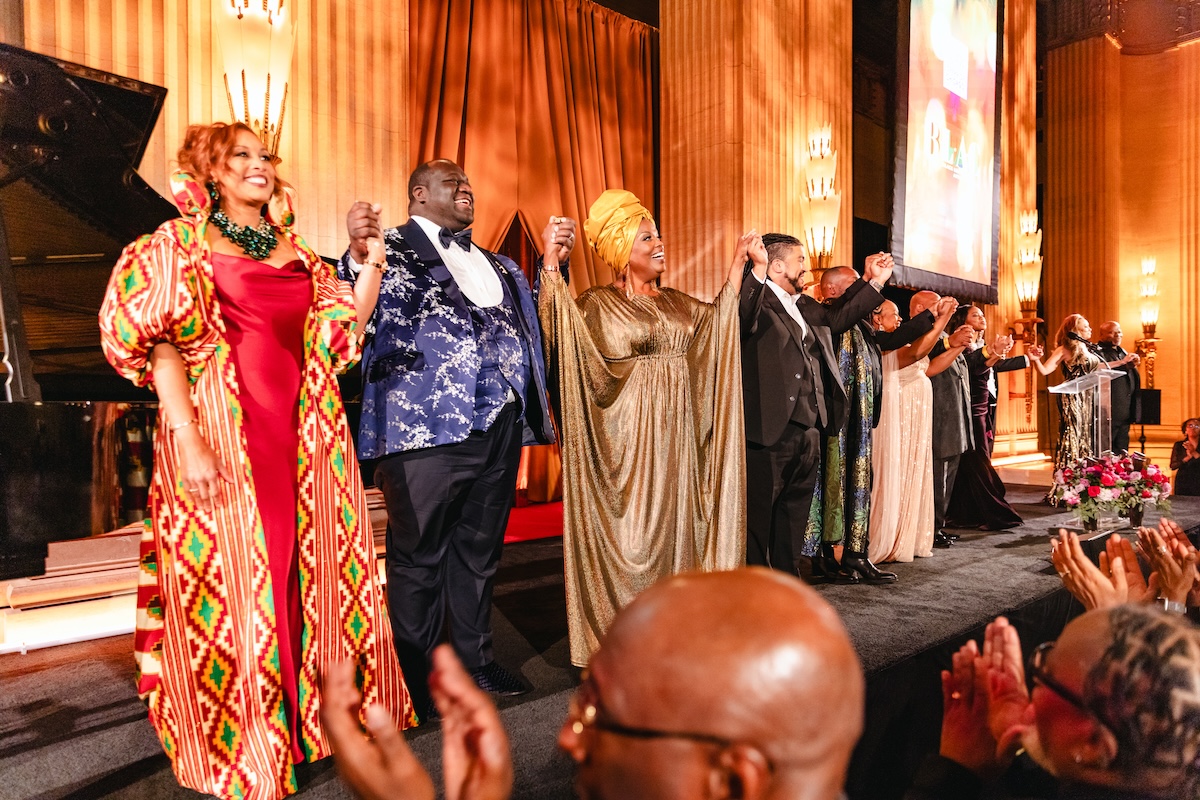

Some of the finest singers in opera today performed last Saturday on the newly christened Robert and Penelope Steiner Parquet at the Civic Opera House. The concert was a product of the Black Leadership Arts Collective (BLAC), which was formed during the pandemic. What started as the "Cuzzins Cookout" in Brooklyn became a powerhouse collective of Black musicians that perform on stages and opera houses all over the world. Soprano Alyson Cambridge emceed the evening and performed a very saucy "Habanera" from Bizet's Carmen, complete with a rose tossed to the gentleman seated next to me. Kevin Miller accompanied the singers on piano. Miller is in high demand and has performed at numerous prestigious festivals and concert halls worldwide.
The program started with a duet from Puccini's Tosca, featuring soprano Angela Brown and tenor Chaz'men Williams-Ali. They acted the parts of Tosca and Cavaradossi with passion and humor. Brown and Williams-Ali also performed as the doomed Aida and Radamès from Verdi's Aida, singing "O terra addio" as they are buried alive. Mezzosoprano Lucia Bradford played the scorned princess Amneris, singing outside the tomb. Bradford showed off her range as Ulrica from Verdi's Un ballo in maschera, singing "Re dell' dell'abisso affretati."
Giuseppe Verdi was a favorite of the evening. Baritone Lester Lynch played the villainous Iago from Otello, singing a sinister "Vane...Credo in un Dio crudele," which translates as "I believe in a vengeful God." Later in the program, Otello is sung by tenor Issachah Savage. He is joined by one of my favorite baritones, Reginald Smith, as Iago, singing "Si pel ciel". Smith appeared in Champion as an aged Emile Griffith at the Lyric Opera of Chicago. Smith's expressions were perfectly sinister as Iago, 'stirring up some mess' as my granny would say. Later in the performance, Savage would sing "Mein lieber schwan" from Richard Wagner's Lohengrin. It was the lone German song on the program, and Savage performed it beautifully. I believe that singing Wagner is another skill set, and Savage has the chops for it.
Soprano Laquita Mitchell sang "Divinités du Styx" as the title character in Christoph Gluck's Alceste. Her impassioned aria was a highlight, as Gluck is not often performed. Mitchell also sang "Ciel mio padre" from Aida. Soprano Jacqueline Echols and Grammy winner Kenneth Overton sang "C'est toi, mon père" from Jules Massenet's Thaïs. Echols brought the house down as Gilda singing "Caro nome" from Verdi's Rigoletto. Her high C was flawless, as was every other note. The singers were not mic'd, but reached the rafters. I was flashing back to that Memorex commercial with Ella Fitzgerald breaking the glass when Echols hit that note with her coloratura soprano.
Baritone Lester Lynch and baritone-bass Kevin Short teamed up on "Suoni la tromba" from Vincenzo Bellini's I puritnani. It was a powerful duet with clear tones with no lost notes in the lower register. Short and Mitchell teamed up on "Ciel mio padre" from Aida. It is one of my favorite moments from that opera, as Aida is torn between her love for Radamès and loyalty to her father, Amonasro, an enslaved Ethiopian rebel.
The last part of the program paid tribute to Black composers. When Terence Blanchard brought Fire Shut Up in My Bones to the Metropolitan Opera, he saw a stack of operas by Black composers that were never performed on the Met stage. Florence Price was one of those composers, and she was part of the Chicago Black Renaissance that helped create Bronzeville. Overton sang Price's "Song to the Dark Virgin." Margaret Bonds is known as the first Black artist to play with the Chicago Symphony Orchestra. She also wrote or arranged some of the best-known Gospel spirituals. Lucia Bradford led a rousing "Joshua Fit de Battle of Jericho". Mahalia Jackson popularized it and it was a Civil Rights Movement anthem. Bonds was born in Chicago, and Mahalia Jackson called our city her home as well.
Lena McLin was another composer who taught and composed in Chicago. Her uncle was Thomas Dorsey ("Take My Hand Precious Lord"). Dorsey was an influential composer of early blues and gospel music. McLin taught at Harlan High School and Kenwood Academy for many years. Some of her students who have brightened the stages include Yvette Stevens, aka Chaka Khan, Jennifer Hudson, and Mandy Patinkin. Reginald Smith sang "Hold Your Light" in honor of McLin. The finale was Bonds' arrangement of the traditional spiritual, "He's Got the Whole World in His Hands," sung by the entire ensemble of singers. Then, Williams-Ali sat down at the piano and played the opening bars of Richard Smallwood's "Total Praise." This song is a gospel classic that today is what "Oh Happy Day" by Edwin Hawkins was in the 1970s. Almost everyone in the audience knew that song, including me. My eyes welled up just like the first time I heard it.
Throughout the performance, pioneering Black opera singers were projected on two screens. It was a constellation of luminaries, including Leontyne Price, Jessye Norman, Kathleen Battle, and Grace Bumbry. Robert McFerrin Sr. was a surprise to me. He is the father of "Don't Worry Be Happy" singer Bobby McFerrin. Marian Anderson was an opera favorite when the Daughters of the American Revolution declined to have her sing at Constitution Hall because she was Black. The list of Black classical singers is longer than I can list here, but thanks to BLAC, they are being acknowledged and heard in the voices of contemporary talent.
Echoes of Excellence was an uplifting experience in these fraught times when diversity and equity are considered dirty words by some. Monuments to Black soldiers and heroes are being taken down. Well, no one can take away the music and talent that has blossomed in America. These singers and composers continue to spread the gospel of beauty, virtuosity, and excellence. That is a reason for total celebration.
Echoes of Excellence was presented by Black Leadership Arts Collective on November 8 on the Robert and Penelope Steiner Parquet at the Civic Opera House, 20 North Wacker. Please visit www.blackleadershipartscollective.org to learn about the organization and the mentorship it provides to classical musicians.
If you enjoyed this post, please consider supporting Third Coast Review’s arts and culture coverage by making a donation. Choose the amount that works best for you, and know how much we appreciate your support!
