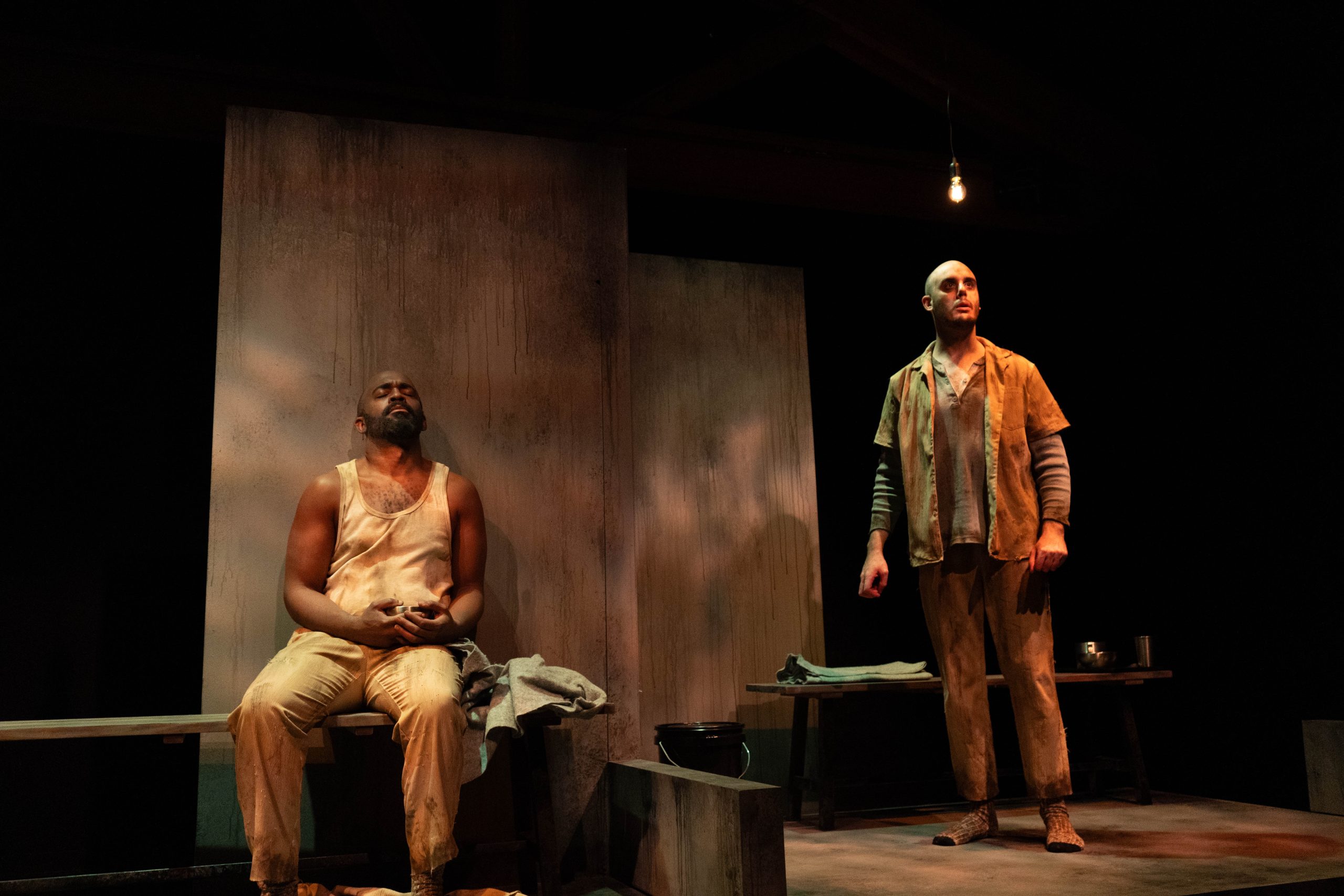

It seems there's a goldrush for plays people sense might be prescient or “timely.” Which in 2025 means shows that predict devastation and authoritarian nightmares. Tin Drum Theatre Company’s The Unseen, written by Craig Wright, directed by Steve Needham, on stage now at Bramble Arts Loft, fits neatly in that prescient category. In it we’re transported to an unnamed totalitarian hellscape where two isolated prisoners build a friendship speaking through a shared wall.
On the left is Wallace, played by Jordan Gleaves, a pseudo-intellectual claiming superior intelligence while his mind disintegrates. On the right is Valdez, played by Carlos André Mai, a naïve man-boy with big sad eyes who, at least in the beginning, is the anchor keeping them both sane. For the last ten years, though they’ve never seen one another, they’ve been the other’s sole companion through an interminable sentence of isolation (onstage) and torture (offstage). We don’t know their crimes, neither do they; in fact, the protagonists can barely remember life before the prison.
The Unseen presents a horrifically common situation. Imprisonment and torture is a human constant. Playwright Wright could have put his two inmates in any historical period. Maybe for that reason The Unseen exists outside our world. The characters suffer under an unnamed, mysterious regime on its dying last legs. They speak in a heightened, literary style that creates distance from, and contributes humor to, some pretty disturbing content.
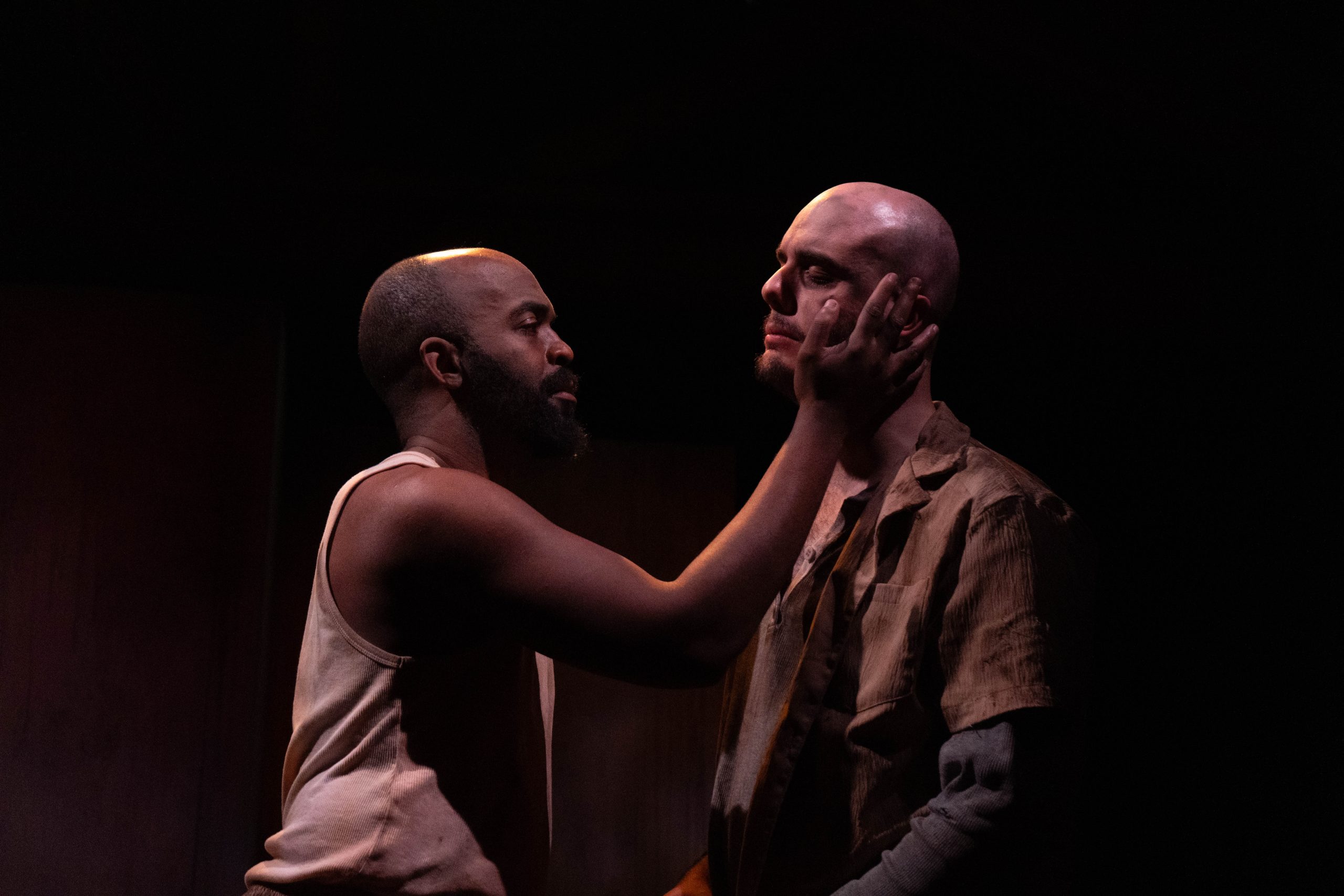
When talking about torture Valdez says, “Because when they tie me down and put that rag in my mouth and put my head under the faucet, I tend to get confused.” To that Wallace replies, “I’m exactly the opposite. I feel those are moments of great clarity. It’s the rest of my life that’s confusing.” “Huh.”
The absurd dialogue and physically isolated characters harken to Samuel Beckett’s. It’s all well and good to wear your influences, of course; though, sometimes, when you put yourself in league with a master, you outclass yourself. Occasionally Wallace’s dialogue, trying to achieve that Beckett stream of consciousness, comes off garbled and silly:
“But the way things work doesn’t work,” he claims. “Every notion is destroyed by its converse, without which the notion itself is incomprehensible—every idea’s a stiffening trap.”
A few eye-roll lines, however, do not distract from what is most definitely an entertaining, well-produced show. Scenic designer Malia Hunter provides grimy Luan cells for the characters. Costume designer Kasey Wolfgang dresses the leads in believably weathered rags labeled “Property of Prison.” And special attention must be paid to sound designer Zach Stinnett, who gives the show the prison beeps and clanks that more and more overwhelm Wallace and Valdez.
Mostly, though, the strength of the show relies on the two main characters. Gleaves and Mai, stuck in their small gray worlds, perform excellently under a difficult set of circumstances. They must imagine a wall separating them from their scene partner, and interact with their spaces as though they were alone fighting eternal boredom. To that end our actors do a lot of “business.”
In theater “business” refers to actions actors deploy to make their characters plausibly occupied onstage. People in real life fidget: they pick things up from desks, they kick rocks, they check their zippers. When actors don’t speak they build the production’s verisimilitude with movements, or “business,” that feel authentic without drawing attention. The script does Gleaves a favor by giving Wallace a lot of movement. Many times the stage directions tell him to adjust his “clock,” a sort of sundial he makes with kitchen utensils. All this fits perfectly with his manic, a-million-words-a-minute, intense performance.
Craig Wright doesn’t do Mai the same favor. By comparison the script gives his character less direction. The business Mai performs in his sad-sack corner is either his invention, the director’s, or, likely, some combination of both. Mai stretches, he plays with his kitchen utensils, and uses his sock as a slingshot. These were pretty inventive and imply a creative team interested in the fine details. Only one moment when Mai stares at his reflection in a spoon did I feel he was taking away from the primary focus.
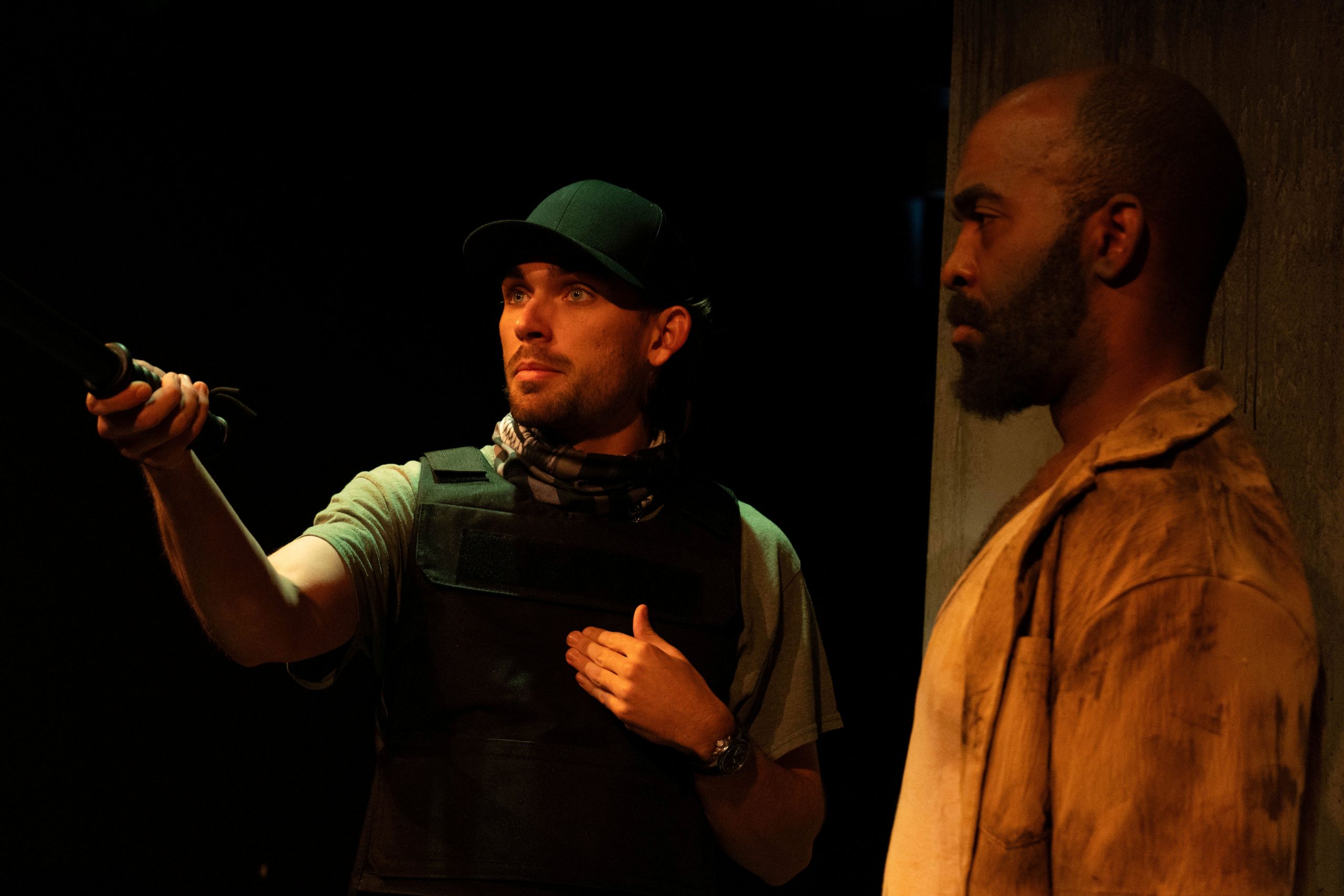
A third character appears briefly at the very beginning, and the conclusions of both scenes. Mister Smeija, or Smash, played by Jacob Coggshall, is the protagonists’ guard and primary torturer. He’s a maudlin madman whose American flag T-shirt is the closest nod to the story’s setting. When he first appears Coggshall is captivating as Smash, an impulsive monster who starts to feel the pain of his victims.
Smash explains his predicament, “Every morning I wake up and I tell myself I’m not gonna get drawn in. I tell myself, today, I’m gonna come to work and do my job. But then I get here and—I don’t know what happens, I see your faces and I get drawn in!”
The prisoners try to win Smash’s confidence and ask for their release. He thinks a moment but ultimately denies them and leaves. Shortly after the two men hear a tapping from a cell nearby and wonder if someone is trying to communicate. This tapping, and what it might mean, carries the action of the second scene.
The ending of the play leaves something to be desired. Without giving much away, Smash returns to the prisoners in a completely different mood than when we first met him. Coggshall’s performance in the second scene, unfortunately, lacks the dimensions of the first. He becomes a fairly typical weirdo, delivering the lines like an anxious auditionee trying to be “memorable.”
People who predict a worsening political climate for the United States may feel queasy watching this show. Absurd humor makes the pill easier to swallow, but at its core The Unseen is bleak, as worst case a scenario as any I’ve seen on stage. No one could be blamed for preferring lighter fare. But those interested can expect an engaging, entertaining experience.
The Unseen by Tin Drum Theatre Company continues at the Bramble Arts Loft, 5545 N. Clark St., 2nd floor., thru November 23. Running time is 85 minutes without an intermission. Tickets are $15-$30.
If you found this post interesting, please consider supporting Third Coast Review’s arts and culture coverage by making a donation. Choose the amount that works best for you, and know how much we appreciate your support!
