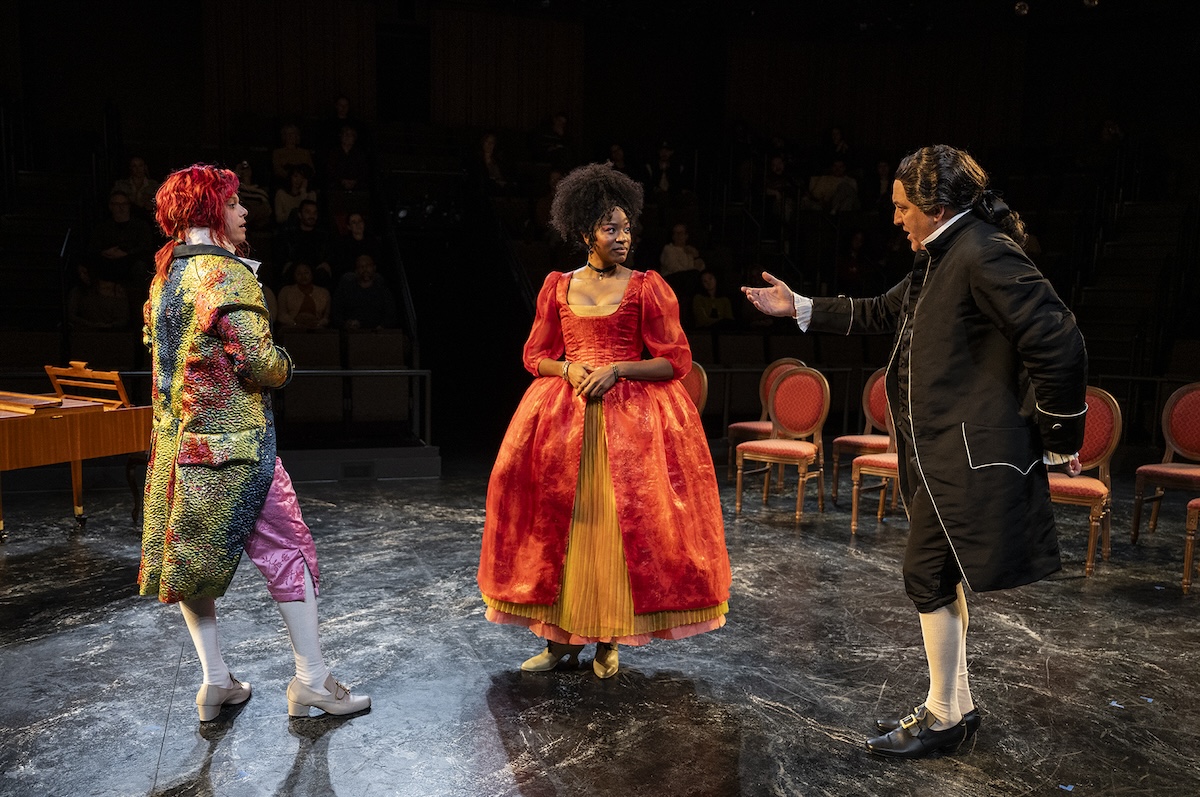

Wolfgang Amadeus Mozart. Whenever I speak or hear the name, his glorious and stirring Requiem is the first thing that springs to mind. Sir Peter Shaffer's Amadeus is now playing at Steppenwolf Theatre, and it is a gorgeous elegy for the genius that is Mozart. I say 'is' because his music lives, giving him an immortality that few possess. The story is told from the viewpoint of Antonio Salieri, a long-maligned composer whose manipulation and plotting led to Mozart's mental and physical demise. Tony Award-winning director Robert Falls makes his Steppenwolf debut at the helm of this brilliant staging.
Ian Barford gives a sharp and expressive performance as Antonio Salieri. Barford carries Salieri's envy and agony over the genius that he does not possess. His dialogue is timed perfectly, letting the words drip with acid, fulfilling the Buddhist adage of "swallowing poison and expecting your enemy to die." His body language is aristocratic, in keeping with the style of 16th-century barons and aristocrats. Much of the humor in Amadeus comes from the upper-class men scheming to hold their positions at court. They are as afraid as Salieri is of this child prodigy, whose masterpieces are complete in his head before the notes are drawn on the staff.

The portrayal of Mozart is carried fearlessly by David Darrow. Shaffer has written Mozart as a man-child genius who never had a childhood. All he knows is music, and he does not process Maslow's hierarchy of needs the same way a non-genius does. Darrow goes to the wall, wild-eyed and physically agile. He perfectly projects the antic mind and synesthesia that Mozart possessed. Darrow is well-matched with the radiant Jaye Ladymore as Mozart's wife, Constanze Weber.
I first encountered Ladymore in Timeline's Relentless, and she has a gift for simmering performances. Her Constanza goes from a willing sandbox partner to Mozart's childishness, to the adult in the relationship who is beaten down by the poverty, pregnancies, and bare living. When Salieri propositions her in an attempt to sabotage Mozart, her delivery conveys contempt. Salieri feeds her a purportedly aphrodisiac sweet and then suggests a liaison. Ladymore gives him a look that says he is beneath contempt. Her subtlety says that Salieri is common, which infuriates him. It is an excellent scene between Ladymore and Barford.
The chemistry of the cast is excellent. The characters interact as if they are not being watched. When Barford and Darrow are in scenes together, the tension is fraught with Mozart being conned and believing Salieri's "favors" on his behalf. I found myself leaning in and felt anger that Mozart's success was being blocked by this villain of lesser ability. I enjoyed the comic relief of the aristocratic circle that Salieri held so tightly. Steppenwolf veteran Robert Breuler is hilarious as the doddering Kappelmeister Giuseppe Bonno. Breuler has little dialogue, but his comic physicality fills in the blanks. John Lister is appealing as the duplicitous Count Franz Orsini-Rosenberg. The Count conspires with Salieri to keep Mozart from a lucrative court position.
Greg Linington lights up the role of Emperor Joseph II. Linington is a familiar face from several television shows set in Chicago. The Emperor is not the sharpest knife in the drawer and is easily manipulated by his inner circle. It is a funny role calling for clueless self-importance, followed by a comical look on his face. The ridiculousness of royalty is distilled in this character. The character of Count Johann Kilian von Strack, played by Yasen Peyankov, sponsors Mozart into the Masonic Order. As a reportedly devout Catholic, membership in the Masons would be forbidden to Mozart, but it became a source of money when he became destitute. Peyankov conveys a mix of anger and heartbreak after seeing Masonic rituals revealed in The Magic Flute. Salieri was behind that as well.

There is a Greek chorus of sorts among the Venticello characters who serve Salieri. Ora Jones, as Venticello 1, has a fabulous stage presence as the gossipy servant. Sawyer Smith nearly steals the spotlight as Venticello 2. Smith hits the stage like the runway with conspiratorial looks that are hilarious. Erica Stephan has a brief but pivotal role as Salieri's mistress, Katherina Cavaleri. She and Barford have some sizzle between them that is enjoyable.
The production values for Amadeus are minimalist, an excellent choice by scenic designer Todd Rosenthal. The actors and dialogue should be front and center because Amadeus is a psychological drama. There is even a condition called Salieri Syndrome for mediocre people who undermine someone of superior talent. I must also applaud the effect of Mozart's sheet music snowing down on Salieri. He cannot escape, and I had a unique vantage point. I could see how the effect was achieved, and I thought it was cool. Salieri's cell, with a bare mattress under broken, arched windows, made an indelible impression.
Music supervisor Mikhail Fiksel arranged Mozart's music for the production. There was also some original music, but the O'Jays' "Backstabbers" played in my head while I wrote this. Kudos to Amanda Gladu for costume design. The elaborate attire of the 16th century was executed to the finest detail, down to the shoes. Some of the patterns look to have made a reappearance in contemporary fashion.
Robert Falls is best known for his 40-year tenure as the artistic director of the Goodman Theatre. He has directed plays by Tennessee Williams, Arthur Miller, and Eugene O'Neill. Most significant to me was his updating of Mozart's Don Giovanni for the Lyric Opera of Chicago's 60th anniversary. I had never seen anything like Mariusz Kwiecień as the louche Giovanni descending into hell. Falls is the recipient of honors and awards from the theater world, including an induction into the Theatre Hall of Fame. His direction of Amadeus bears the mark of taut rhythms requiring actors to be on their A-game. I highly recommend that you get yourself to Steppenwolf to see Amadeus. It will spark conversation and evoke suspicions of whether Mozart was murdered or died of sepsis. (The modern medical consensus is that he died of an illness.) It is an excellent way to spend an evening.
Amadeus continues at Steppenwolf Theatre, where it is performed in the Ensemble Theater. Running time is 2 hours and 45 minutes, including an intermission. Performances have been extended through January 25. Steppenwolf Theatre is located at 1650 N. Halsted St. For more information and tickets, please visit www.steppenwolftheatre.org.
For more information on this and other productions, see theatreinchicago.com.
Did you enjoy this post? Please consider supporting Third Coast Review’s arts and culture coverage by making a donation. Please choose the amount that works best for you, and know how much we appreciate your support!
