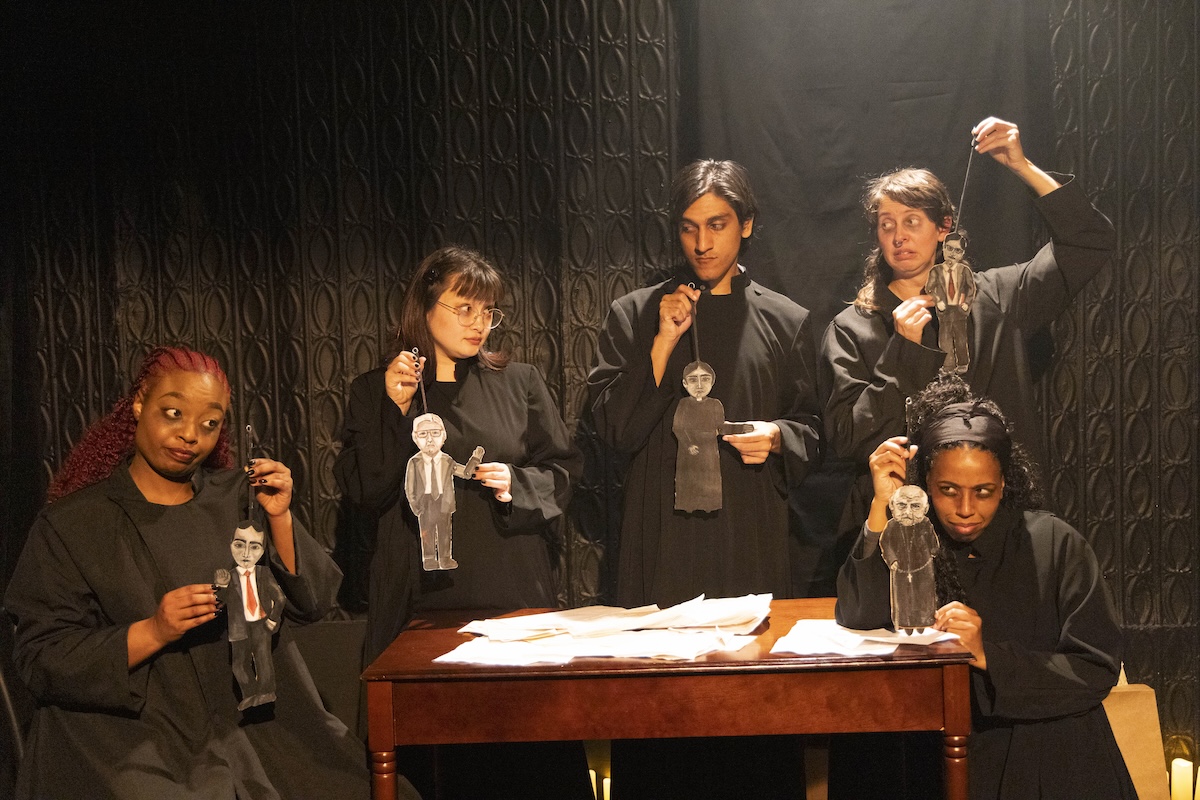

It’s a Swiss town full of writers, where everyone is obsessed with getting published and winning a new literary prize. A Publisher arrives, eager to find new works to be published; he turns out to be the Devil in human form (horns are no longer de rigueur). That’s the basic setting and storyline of A Devil Comes to Town, now being staged by Trap Door Theatre in a fantastically choreographed hour-long performance. A Devil Comes to Town is occasionally puzzling but always engaging as long as you don’t demand that it make complete sense.
Five actors form the corps de ballet, for which director Jeremy Ohringer devises creative movement throughout the production. Ohringer also adapted the script for A Devil Comes to Town from the 2019 novella by Italian writer Paolo Maurensig, who blended Alpine magical realism with a nutty plot about writerly zeal and a subplot about foxes and rabies. Anne Milano Appel translated the novel.
The actors are Dinah Berkeley, Juliet Kang Huneke, Shail Modi, Lydia Moss and Y’vonne Rose Smith. They all perform multiple roles, including the Devil, local authorities, and Father Cornelius, the vicar. All five actors are excellent, with notable work by Shail Modi (who occasionally fixes us with a strange hypnotic stare) and Juliet Kang Huneke, who plays several local officials in a farcical style.
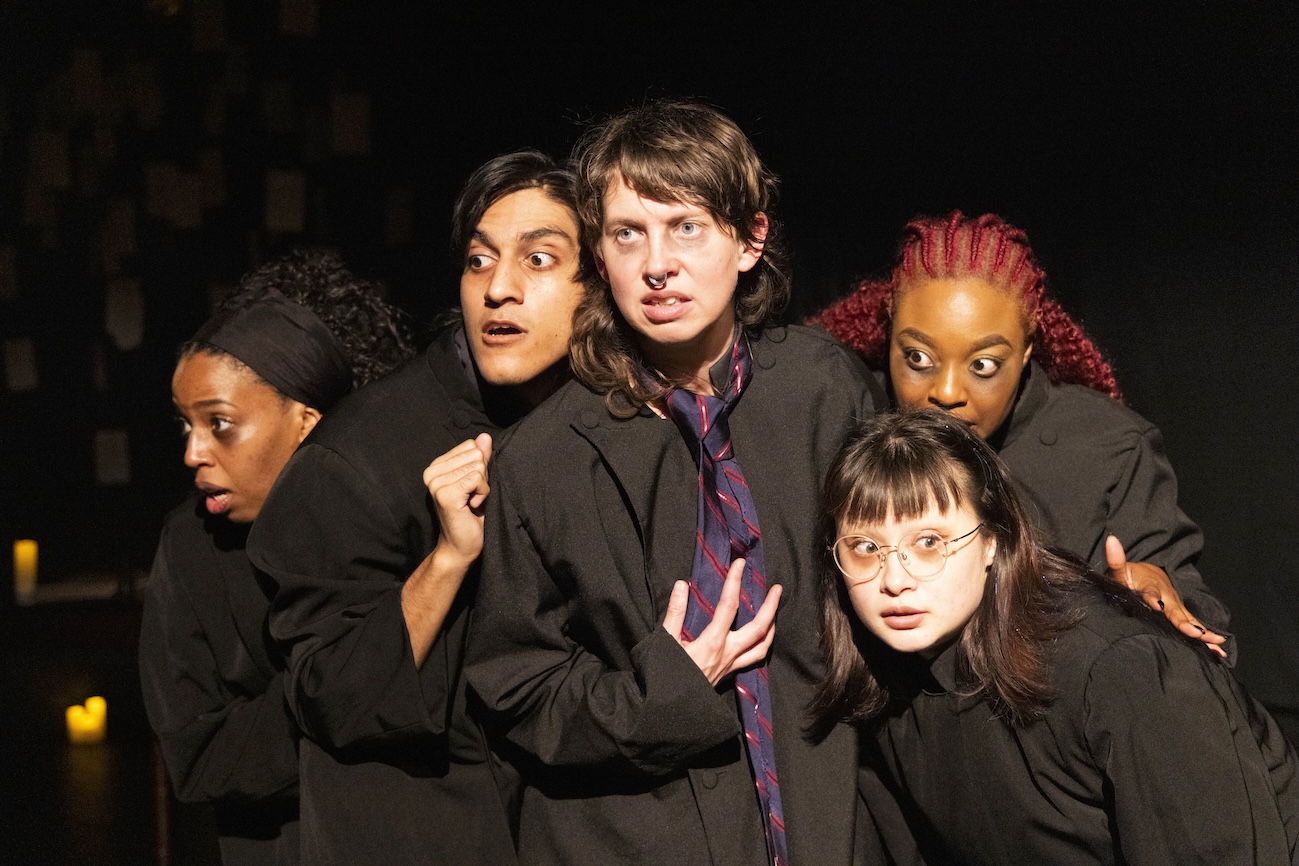
The story begins in 1991, when the Publisher, seeking manuscripts to publish, attends a conference on psychoanalysis in a town on Lake Zurich. He hears Father Cornelius speak on “The Devil as Transformist” and commits to publish his work.
Father Cornelius places blame for the prominence of the Devil. “First the Church, and later romantic literature, gave the devil prominence: they portrayed him in various ways, they gave him a face, a character, they provided him with a job, a mission, they clothed him in all kinds of attire, to the degree of making him visible, alive. In short, they humanized him,” he tells the Publisher. (Beware, because the Devil behaves much like a fox with rabies; he lurks around those he hungers after, befriends them, and then attacks them.)
Father Cornelius tells the Publisher that he knows a place, where “a whole colony of writers is overcome by a particularly enterprising devil.” That place is the Swiss town of Dichtersruhe (“poet’s repose”), where Father Cornelius is the vicar. Thus begins the quest by the Publisher/Devil to get more writers to contribute manuscripts. The writing is inspired by the announcement of a literary prize, named after the esteemed writer Goethe, who once stopped there.
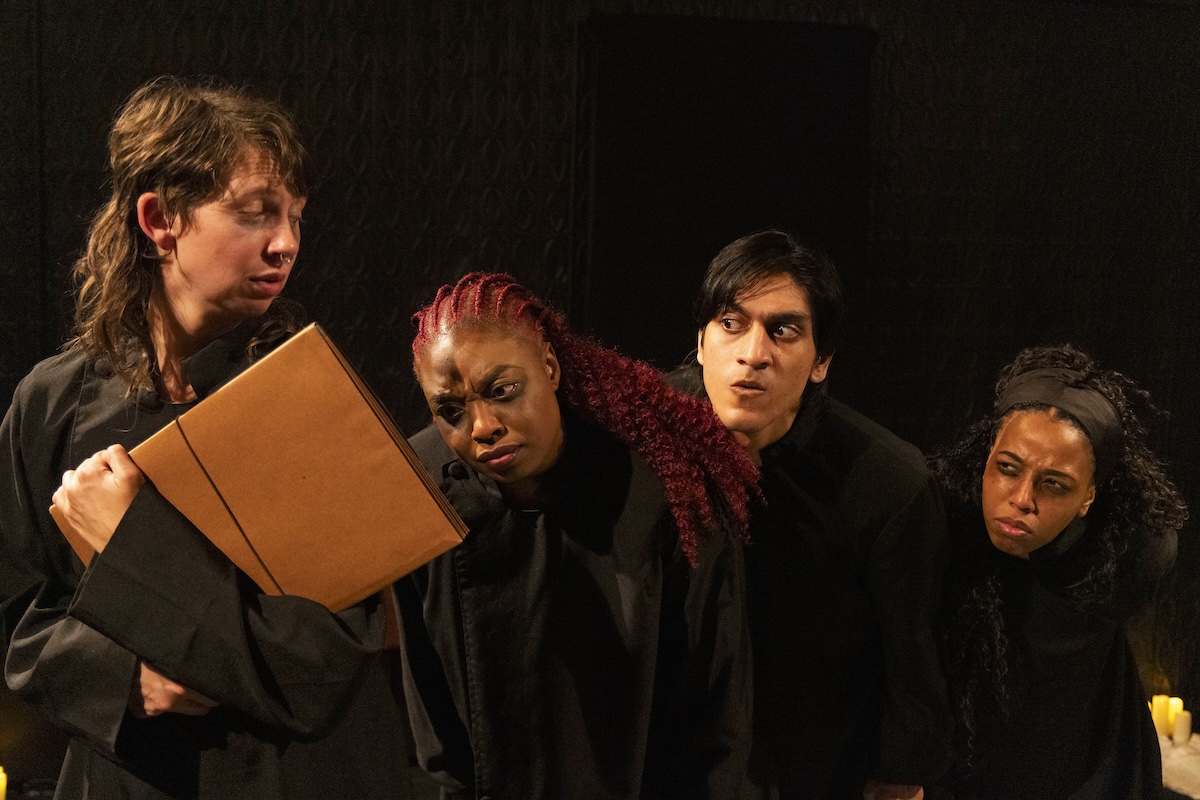
The story moves to that town where manuscripts flow in—piles of paper, paper slips hanging from the rafters, paper everywhere. The writers know they will be divided into the Chosen and the Rejected, yearning for the prize of ten thousand Swiss francs.
My favorite scene in this fully choreographed performance is when the five actors mime writing, moving and dancing together, writing in the air, on their hands, on someone’s back. Other scenes are dramatized with puppet figures, small and large. Puppet design by Saskia Bakker, costumes by Finnegan Chu, lighting by Karen Wallace and sound design by Oskar Westbridge. Stage manager is Grace Herman. (The stage design is minimal with piles of paper and lighted candles everywhere. Dozens of candles. After a moment of concern, I decided not to worry about whether the fire marshal had been consulted.)
A Devil Comes to Town continues through December 6 at Trap Door Theatre, 1655 W. Cortland Ave. Running time is one hour with no intermission. Tickets are $22 for performances Thursday-Saturday. The play is part of the theater’s Trap Open Series, which explores nontraditional playmaking and gives voice to the next generation of theater artists.
For more information on this and other productions, see theatreinchicago.com.
Did you enjoy this post? Please consider supporting Third Coast Review’s arts and culture coverage by making a donation. Choose the amount that works best for you, and know how much we appreciate your support!
