
During 2025 our theater team wrote almost 200 articles for our Stages page, which included opera, dance, comedy, magic, children’s theater and the occasional interview and theater book review. That may not sound like a lot for a team of writers, but remember our writers are all part-time at Third Coast Review while earning a living with a full-time job or several side gigs. (That’s why we ask you to support our 2025 fundraiser, which is dedicated to raising money to pay our writers an end-of-year stipend.)
As our critic Lauren Katz notes in her recap, the Chicago theater scene took some exciting risks this season in a moment where that can be quite tough. Funding is down, and audience turnout continues to struggle post-Covid. But there is exciting theater on Chicago stages and we want to recognize our favorites. Some media publish a list of the best theater of the year, but we prefer to tell you about the plays that made us the most giggly, tearful, reflective, or astonished. Read on as our writers recap what delighted us at the theater in 2025.
Berlin at Court Theatre (June Sawyers)
Among the plays I reviewed in 2025, my favorite was the world premiere of Berlin at Court Theatre. Why? Because I found it inventive and engrossing not only in the very visual way the story unfolded but also by the performances. In particular, I was blown away by Elizabeth Laidlaw’s unforgettable turn as Hitler.
Jason Lutes took some 20 years to complete his graphic novel, Berlin. Condensing Lutes’ 550-page magnum opus into theatrical language is no easy feat but Court Theatre brought it to the stage in a masterful adaptation by Mickle Maher, directed by Charles Newell. Berlin is set in the waning years of the Weimar Republic. It features a cross-section of Berlin’s population—students, journalists, musicians, protesters—and takes place between 1928 and the rise of Hitler and the National Socialists in 1933.
Berlin focuses on a dozen characters with actors playing multiple roles and the entire ensemble makes it appear effortless and seamless. The most remarkable figure is Hitler himself, played by Laidlaw (who also plays another character). We watch, mesmerized, as she dons a long black trench coat and places an officer’s cap on her head. Then she looks into a small round mirror that another character holds and deftly paints a tiny black mustache above her lip before turning toward the microphone spouting venom. It is a stunning, and chilling, moment—one I won’t soon forget.
Fool for Love at Steppenwolf Theatre (Adam Kaz)
My favorite show this year was probably the first. Steppenwolf’s production of Sam Shepard’s Fool For Love, directed by Jeremy Herrin, all the way back in February, was one of the best theater experiences I’ve ever encountered.
Fool For Love follows a heated argument between ex-lovers Eddie (Nick Gehlfuss) and May (Caroline Neff), the two of them duking it out in a sweaty Mojave Desert motel room. Eddie says they are destined to be together and insists she take him back. But May has seen this charade before and won’t be fooled.
My initial review spoke to the excellent performances and production values. I was especially impressed by scenic details like the missing ceiling tiles and pool ladder. Having thought about the production a great deal in the months since, however, I understand my review barely scratched the surface of what made this show so spectacular.
The review mistakenly addressed the events as if they were literal without acknowledging the story’s more abstract and cerebral elements. Fool For Love is not a straight drama. After greater analysis one realizes the show has more in common with Waiting for Godot than The Notebook, for example.
The giveaway is May’s insistence that this exact thing occurs again and again: Eddie comes back and promises he’ll stay, she believes him, then he leaves. The audience starts to wonder, Does it really happen just like that? Again and again?
All this suggests the characters are in a sort of time loop or limbo, one where they’re doomed to live out this drama forever. In a way, one realizes, it’s a commentary on theater itself, that we spectate as people relive the same dramas every night. One could say the actors are stuck to the stage just like the characters are stuck to their dilemmas.
All this compliments Shepard’s genius more than anything the actors or crew did specifically, which maybe explains why it wasn’t worth saying back in February. Still, no other show returned to my memory as often or as pleasantly as Fool For Love. As the show that never leaves, it deserves its place as my number one of the year.

Translations at Writers Theatre (Lauren Katz)
I saw a lot of great plays in 2025—all ranging in style and approach. The Chicago theater scene took some exciting risks this season in a moment where that can be quite tough. Funding is down, and audience turnout continues to struggle post-Covid. It was uplifting to see so much beautiful art take the stage, and to witness so many audience members coming out to support theaters of all sizes.
As I think back on some of the strongest work I saw, Translations by Brian Friel at Writers Theatre floats to the top of that list. Director Braden Abraham’s ensemble was strong as they brought this charming Irish village to life. Taking place in the town-land of Baile Beag/Ballybeg, we meet a group of students at a small hedge school run by Hugh (Kevin Gudahl) and Manus (Andrew Mueller). As the British soldiers enter the village, it’s clear that the small, sheltered world is about to turn upside down.
The play stood out for so many reasons. The design was fantastic (in particular Andrew Boyce’s highly detailed scenic design). The ensemble brought wonderful chemistry, and the production was full of heart. The story itself pushed the piece over the edge for me. Friel’s play is about many things. Colonialism, border challenges, and even love. At the root, this is a story about language. We have so many different ways to communicate in this world, and Translations offered a helpful reminder that even when it feels like there’s no hope to ever understand one another, we often still find a way.
This Too Shall Slap at Second City (Anthony Cusumano)
In my nine years as a Chicago resident, I’m pretty sure I’ve only missed one of Second City’s mainstage revues. While 2016’s The Winner…of Our Discontent will always remain a sentimental favorite—I still quote Jamison Webb’s chaotic “Bassman” character on a regular basis—This Too Shall Slap, which opened in May and is still playing six nights a week, is the best production to come out of the venerable comedy theater in years.
The six-member ensemble delivers start-to-finish laughs in a series of delightfully absurd sketches. Most Second City revues feature a clear standout performer or two, but this group is universally spectacular, with undeniable chemistry and all-around affability. I’ll never be able to see a reference to Salesforce without thinking of Leila Gorstein’s haunting corporate retreat meditation leader, or drink a bottle of Gatorade without remembering Adonis Holmes’s bizarre school nurse who considers the sports drink an all-fixing miracle elixir, or hear “Lovely Day” without picturing Hannah Ingle as a Paula Dean-esque cooking show host boogie down between mental breakdowns.
Remember those names, along with Bill Letz, Jordan Stafford, and Adisa Williams—this cast is poised for stardom. Skipping this show would be a slap in the face.
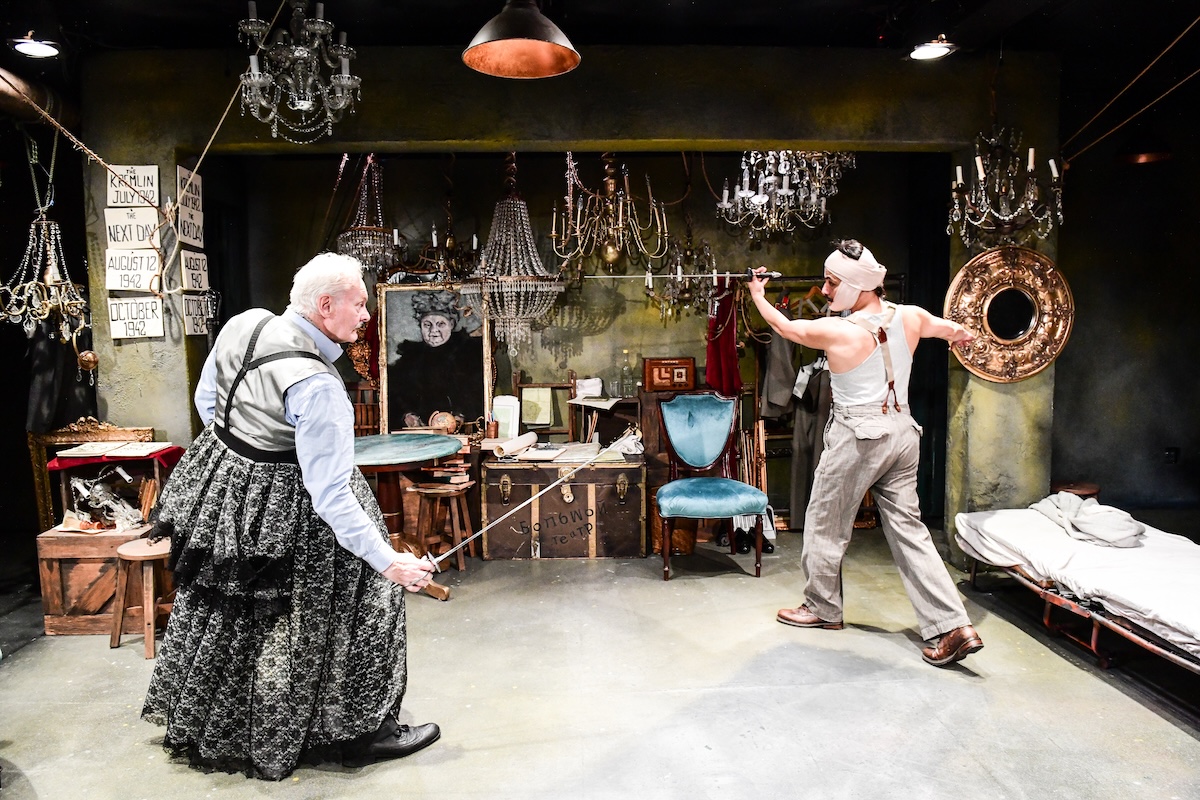
Six Men Dressed Like Joseph Stalin by A Red Orchid Theatre (Nancy S Bishop)
It took only two actors to make Six Men Dressed Like Joseph Stalin into a feast of World War II history, Russian customs, and a love letter to theater. Director Dado directed this clever and prescient play with style and wit for A Red Orchid Theatre, and its highlight was the delicious performance of veteran Chicago actor John Judd, playing a Stanislavski-trained actor who now is training Joseph Stalin body doubles. Judd is masterful in his movement and his character’s theatrical and political musings, while his student (Esteban Andres Cruz) is manic and soulful. (They go by code names Koba and Soso.)
The language of Dianne Nora’s script is also a delight—crisp, informative and playfully droll. Soso and Koba have casual conversations between lessons and Soso has a chance to ask his elder about his theater background, his experiences performing before Stalin, his time in Siberia, and how he lost his fingernails. They get drunk on vodka, sword fight while acting a scene from The Seagull, and even dance (with Judd in a skirt).
Red Orchid’s tiny performance space enhanced the charm of Six Men. The play could certainly succeed on a large proscenium stage but you’d lose the magic of seeing the actors’ every expression and small gesture. I saw Six Men Dressed Like Joseph Stalin twice and I’d see it again in a minute.
Beauty and the Beast by Broadway in Chicago (Erin Ryan)
Chicago never disappoints when it comes to theater. Whether the venue is big or small, the cast is well known or new to the scene, or the story is heartwarming or heartbreaking, Chicago theater really has it all.
My favorite show I had the pleasure of seeing this year was hands down, Broadway in Chicago’s Beauty and the Beast at the Cadillac Palace Theatre. This show was packed with technical skill on every level. It had an insanely talented and engaging cast, the most extraordinary lighting and projection design, and plenty of jaw-dropping magic tricks that left you thinking “how did they do that?” This show was truly a spectacle.
Audiences often love to show their support with a final standing ovation, but this was the only show I have ever seen where the audience couldn’t help but jump to their feet in the middle of act one after the impressive 15-minute number, “Be Our Guest.” Every artist whose work went into creating that number electrified a room of over 2000 people and that is one theater moment I will never, ever forget.

Titanique by Porchlight Music Theatre / Broadway in Chicago (Doug Mose)
In a year in which I saw several powerhouse performances (Cynthia Erivo at Ravinia), my favorite was last spring’s joint Porchlight / Broadway in Chicago production Titanique—an irresistibly silly confection that answered the age-old question: what would happen if Celine Dion not only sang the theme from Titanic, but inserted herself and her song catalog into every scene, with backup dancers in tow?
The answer brought plush eggplant emojis, Peabo Bryson, Julia Sugarbaker and Kathy Bates in a rowboat memorably, convulsively alive on the Broadway Playhouse stage at Water Tower Place for 14 deliriously funny weeks.
I don't know if Titanique was the best show in Chicago in 2025, but it certainly was the funniest.
Rachmaninoff and the Tsar by Writers Theatre (Susan Lieberman)
Rachmaninoff and the Tsar was new territory for Hershey Felder: He broke his solo format and brought a second character onstage. The play rests on a fictional conceit: Nicholas II, executed along with his wife and children in 1918, pays a visit to Rachmaninoff’s morphine-charged imagination in 1943 as the composer approaches death. The scene pits these opposites against each other to bring out their respective temperaments and provide an abundance of historical detail. The show was new territory for me, too: Besides gaining a deeper understanding of Russian music and history, I could finally put the mythology of Princess Anastasia to rest.

Shucked by Broadway in Chicago (Lisa Trifone)
Shucked was a delightfully corn-y touring production that featured laugh-out-loud jokes and more than a kernel of charm. Shucked at the CIBC Theatre is hilarious, heartfelt and (forgive me) ear-resistible, a truly cream-of-the-crop show and proof that American musical theater is still capable of winsome, surprising and original works worth their ever-inflating ticket prices.
With a book by Robert Horn (Tootsie, Hercules) and music and lyrics by Brandy Clark and Shane McAnally (both well-established country music artists), Shucked absolutely shouldn't work. It's silly and lightweight and in less talented hands (the ensemble touring cast is essentially superb), the corny comedy throughout could quickly become stale.
The show accomplishes what so many others of its ilk often find next to impossible to do: delivering a well-written, solid plot and believable stakes alongside strong musical numbers that develop character and advance the plot. We get introduced to Cob County and its residents, understand the crux of the challenge at hand and are on our way to Tampa and back all within the show's first five numbers, and the economy of storytelling is both appreciated and expertly done. Art that knows what it is and embraces that truth is usually the most successful kind of art, and Shucked proves this in spades as it leans into the...corniness...of its comedy. There isn't a pun that goes unsaid, a rock under which a potential joke can hide.
Twisted Melodies at Northlight Theatre (Kathy D. Hey)
It is the holiday season, and Donny Hathaway’s This Christmas is on the airwaves of traditional radio and the streaming services. It led me to choose my favorite play of 2025, Twisted Melodies, written by and starring Kelvin Roston Jr. The play has been around for at least a decade, and Twisted Melodies was staged in July by Northlight Theatre at the North Shore Center for the Performing Arts.
This show appealed to me on so many levels. I am from that generation that listened to WVON as a kid. Donny Hathaway was in constant rotation, solo and with Roberta Flack. Roston captured Hathaway’s voice and performance style perfectly in Twisted Melodies. Even more importantly, he captured the torment of mental illness that caused Hathaway to take his own life in 1979.
Roston wrote the play with a gentle balance between the music and the paranoia. He also uncovered how the treatment was a trap for Hathaway. Musicians like Hathaway think in music and see the notes before they write them down. Medications muted him, and Roston’s performance of Hathaway as an unchained genius was harrowing. I knew how the play would end, and my own inner dialogue was saying, “please don’t.” His silhouette, wearing that apple jack hat and orange-tinted leather, remained in my mind for days after.
Roston captured the emotion and the performance style impeccably. I have also seen Roston sing in The Jackie Wilson Story, The Gospel at Colonus, and A Nativity Tribute. Listening to him as Donny Hathaway was like coming home, and it touched my soul. I went home and played Donny Hathaway music, still feeling the music buzz.
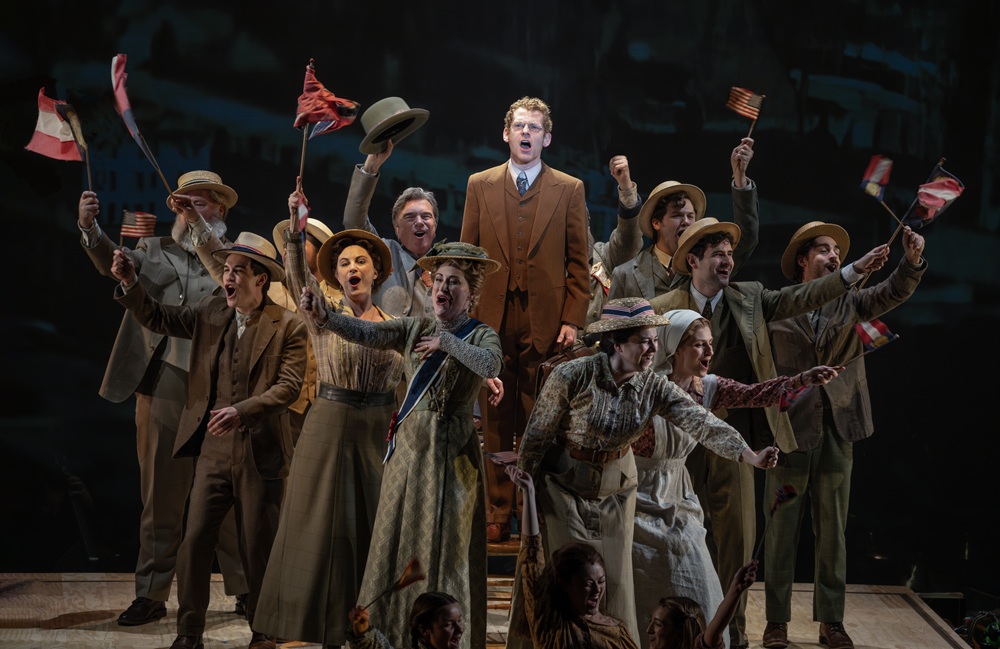
Parade by Broadway in Chicago (Anne Siegel)
The musical Parade staged at the CIBC Theatre is a drama of rage and antisemitism. Based on a true story set in Atlanta, it involves the 1913 rape and killing of a 13-year-old girl in the basement of the pencil factory where she worked. The musical's focus is on the main suspect: Leo Frank, the factory’s manager. He's Jewish and a recent Brooklyn transplant. Frank is arrested and charged with the crime. Although his sentence is later reduced from the death penalty to life imprisonment, a few local townsfolks have something else in mind..
Parade has strong theater credentials, written in 1998 by two-time Tony Award winner Alfred Uhry (Driving Miss Daisy), with music and lyrics by three-time Tony Award winner Jason Robert Brown (The Last Five Years). Furthermore, it was co-conceived by 21-time Tony Award winner Harold Prince and directed by two-time Tony Award winner Michael Arden (Maybe Happy Ending). A 2023 Parade revival, featuring Ben Platt (Dear Evan Hansen), won a Tony for the Best Revival of a Musical and two others for its music.
What surprised me so much about this brilliant production is that it's definitely NOT for children—not with images of a man hanging from a tree, and not with some of the language (which was no doubt common to use in the historical period). I realize that many musicals aren't made with children in mind. For those seeking escapism in theater, who want everything tied up with a bow (and a smile) at the end, this show isn’t for you. Its unflinching gaze at history tells a story that must be told, even if it isn’t easy to watch. But I never saw any reviews of Parade that pointed out how problematic this may be for some audiences (not just children).
And the runners-up are:
A Lie of the Mind (Raven Theatre)
Female, Ashkenazi, With a Sewing Machine (Arts Judaica)
Incognito (Tin Drum Theatre)
Jekyll & Hyde (Kokandy Productions)
Lobby Hero (Shattered Globe Theatre)
Manual Cinema’s Christmas Carol (Manual Cinema)
Mr. Wolf (Steppenwolf Theatre)
R.U.R. Rossum’s Universal Robots (City Lit Theater)
The Mannequins’ Ball (Trap Door Theatre)
The Taming of the Shrew (Court Theatre)
Theatre of the Absurd Festival (Gwydion Theatre and Chopin Theatre)
Support arts and culture journalism today. This work doesn't happen without your support. Contribute today and ensure our writers can continue to contribute and we can continue to share the latest reviews, essays, and previews of the most anticipated arts and culture events across the city.
