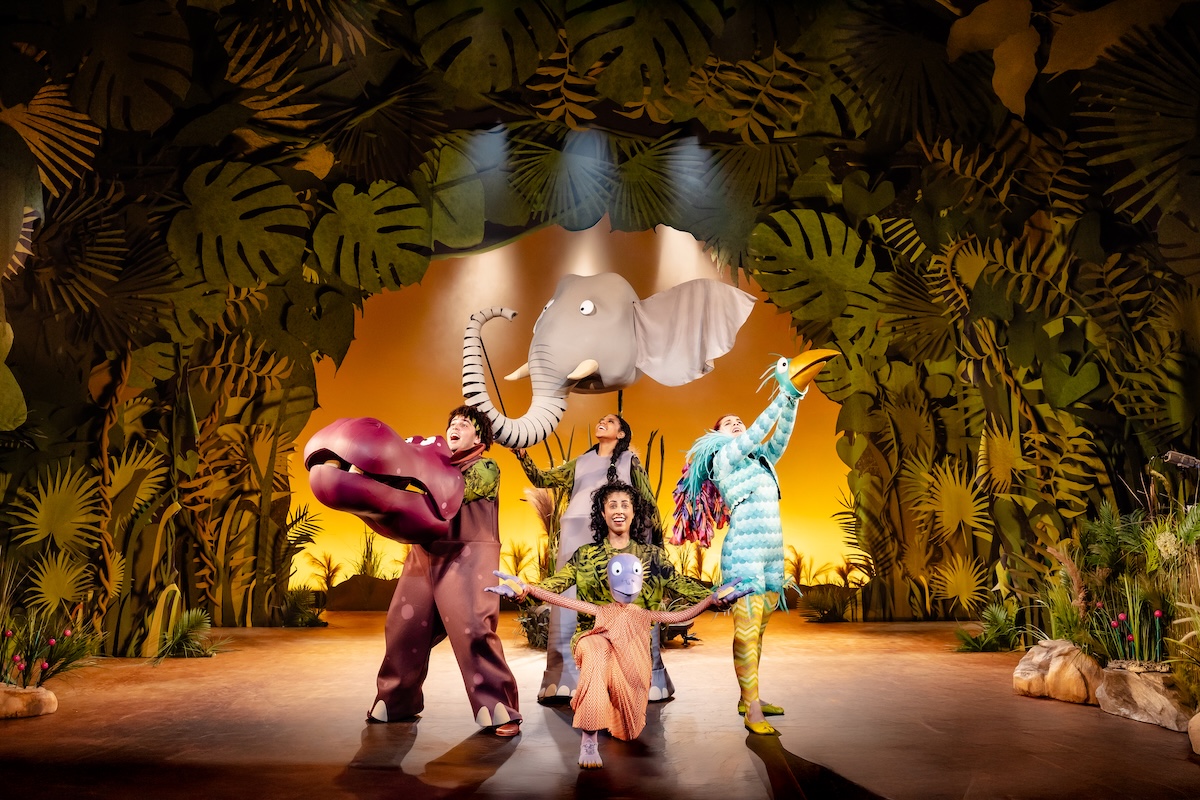
The 8th Chicago International Puppet Theater Festival concluded Sunday, after 12 days of puppet theater productions at dozens of venues around the city. Our Third Coast writers are puppetry fans and they’ve written mini-reviews of the shows they saw this week. For more of our puppet theater reviews, see last week’s dispatch.
The puppets have departed but they’ll be back for the 9th festival January 20-31, 2027.
The Sex Lives of Puppets (England)
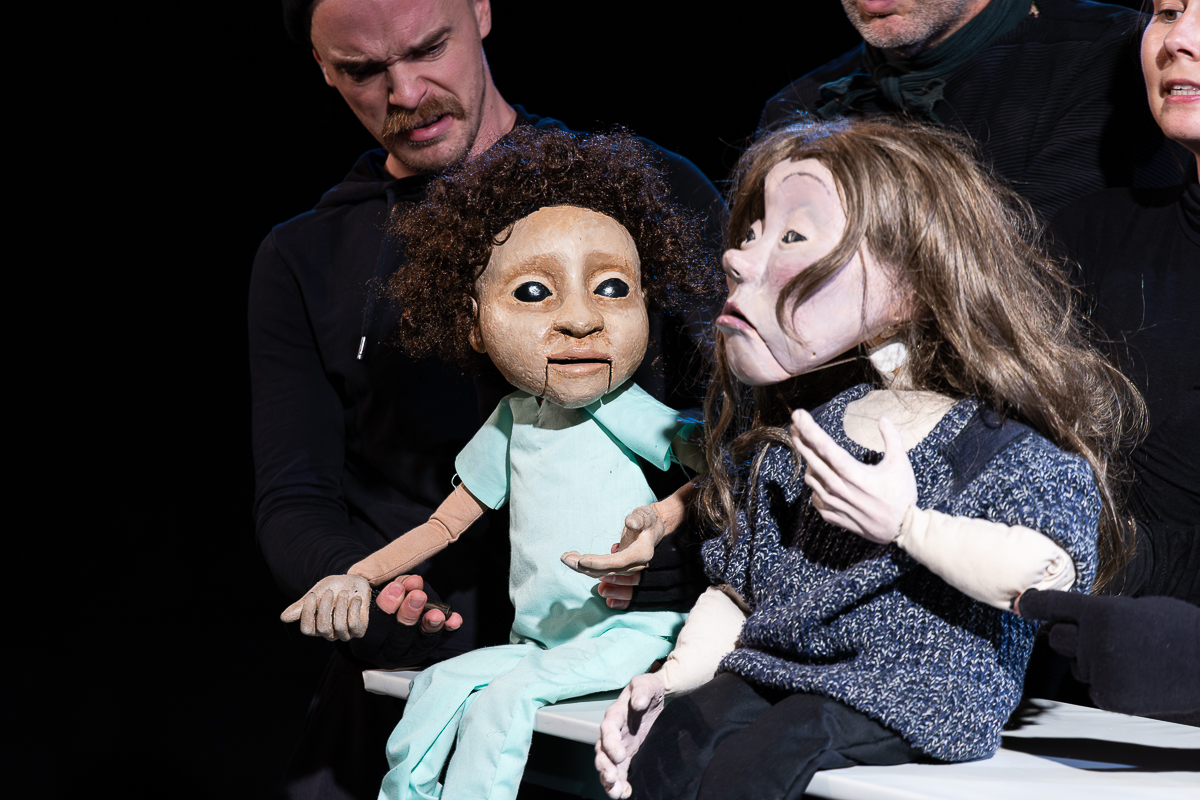
Blind Summit’s The Sex Lives of Puppets attracts an audience with its bawdy title, and, oh boy, does it deliver. The 100-minute production—there’s an intermission—is a vignette show. In each segment one or two puppets answer a sexually probing question asked by an invisible, unidentified interviewer.
As with any vignette show, one invariably compares the pieces. In the battle of averages, Blind Summit comes out hot, with many more hits than misses. The lovable puppets, Bunraku-style but without moving legs, are operated tabletop by two talented puppeteers, one controlling the head and silly voice, and the other on arm duty.
The interviews start with shock. A bumbling financier, after a lot of bashfulness, admits, “She likes to jerk me off.” An old Scottish granny asks, “Does he think I like it, him pounding away? Pounding away?” As their monologues continue, almost without fail, a bit of vulnerability shines. Loneliness is a popular topic, and the goofy discussions have a satisfying depth.
The puppeteers strive for believability in their vocal patterns, and in that area, unfortunately, they make the worst mistakes. Some of the dialogue sounds improvised and echoes the worst patterns of regular speech: repetitions, ums, etc. The puppeteers could benefit from cutting those bad habits.
One of the show’s best moments was a surprising break from the Bunraku-style. In the segment “Puppet Porn,” with steamy music in the background, we’re treated to all manner of sexually explicit shadow puppets. It was hilarious, perfect, though a bit much for some theatergoers. “Puppetry Porn” was the last segment before intermission. The family next to me left and never returned for the second act.
The performers could cut the mumbling, but for the most part, Blind Summit’s show is a fun, dirty good time. The Sex Lives of Puppets was performed on the Biograph Theater’s mainstage. See the trailer for this show at the end of our article. (Adam Kaz)
Does a Dog Have Buddha Nature? (Chicago)
The desire to rise above our mortal coil has informed art, religion and philosophy as long as humans have walked upright. Blair Thomas, artistic director and founder of the Chicago Puppet Fest, offers a Buddhist response to that preoccupation in two very different pieces, staged on the Chopin Theatre mainstage. His curtain raiser Passing Through the Bardo, set to Brian Dewan’s ballad Cowboy Outlaw, concerns a corpse that became a carnival attraction. His main work, Does a Dog Have Buddha Nature? takes the quotidian world of a dog and his owner to poetic heights.
The “bardo,” for those (like me) not well versed in Tibetan Buddhism, refers to the gap between death and rebirth. Accompanied by Dewan’s song and draped in a death cloak, Thomas enters as real-life outlaw Elmer McCurdy; extracts a crossbar to become his own puppeteer; and plays McCurdy’s freak mummified body that captivated the public for decades. Thomas uses this most American story to consider the Buddhist version of limbo.
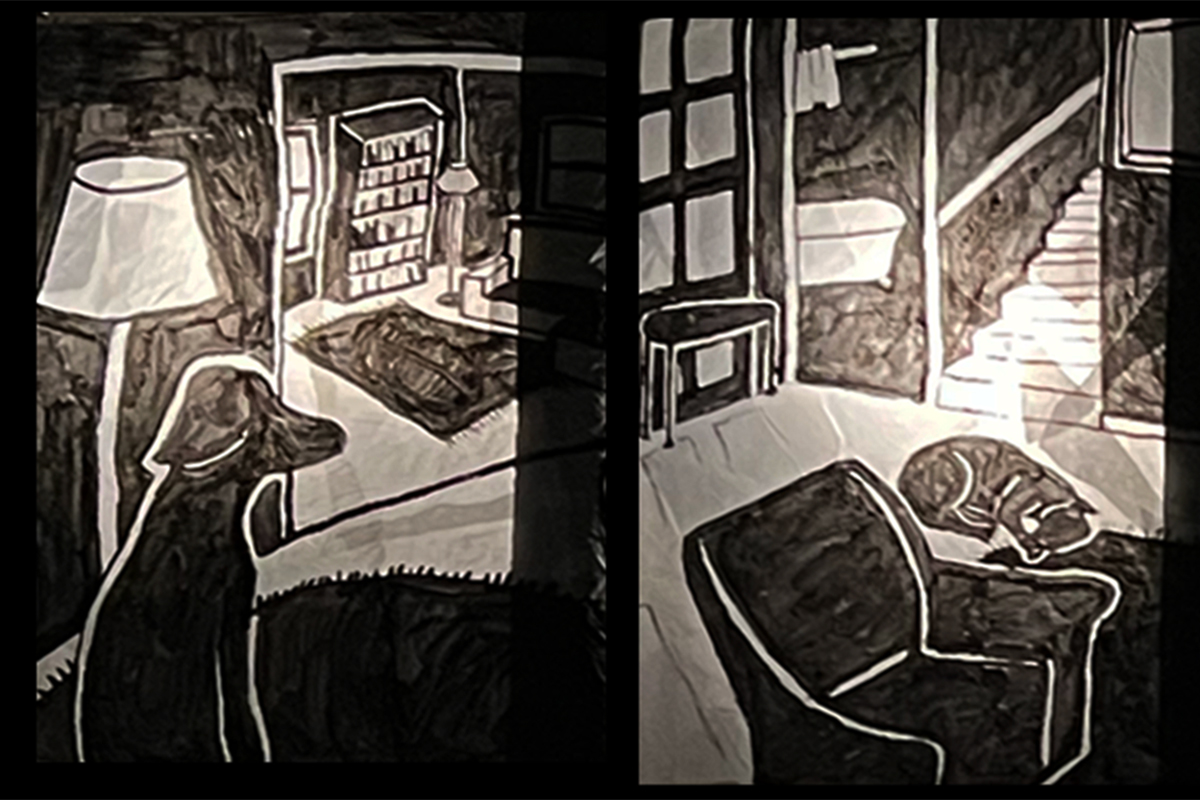
Does a Dog Have Buddha Nature? also brings Eastern spirituality into a standard American setting. Using cutout images on a translucent background, Thomas literally unrolls the narrative on four separate but visually connected panels. Seated in front of the panels is the Nois Quartet, featuring four saxophonists —soprano (Julian Velasco), alto (Natalia Warthen), tenor (Jordan Lulloff) and baritone (Janos Csontos) —playing music by Travis LaPlante. Thomas takes a dog through aggression, shame, affection, rest, joy and all else in a wondrous glide as he explores whether this domesticated creature can reach an enlightened “Buddha nature.” (Susan Lieberman)
The Enormous Crocodile: The Musical (England)
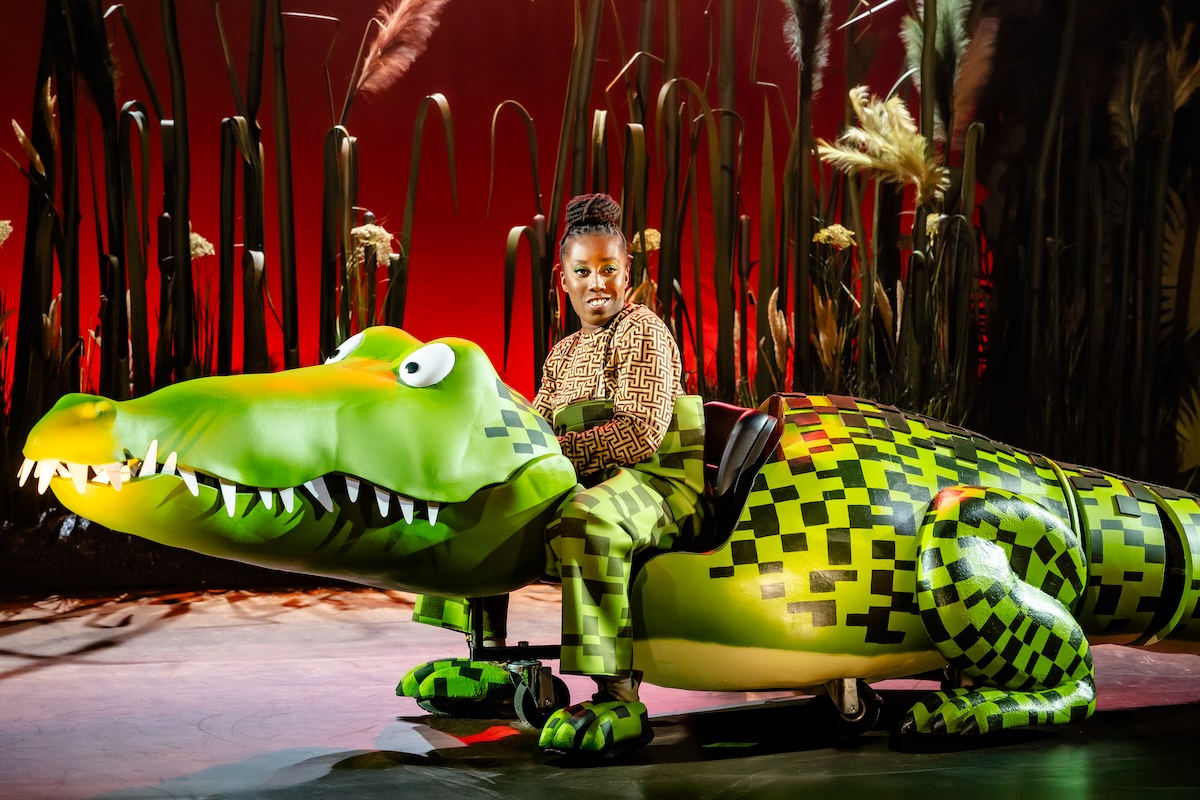
The Enormous Crocodile by the Roald Dahl Story Company is adapted from Dahl’s 1978 book about a greedy crocodile that wants to eat children. This gigantic creature is rumbling through the jungle, looking for its prey. But it really doesn’t seem like an evil monster as it’s played with whimsy by Chelsea Da Silva, so no fears about kids in the audience being terrified. (The play continues after the festival ends so you have three more weeks to see this delightful show.)
The other animals in the jungle keep the Croc from gobbling its dinner and they sing and dance their way through 18 songs in this 60-minute show. The other featured puppets are Precious Abimbola as Trunky the Elephant, Jordan Eskeisa as Humpy Rumpy the Hippopotamus, Marienella Phillips as Muggle Wump the Monkey, Ciara Hudson as Roly Poly Bird, and René Francalanza as Swing. Three more puppeteers play the children, wearing their kid costumes like bibs and kneeling to mimic kiddie height.
The puppetry style is a cross between regular performance and puppetry. The puppeteers are also singers and dancers; their costumes are partly animal and partly clothing that blends in to the animal’s look. (Puppeteers who manipulate large puppets are typically dressed in black and blend into the background.)
The Enormous Crocodile musical was developed by Roald Dahl Story Company, Emily Lim (director), Ahmed Abdullahi Gallab (composer), Suhayla El-Bushra (book and lyrics), and Tom Brady (additional music and lyrics and music supervisor). Toby Olié is co-director and puppetry designer with Daisy Beattie.as puppetry co-designer. Fly Davis is set and costume designer. Vicki Igbokwe-Ozoagu is choreographer.
This all-ages production is making its US premiere as part of the Chicago International Puppet Theater Festival and continues through February 21 at the Studebaker Theatre in the Fine Arts Building, 410 S. Michigan Ave. Tickets for The Enormous Crocodile for February 2-21 and more information available here. (Nancy S Bishop)
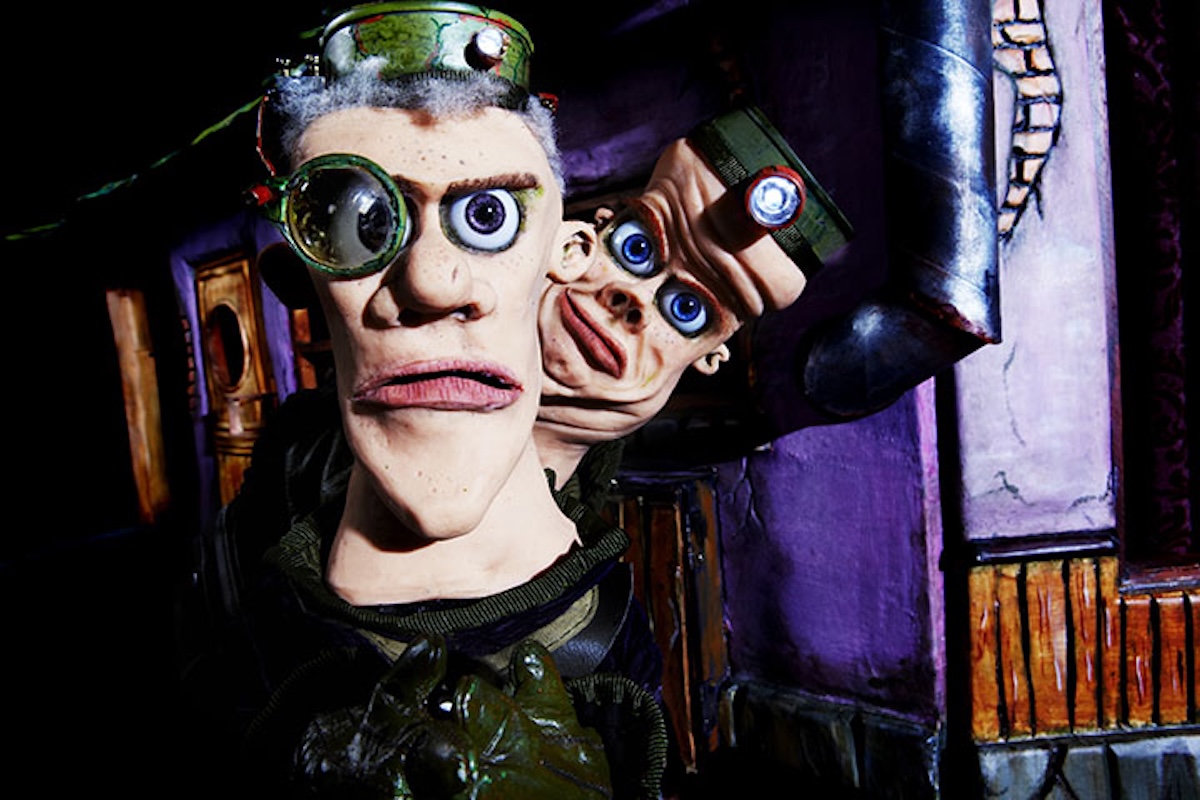
The House (Denmark)
The Sofie Krog Theatre from Denmark brings a unique Nordic vibe. Sofie Krog and David Faraco are the creators, puppeteers, and producers of The House, Something is always brewing beneath the surface in the Nordic tales I have read. The House recalls Hans Christian Andersen stories for me. There are flights of fancy, but also gore and a different relationship with death.
Something is not quite right at the Warehouse Family Funeral Home. Flora, the housekeeper, is pulling gold teeth out of the corpse’s mouth. She has a treasure chest full of ghoulish goods. Henry, Flora’s husband, is forced into service as an axe-wielding accomplice to change the will of the funeral home owner, Mrs. Esperanza. The Lawyer makes two visits for these adjustments to Mrs. Esperanza’s will, as she lays dying upstairs in a curtained bedchamber.
Enter two bumbling goons, Tony and Bruno, there to snag the stash of gold teeth and whatever else they can find. The intuitive Dog gets the biggest laughs (except when Bruno moons the audience).
The puppets are highly stylized and remind me of the great John Kricfalusi’s Ren and Stimpy. They transcend the cartoon aspect through the dark realism of the subject matter. The action is farcical, and the pacing is brilliant. When Dog does a double-take or breaks the fourth wall, it is as if it is human. The house was packed at Steppenwolf’s Merle Reskin Space, and The House, a 55-minute performance, was mayhem at its best. (Kathy D. Hey)
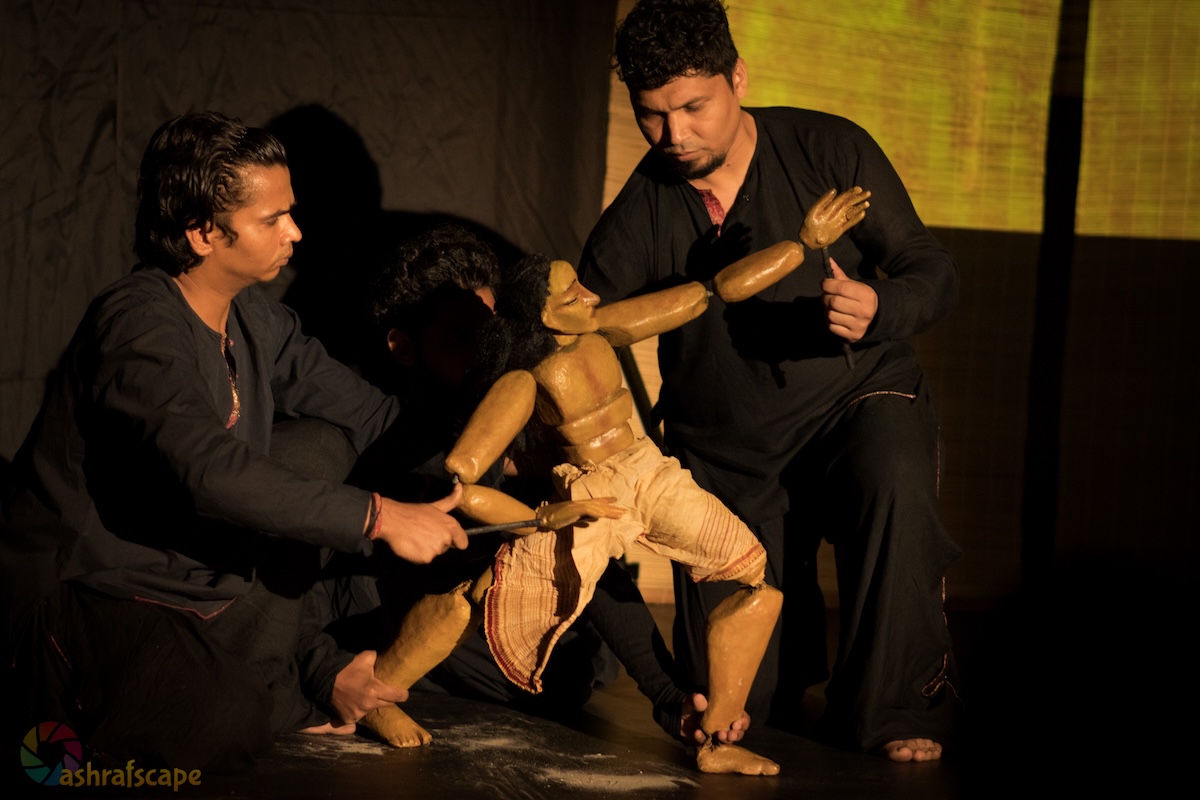
About Ram (India)
Traveling from New Dehli, Katkatha Puppet Arts Trust brings About Ram. This hour-long wordless production, sustained throughout in mystical energy courtesy of hypnotic music, tells the story of Prince Ram from the Bhavbhuti Ramayana. Using Bunraku-style puppets, shadow puppets, masks, and projected animations, we watch Prince Ram search and fight for his abducted beloved Sita. People who know the story will experience the show as a gorgeous reminder of its main points; everyone else, however, who isn’t familiar with the Bhaybhuti Ramayana, will be totally baffled.
About Ram relies on four puppeteers but three pull the most weight operating a Bunraku Ram. He’s about waist-high and begins onstage sleeping, his breath, I think purposefully, the first movement animated by the puppeteers. Then he wakes, he runs, he swims, he encounters a female puppet. All believably and thrillingly performed by the puppeteers who, though onstage, melt behind Prince Ram.
About Ram is a series of wonderful sequences and tableaus. Ram makes a pile of sand, and later the sand functions as a trail upon which he runs and walks. When Ram battles Ravan, a ten-headed demon king, one of the puppeteers becomes Ram and showcases some impressive swordsmanship.
All of this is beautiful and commendable, but how these images relate to one another, or how one scene travels to the next, is not readily apparent. Sometimes the puppets contributed to the confusion. When portraying Ravan, for instance, the puppeteers use both masks and a shadow puppet. But the mask and puppet, meant to portray the same character, were too dissimilar, so one could be forgiven for losing the thread.
Unless you know the story, the best way to enjoy the show is to abandon any hope of following the plot. Just enjoy the wonderful production. There’s plenty to admire. About Ram was performed at the Dance Center of Columbia College. (Adam Kaz)
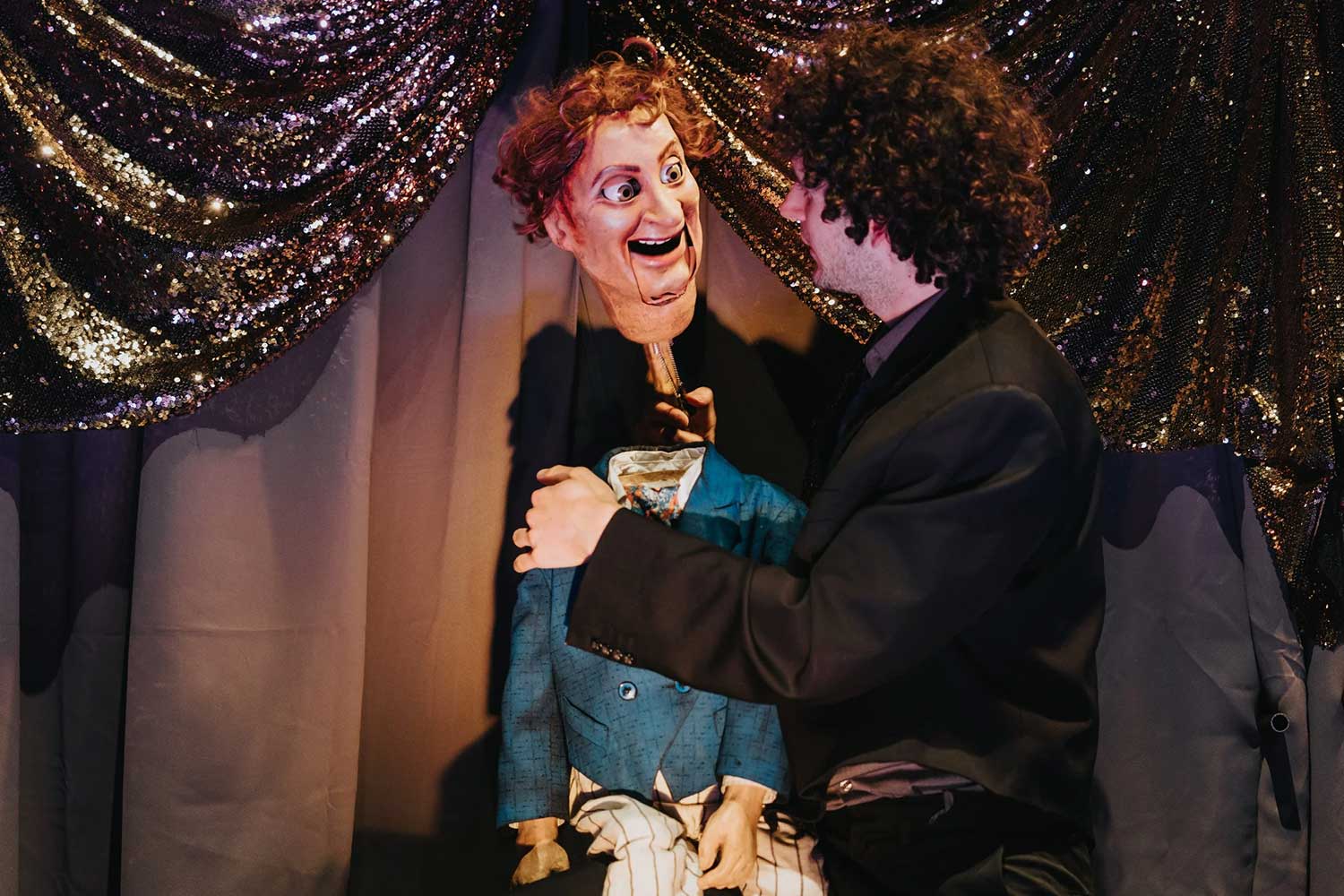
Trust Me for a While (France)
Plexus Polaire is the story of a ventriloquist, a mannequin, and trust. Plexus Polaire is from France, where puppetry more often makes political statements and makes a buffoon of anyone. Pedro Hermelin Vélez is the befuddled ventriloquist who speaks for Teddy, a bright-eyed puppet with red hair and a cravat. Trust Me for a While was presented at the Reva and David Logan Center.
A mischievous cat peeks out while the audience is being seated and then becomes a part of the story, but not in the way I expected. The same thoughts merge between puppeteer and Teddy, with a strange turn of events that gave me goosebumps, but made me laugh too. As an American, I grew up with a different sensibility about what a puppet does and a clear idea of good versus bad. It would be bad form to laugh at a violent stabbing except when the victim is a mouthy puppet. Or is it the ventriloquist?
Trust Me for a While, a 45-minute performance, is brilliantly staged, with a set that distracts and fascinates the viewer. Something about the blend of colors and the bright gold valance pulled me into the scenery. This is puppetry at its most skilled. The story can be perceived as a political or moral tale, depending on the viewer. Yngvild Aspeli directed, with Melody Shanye Mahe and Laëtitia Labre handling the puppets offstage. There is beauty in the simplicity and the macabre. The audience was transfixed by the scary and the comic. (Kathy D. Hey)
Enjoy the trailer for The Sex Lives of Puppets.
Support arts and culture journalism today. Our work can’t happen without your support. Contribute today and ensure we can continue to share the latest reviews, essays, and previews of the most anticipated arts and culture events across the city.
