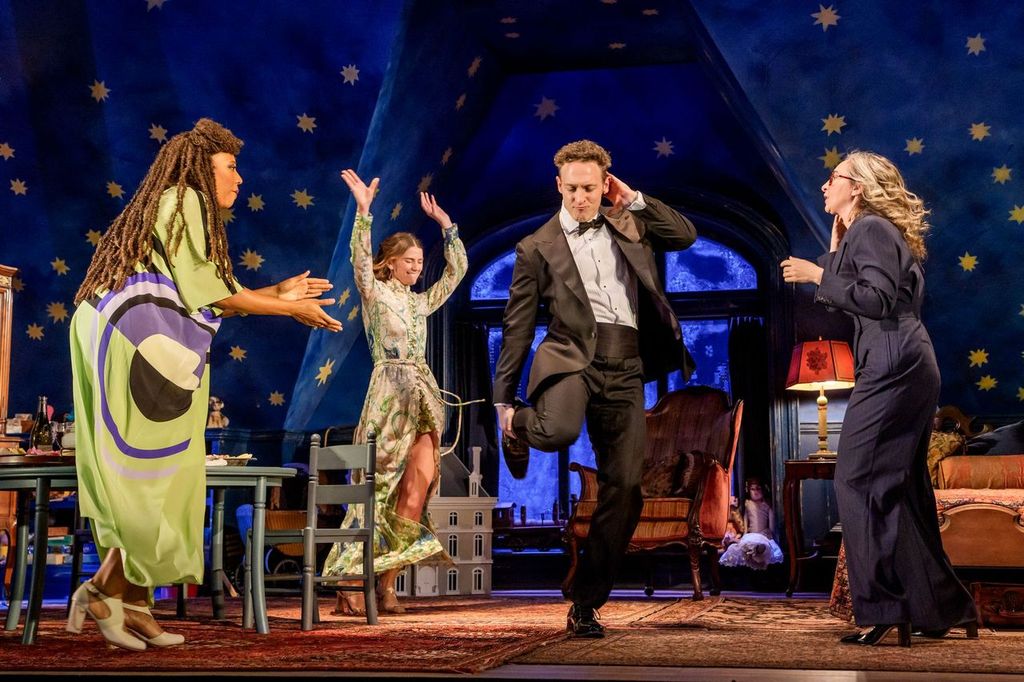
There is so much good about the Goodman Theatre’s current production of Holiday that I wish it were better.

It’s an understatement to say that the play arrives with some history attached. A favorite of mid-century audiences, the Goodman itself has produced Philip Barry's 1928 play Holiday four times since 1930. Add to that the two Hollywood adaptations—the stiff but faithful 1930 film when sound pictures were still finding their footing and George Cukor’s 1938 classic with Katharine Hepburn and Cary Grant—and Holiday comes with a built-in mythology that this revival never quite earns.
It also arrives carrying the additional weight of a genuine loss. Richard Greenberg, who died last year, was one of the most distinctive and critically admired American playwrights of the last several decades. Take Me Out (Pulitzer Prize winner) and The Violet Hour alone would secure his place in the canon. His adaptation of Holiday—completed before his death—now feels like a final reminder of what we've lost: a writer with a scalpel for a mind and a musician's ear for dialogue.
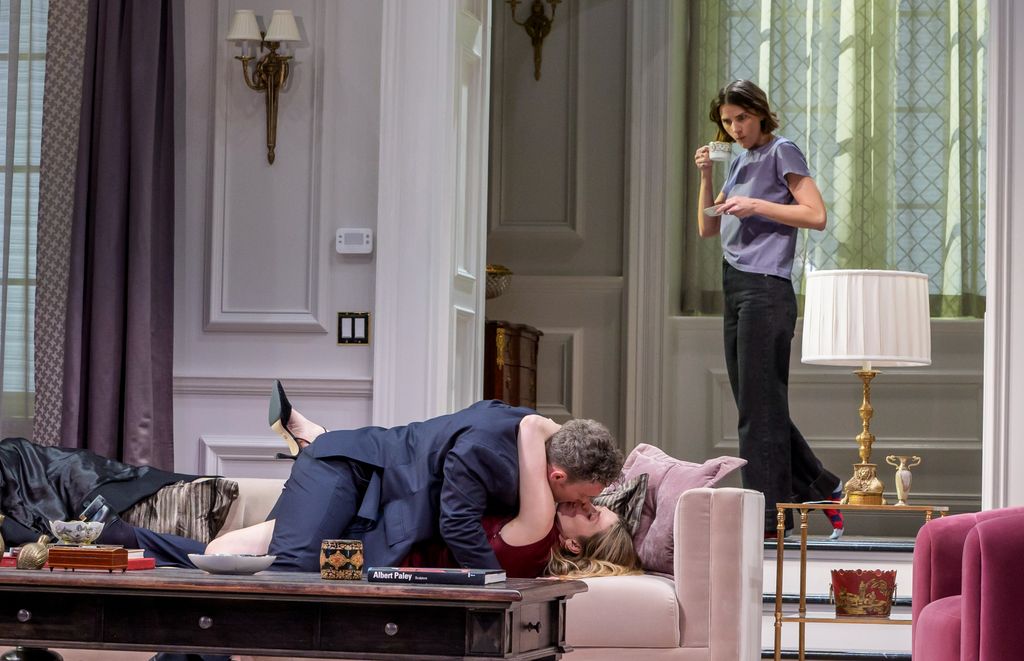
Greenberg didn't merely update the setting by adding contemporary touches like texting and Ubers; he modernized the play itself, refreshing what is by now Barry’s dated dialogue and adding shocking concepts like women with their own careers—giving the characters a contemporary crispness without losing the play’s 1920s architecture. His version is smart, incisive, and rhythmically alive. It’s the best thing about the show.
This production also marks Robert Falls’s return to the Goodman after retiring as its artistic director. Over his long career, Falls has delivered some of the most vital, muscular work on this stage, which makes the dead air of this staging baffling. Comedy—especially Barry’s brand of brittle, high‑society comedy—needs a tight ship. Precision in pacing and a real connection among the ensemble are essential. Here, the ship wobbles.
The one performer who seems to understand the assignment is Wesley Taylor as Ned Seton, who gives the kind of turn that focuses the entire play around him. By the middle of the evening, Taylor was receiving entrance laughter and exit applause—and earning every bit of it. His Ned is brittle, self‑aware, and wickedly funny, but never a cartoon. He’s the only figure onstage who seems fully conscious of the absurdity of the Seton family’s wealth and the emotional rot beneath it. When he’s onstage, the play crackles. When he’s gone, it's like someone's pulled the plug.
Visually, the production is anchored by Walt Spangler’s gorgeous set design, a sweeping, opulent interior that captures both the grandeur and the suffocating rigidity of the Seton household. Spangler, a Goodman veteran, fills the Albert stage with elegance and architectural intelligence. The set in the first and third acts is beautiful but airless—a perfect metaphor for the family’s emotional landscape; the second act “playroom” gorgeously warm and inviting in contrast. It received its own round of applause when revealed.
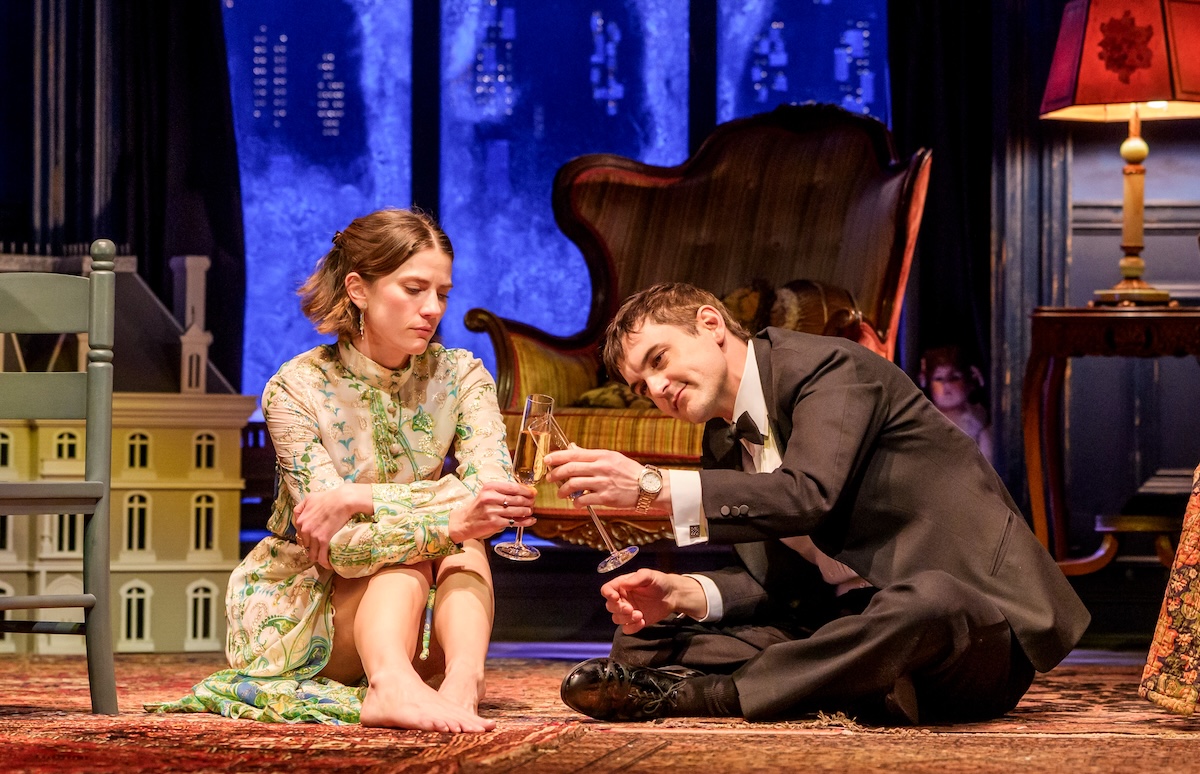
Where the production falters is in the acting, which too often doesn’t reach the level of Greenberg’s dialogue and thought. Performers plant themselves mid‑stage, stare into the middle distance, and deliver lines with the rhythmic solemnity of an incantation or a particularly affecting children’s rhyme. Instead of connecting with each other, they play outward, as if the audience were the only scene partner that mattered. It’s presentational in the most literal sense: behavior performed at us rather than lived between them.
This is especially surprising in the case of Jordan Lage, an actor with a long and distinguished history interpreting Mamet—work that demands spontaneity, muscularity, and a kind of lived‑in realism. Here, though, Lage’s performance feels oddly formal, as if he’s been directed to impersonate a cigar store Indian with a sarcastic streak. His Seton patriarch has presence, but not much pulse.
The production does, however, succeed in highlighting one of Holiday’s most enduring, but often overlooked tensions: the archetype of the “poor little rich girl,” embodied by Linda Seton, played by Bryce Gangel. Linda’s dissatisfaction—her yearning for freedom, authenticity, and escape from the Seton machine—has long been read as noble. Here, it reads as what it is: privilege so deep it becomes invisible to the person who holds it. Linda is devastated because she can’t throw the kind of party she wants for her sister’s engagement—a celebration that, in her mind, is somehow about her. Her rebellion is real, but it’s also self‑centered, and the production wisely refuses to sentimentalize it.
In the end, the Goodman’s Holiday is handsome, intelligent, and intermittently stirring. Greenberg’s adaptation is superb, Spangler’s set is gorgeous, and Wesley Taylor delivers the performance the production desperately needs more of. But the acting elsewhere never quite meets the writing, and Falls’s direction doesn’t correct the imbalance. The ingredients are here for a great revival; the execution leaves us imagining the version that might have been.
Holiday has been extended through March 8 at the Goodman Theatre (170 N. Dearborn). Tickets are available at www.GoodmanTheatre.org. The three-act show runs 2.25 hours with a 15-minute intermission between the first and second acts.
For more information on this and other productions, see theatreinchicago.com.
If you found this post interesting, please consider supporting Third Coast Review’s arts and culture coverage by making a donation. Choose the amount that works best for you, and know how much we appreciate your support!
