

You may appreciate the play Hamnet because you loved Maggie O’Farrell’s 2020 novel or the 2025 film directed by Chloé Zhao. In either case, your view of the Hamnet story will be refreshed when you see the Royal Shakespeare Company version now on stage at Chicago Shakespeare Theater. (If you see Hamnet without either experience, please leave a comment below and let me know what you thought about it.) Erica Whyman directs this stunning and evocative production, adapted for the stage by Lolita Chakrabarti.
RSC's production transferred from their Swan Theatre in Stratford-upon-Avon to London's West End and was a great success. The Chicago Shakes production is the first on RSC's US tour with a few stops to follow.
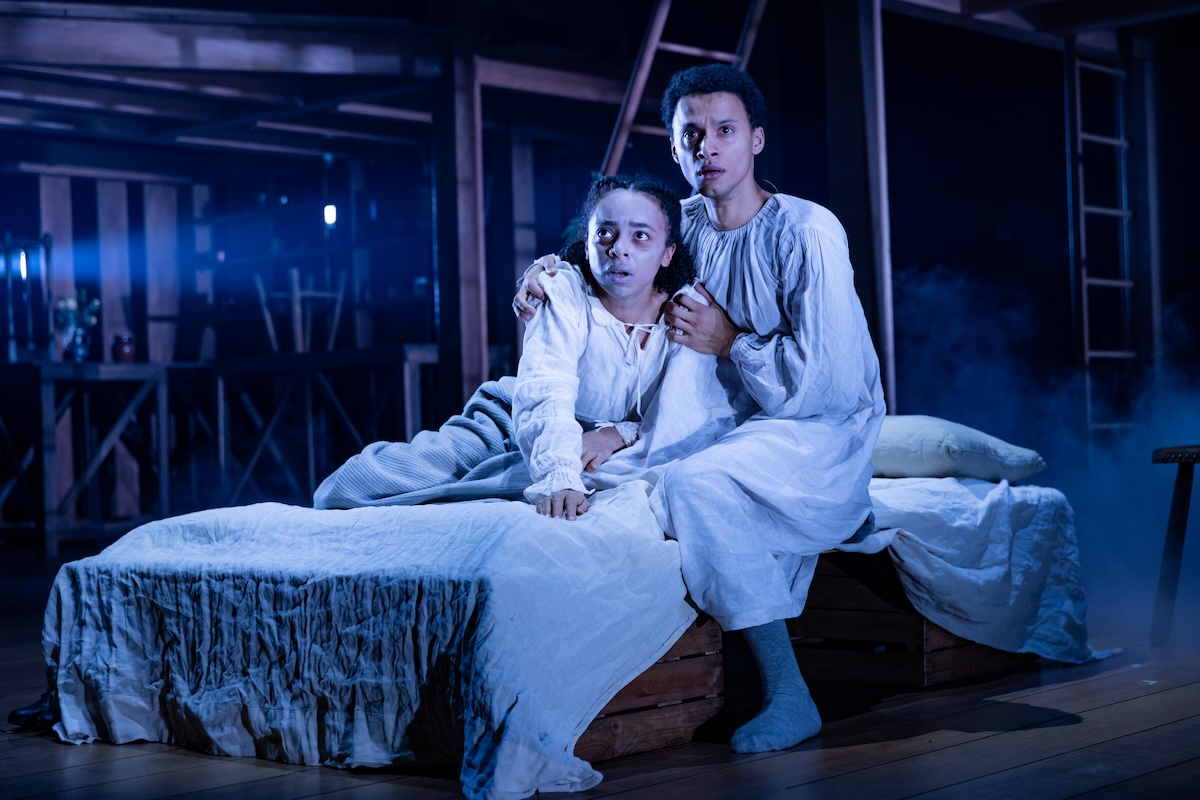
Sterling performances by the two leads—Rory Alexander as William and the rivetingly emotional performance by Kemi-Bo Jacobs as Agnes—carry the play home to its teary conclusion as we see a first performance of Shakespeare’s new play, Hamlet. Director Whyman comments in an interview in Third Coast Review that although women are marginalized in much of Shakespeare’s work, “Hamnet restores her story to center stage, and in doing so you see his plays and characters through the lens of a rich, loving, tragic and resilient family life.” Agnes’ brother Bartholemew (Troy Alexander) is also a strong and sympathetic character.

The Hamnet story begins with Agnes and William meeting, falling in love, marrying and having children while William is trying to start his career as a playwright and actor in London, where he knows he must work to succeed. He races home to see his family occasionally but because of his absence, misses the sickness and death of one of his children when the plague strikes the family. He heads home when he receives a note saying daughter Judith (Saffron Dey) is seriously ill and may not live but when he arrives he finds that her twin brother Hamnet (Ajani Cabey) has died. The scenes of parental grief are wrenching.
Agnes is unhappy with William’s absences but he finally convinces her to come to London and bring the family to live there with him. Her first trip to London results in the extraordinary scene where she sees an actor who looks like her son perform Hamlet’s “What a piece of work is man” soliloquy. (Ajani Cabey plays both the boy Hamnet and the actor.)
Director Whyman creates some beautiful pieces of choreography and staging, such as the way Agnes’ pregnant form is created by two actors circling and wrapping her in fabric to create a “bump.” Her childbirth scenes—first of older daughter Susanna (Ava Hinds-Jones) and then of the twins Judith and Hamnet—are also handled well. As Agnes is going through the pains of childbirth with the twins, Hamnet and then Judith bring her infants wrapped in swaddling clothes.
The scenes with William’s theater troupe in London are brief but charming (especially for a theater fan). We see scenes where the troupe that will become known as the Kingsmen rehearses a play and other scenes where they are sword-fighting. As they read the new pages for Romeo and Juliet, actor Richard Burbage (Bert Seymour) asks, “Why must I always die? …. Romeo is poisoned. I perish in almost every play.” Will Kempe (Nigel Barrett) replies, “That’s a hidden message from the author.” Henry Condell (Karl Haynes) snickers.
In another scene, they rehearse the play we know as The Comedy of Errors; Kempe improvises a line. William tells him it ruins the meter and then says, “D’you know how long I spend selectin’ every word? Can you fathom how much thought and effort go into every single syllable? You must not play lightly with what I offer, and I’ll not underestimate your worth.”
Lolita Chakrabarti’s script follows the story line from the film fairly closely. But there’s a purity to the story here (as my plus-one commented at intermission), that may be mostly because of the simplicity of the modernist wood-structured set (set and costume design by Tom Piper) and the smaller cast. The Globe Theatre scene, for instance, gains drama as Agnes alone watches the actor; she’s not part of a crowd scene. That impression carries throughout the play as actors perform as if in an Ivo van Hove production. Erecting that multilevel set and its many movable parts surely cost a few pounds/euros/dollars, and RSC proves that elegant, luxurious staging is not a requirement for great theater.
Original music is by Oğuz Kaplangi with sound design by Simon Baker and lighting by Prema Mehta. Movement director is Ayse Tashkiran.
I wanted to understand how long Shakespeare’s “commute’ was from London to Stratford-on-Avon. We know in the film that he rode horseback but he may also have walked, as some scholars think. The distance is about 100 miles, so it’s less than two hours’ drive today but Shakespeare’s trip on horseback would have been two or three days. Walking would have taken six days. When he received that note about Judith’s illness, he would have had two or three angst-ridden days to reach home.
Hamnet continues in the Yard at Chicago Shakespeare Theatre on Navy Pier through March 8. Performances Tuesday-Sunday. Running time is 2.5 hours with one intermission. I admit I am sometimes impatient at plays that run more than two hours, but I was enthralled throughout every moment of Hamnet’s 2.5 hours. Here’s a link to tickets and more information.
For more information on this and other productions, see theatreinchicago.com.
Support arts and culture journalism today. This work doesn't happen without your support. Contribute today and ensure we can continue to share the latest reviews, essays, and previews of the most anticipated arts and culture events across the city.
