
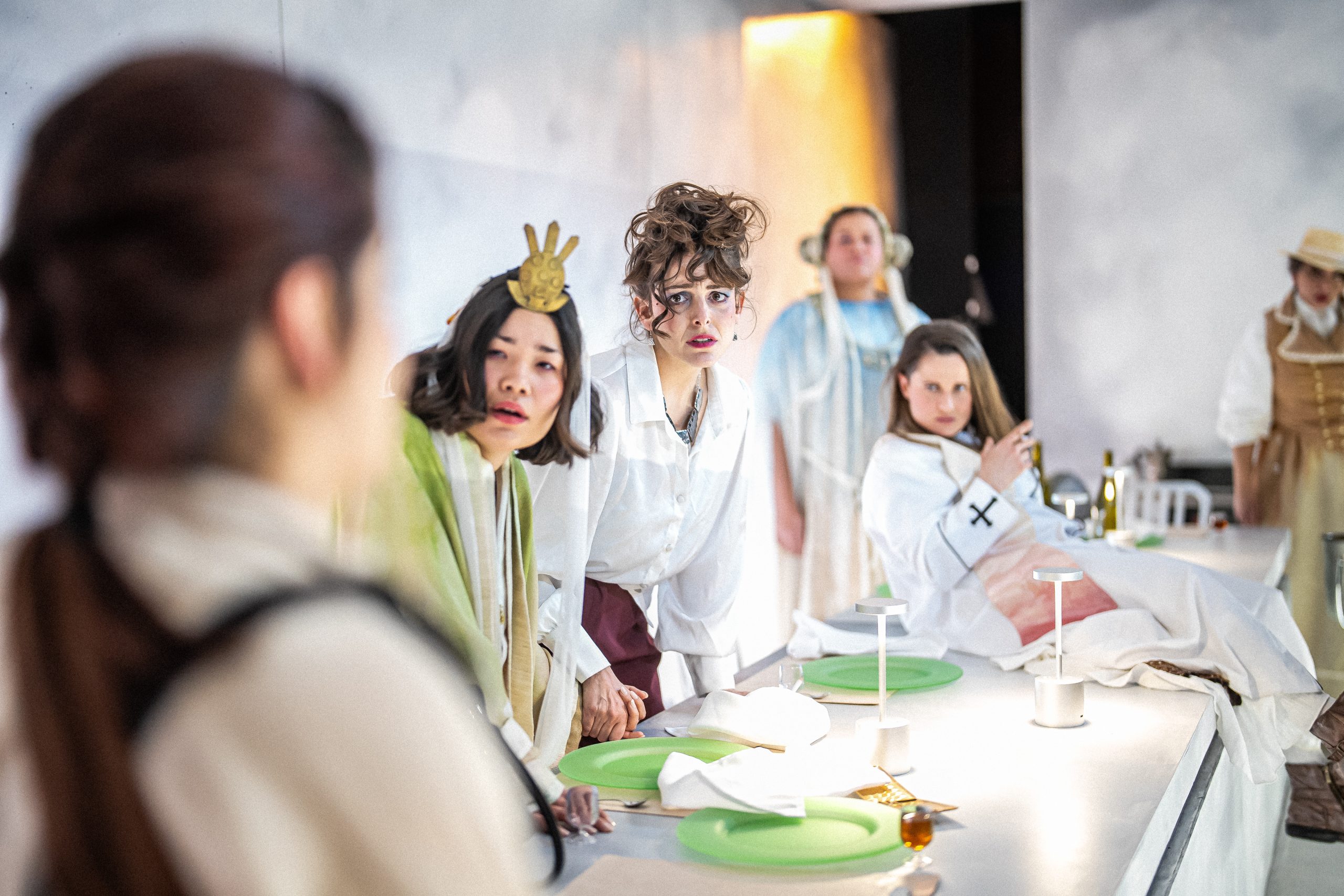
It’s a Saturday night at an upscale restaurant. Marlene (Claire Kaplan) has arrived and it’s clear she is here to celebrate. She has many guests attending, and she wants the wine to just keep flowing..
As the women start to arrive, it’s clear that this scene does not take place today. Isabella Bird (Susaan Jamshidi) walks in, followed soon by Dull Gret (Yourtana Sulaiman), Pope Joan (Morgan Lavenstein), Lady Nijo (Hannah Kato), and Patient Griselda (Luke Halpern). The waitress (Collin Quinn Rice) presides over the event—no lines, but clearly with some opinions on what is unfolding. Famous women from across history are all here to celebrate Marlene’s recent promotion. The evening begins with nothing but excitement as the women get to know each other. However, as the wine continues to flow and chaos ensues, the mood starts to shift. They may have been invited because of their achievements, but is everything really as it seems?
Playwright Caryl Churchill writes what many might consider an intimidating scene, set in the Thatcher era. These women are all from different eras, and as the chaos builds and they all start talking over each other, it can be hard to even grasp what is happening. However, if you really listen, you'll start to see that they have more in common than meets the eye. All of these women are remembered for their successes–the power they were able to grasp at a time when women were only seen through the achievements of their husbands (or other men). As the truth begins to trickle out, we also learn just how much each woman had to sacrifice, particularly in the realm of love and motherhood. As the darkness builds and stories of death and heartbreak take over, you'll wonder: Is it ever possible for a woman to have it all?
Caryl Churchill’s Top Girls follows Marlene, the newly promoted managing director of Top Girls Employment Agency. Rising to the top in this way, she thinks she has done the impossible. It’s clear in the opening scene that she sees herself as one amongst the many women in history who have done the very same—found a way to hold the power in a man’s field. However, as the play goes on, we begin to learn that not everything is as it seems. One often has to give up a lot to find their place of power. For Marlene, it might be that some of those sacrifices hurt others in her life in a far larger way than she had ever anticipated. Churchill invites us to consider: What would you do to meet your desires, and at what cost?
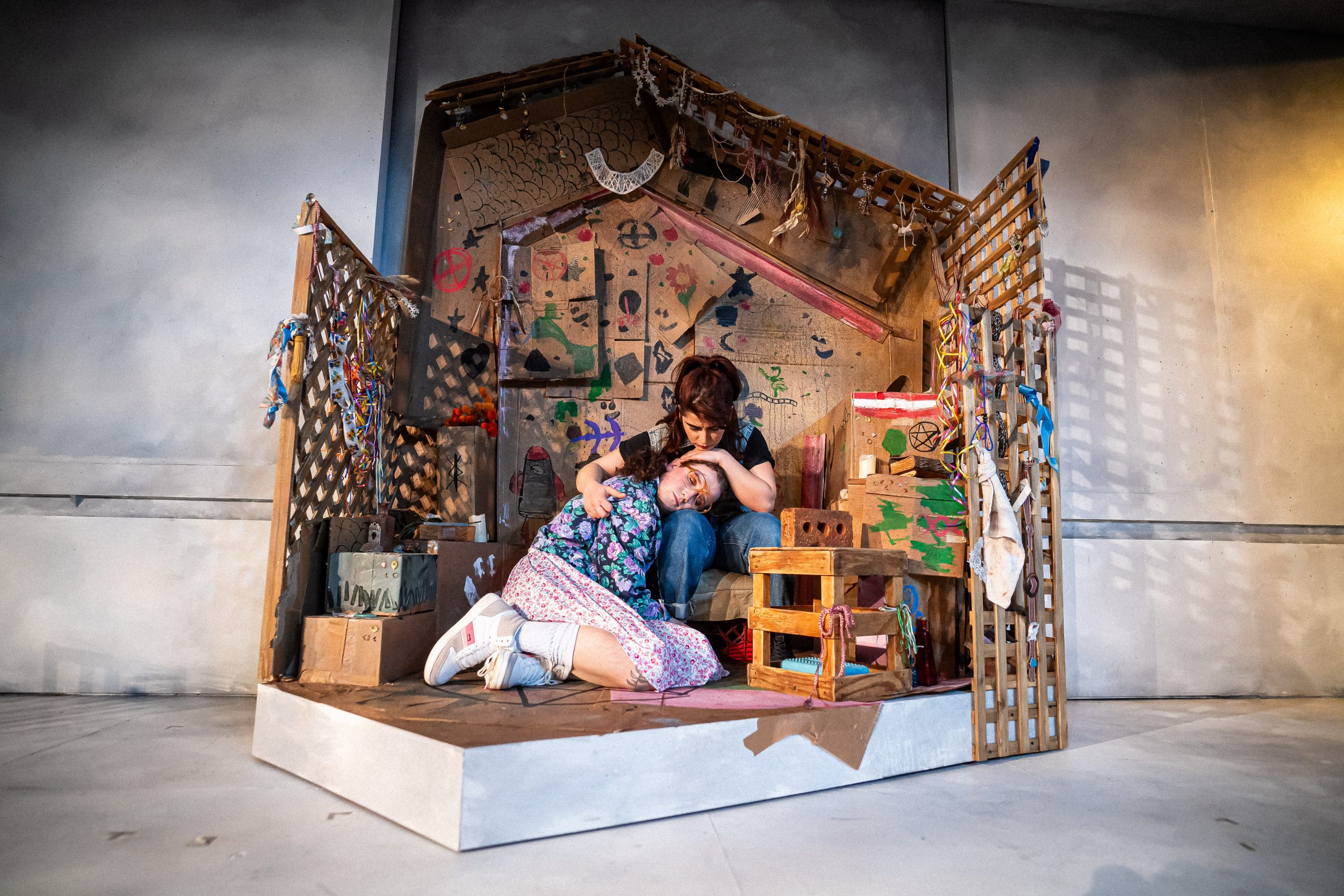
Cleverly directed by Lucky Stiff, the production is fast-paced. Lucky Stiff’s talented design team creatively transports the audience between locations—capturing both the slightly absurd feel of Act 1 and the grounded, more realistic vibe of Acts 2 and 3. As much as Top Girls can feel larger-than-life, part of what really makes this performance is the relationships at its core. Churchill creates the characters in such a way that makes it possible to understand where each is coming from, even if you do not always agree.
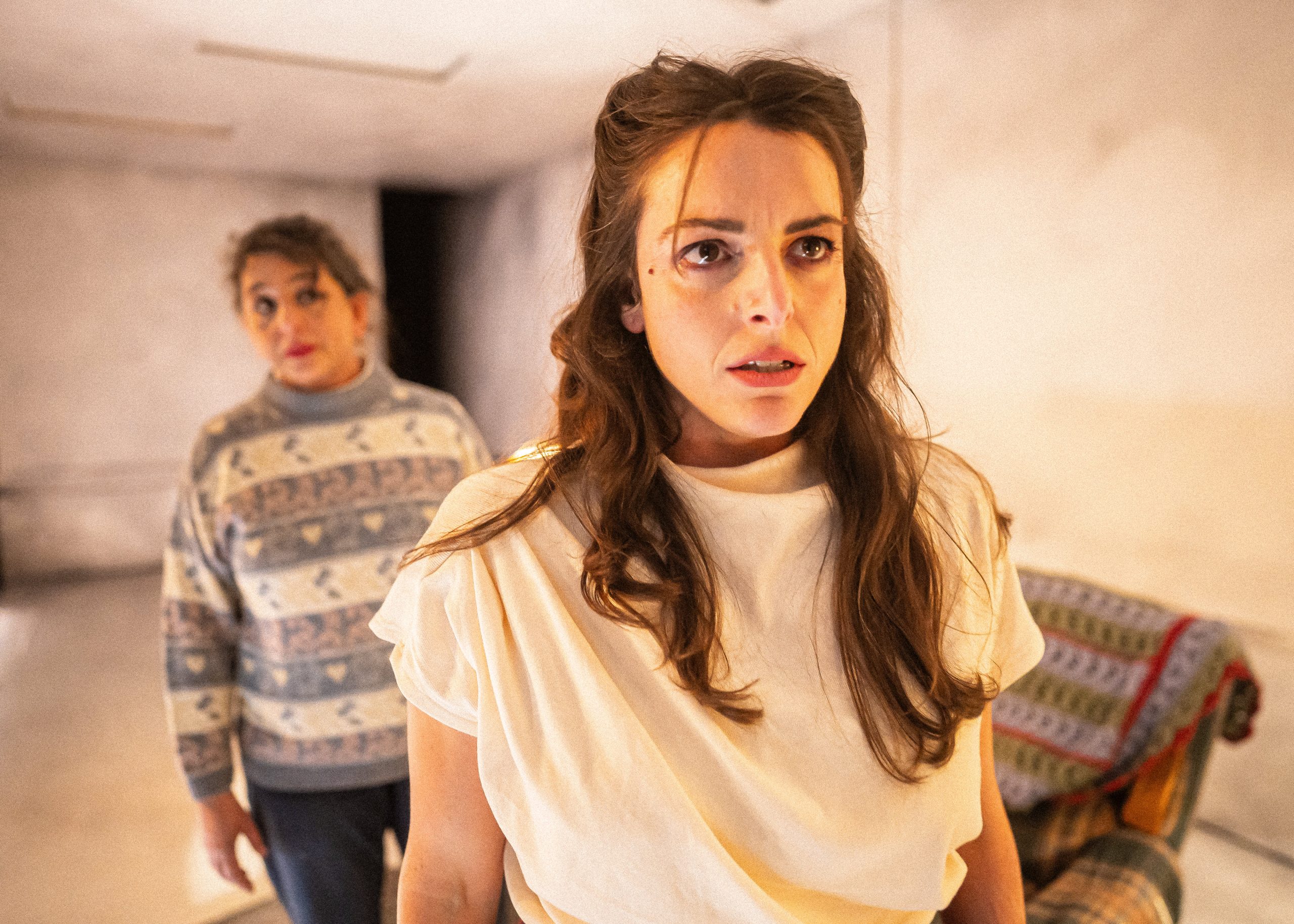
Act 3 takes place a year earlier in the home of Joyce (Susaan Jamshidi), Marlene’s sister. Marlene has come for a visit to see Joyce and her niece, Angie (Yourtana Sulaiman). Once Angie goes to bed and Marlene and Joyce are left alone in the living room, there is finally space for all of their grievances to bubble to the surface.
Costume designer Anna Wooden has helped highlight the distinction between these two women. While Marlene is dressed in her business attire, Joyce is more disheveled, wearing a sweater and jeans that seem appropriate for her very different lifestyle. As the two finally begin to catch up, it’s clear that Joyce holds quite a bit of resentment towards Marlene for leaving her family to achieve her high-powered business dreams. Lucky Stiff directs the scene beautifully—full of silence. Kaplan and Sulaiman bring a genuine approach to the strained relationship. Both have their reasons for the lives that they lead, and, particularly with these performances, it’s tough to a pick a side. Churchill invites her audiences to see the nuance around the larger concept of feminism. Every woman has a choice, and rarely is it an easy one to make.
Packed with intriguing questions and stellar performances, Top Girls is a must-see. The play may been written in the 1980s, but unfortunately, Caryl Churchill’s work remains just as relevant today.
Top Girls runs through March 22 at Raven Theatre, 6157 N. Clark St. For tickets and information, see the Raven Theatre website. Run time is 2 hours and 30 minutes with two intermissions.
For more information on this and other productions, see theatreinchicago.com.
Did you enjoy this post? Please consider supporting Third Coast Review’s arts and culture coverage by making a donation. Choose the amount that works best for you, and know how much we appreciate your support!
