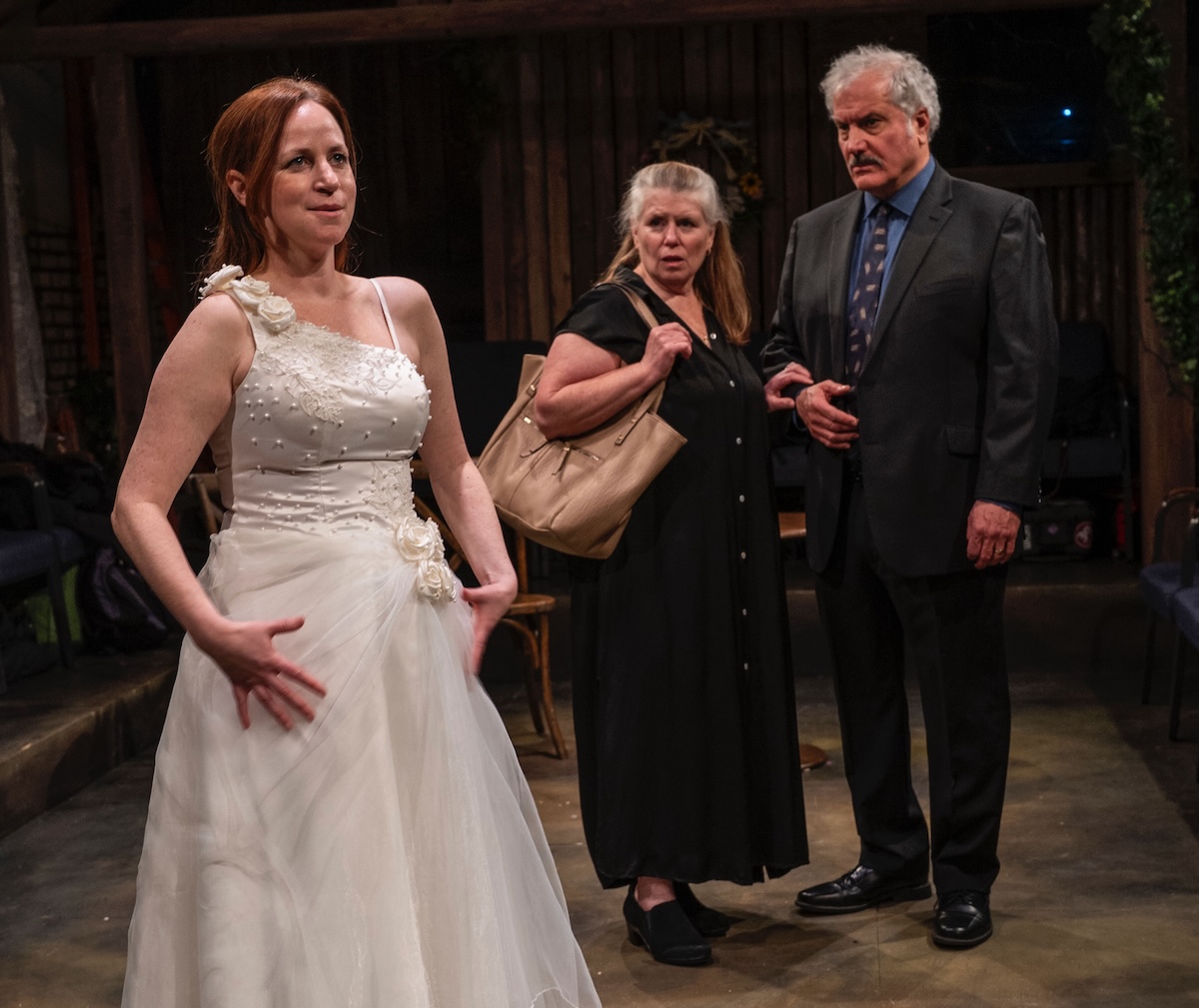

It’s a few days before the wedding of Kara and Levi and in the small town of Milton, Nebraska, that’s a big event. As the play opens, we meet Levi (David Stobbe) and his friend and best man Doug (Glenn Obrero). They’re talking about that event, as Levi prepares to work in a field. A piece of noisy farm equipment rumbles in the background
That’s how Alex Lubischer’s play Pivot begins; its world premiere is now being staged by Rivendell Theatre Ensemble, directed by Hallie Gordon. It’s a family story and a love story, a story full of tragedy…and laughter. It’s a human tragicomedy, of how people grieve and deal with loss.
Levi Acren is farming 40 acres of his father’s farm land. George Acren (Keith Kupferer) is semi-retired and living in town now; he’s being treated for cancer. (His cancer may have been caused by the use of the chemical herbicide Roundup made by Monsanto; George’s first wife died of cancer. We learn that there are many cases in town.) George’s second wife is Anne, played by Tara Mallen, Rivendell’s founding artistic director. Levi and Kara plan to live at the “home place,” and Kara (Ashley Neal) is planning their wedding reception in the barn. But events get in the way of the wedding plans and that is the crux of the Pivot plotline.
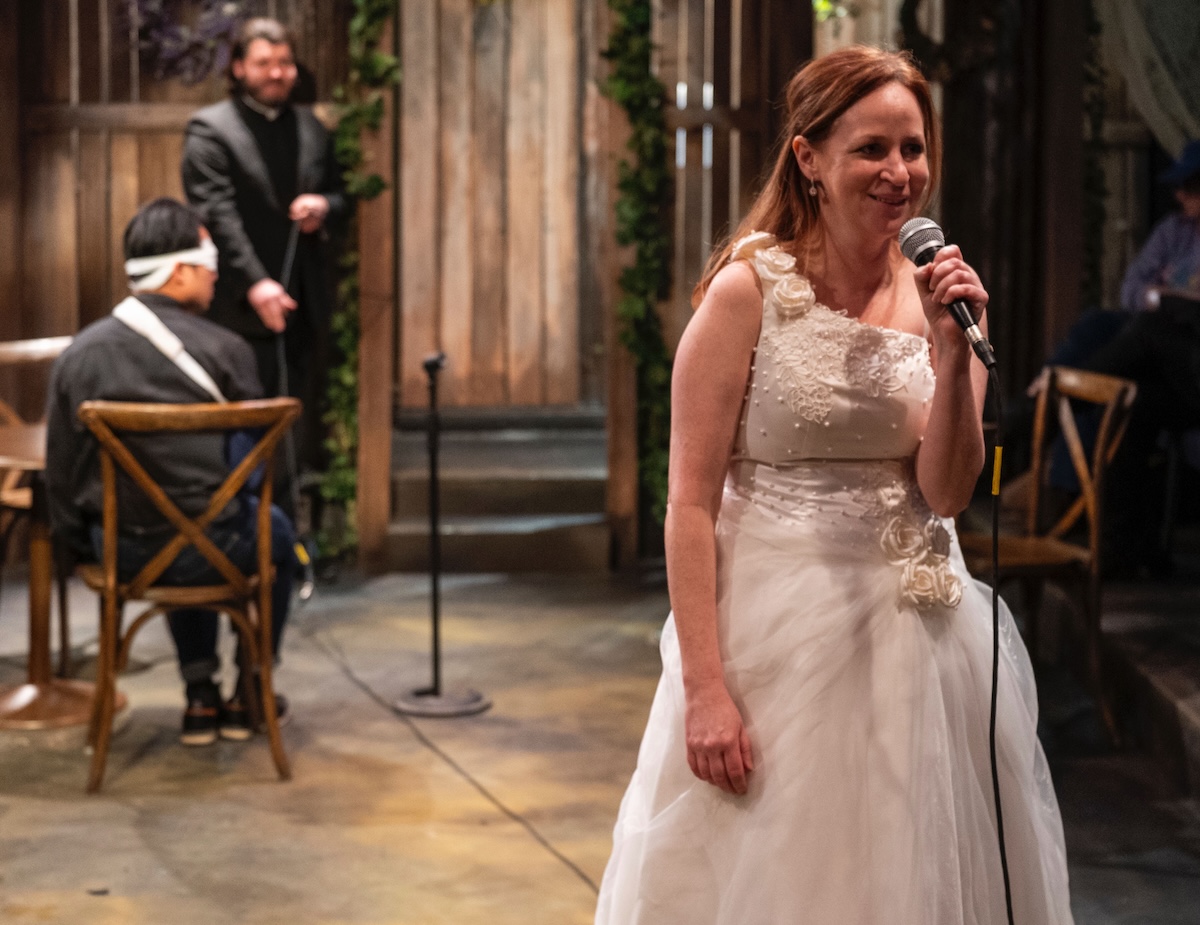
I can’t tell you any more of the story because the plot is full of spoilers. I think the play will have far more power if you see it as I did: Knowing nothing about it.
Kara’s role is the heart of the story and she’s on stage for most of the play.. Ashley Neal gives a strong, deeply rooted and emotional performance, even though we may disagree with some of her opinions and actions.
We detour here to explain that the noisy farm equipment is an irrigation pivot, a piece of equipment invented in the 1940s in Nebraska. It has a long sprinkler arm that circles around a field like the hands of a clock, irrigating the crops. From high above, pivots make circular patterns on the land. Today it’s one of the most widely used methods of irrigation in modern agriculture. Dramaturg Tanya Palmer provides a helpful description of these agricultural practices in one of Pivot’s digital programs.
Of course the word “pivot” can also describe the action a person might take when faced with a difficult decision or a need for change.
David Stobbe does triple duty in Pivot. He plays Levi and he’s also cast as the priest, Father Matt, and plays Ryan, a waiter at Applebee’s.

In the Applebee’s scene, George and Doug are having brunch and guy time. The conversation turns to reading and takes an incongruous turn that really shocked me. George talks about how he tries to read a chapter from the bible every day. He describes the story of Ruth. Somehow this leads Doug to tell him about the book he’s reading and has read before; it’s A Little Life and its story of friendship among four men. Ryan, the waiter, hears them talking and says “Oh My God, I LOVE A Little Life. Which character are you?” Both say simultaneously they are Jude.
This discourse took me right out of the play. The book A Little Life, a 2015 novel by American writer Hanya Yanagihara, is full of sexual abuse and self-harm. Even though it’s beautifully written and was shortlisted for the Mann Booker, you can get a debate going among any group of serious readers because the book is controversial—its violence can make it difficult to read. I had to stop reading it several times to recover from the pain inflicted on Jude by himself and others. But I did finish it. Why did the playwright inject this topic into Pivot? I thought later that he must be signaling something. Is he saying that there’s a human need to inflict pain or harm? I was completely puzzled by this. Please add your comment below if you have seen Pivot and read A Little Life.
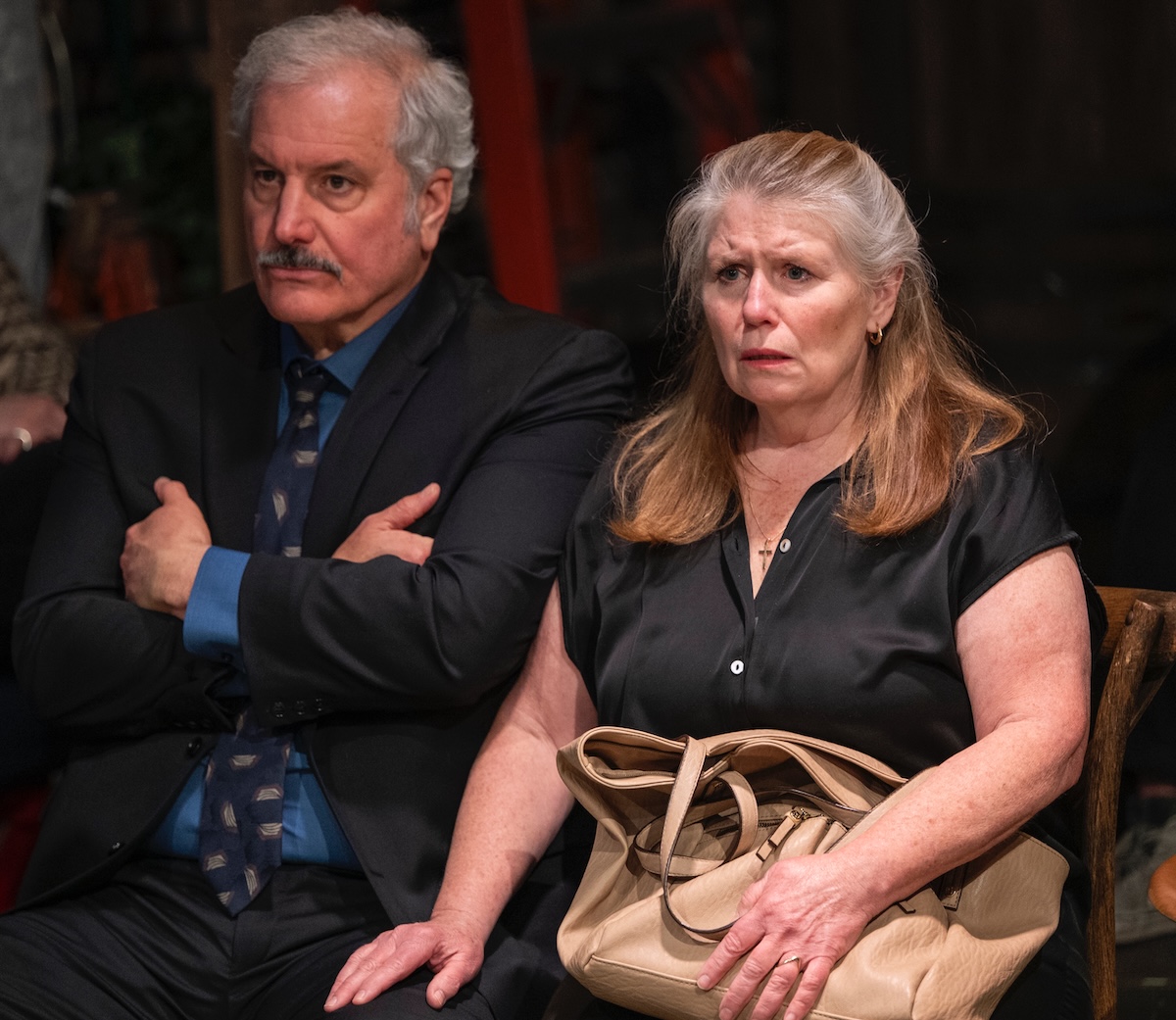
Director Hallie Gordon does a sharp job of directing this play—and she makes the story move. The cast is excellent. Kupferer and Mallen, the actors who play George and Anne, are married in real life; their scenes together as they try to come to grips with their loss are touching. When I say they have the chemistry of a married couple, it’s the real thing.
Kupferer and Mallen, along with their actor daughter Katherine Mallen Kupferer, starred in the 2024 film Ghostlight, about family drama and how theater is a healing force. You can see it on Prime, Hulu, AppleTV and others.
Chicago-based playwright Lubischer was born and raised on a farm in Nebraska. His other plays include Bobbie Clearly, You Deserve to Be Here and Weird Kids.
Jackie Penrod is scenic designer with lighting by Diane Fairchild and sound design by Joyce Ciesil. Costumes are by Janice Pytel. Props design (there are lots of props!) is by Em Allen. Kristi Martens is stage manager.
Pivot by Rivendell Theatre Ensemble (whose motto is “It’s Women’s Work”) has been extended through April 4. The theater is at 5779 N. Ridge Ave. Running time is about 100 minutes with one intermission.
For more information on this and other productions, see theatreinchicago.com.
If you found this post interesting, please consider supporting Third Coast Review’s arts and culture coverage by making a donation. Choose the amount that works best for you, and know how much we appreciate your support!
