
Fascism never completely goes away because the concept of a utopian society or a "golden age" is subject to those in power. Theatre Y is staging the North American premiere of Elfriede Jelinek's Charges (The Supplicants). This play was written in 2013 and updated in 2016 when Europe began experiencing refugees from war-torn countries pouring in by the thousands. This production is directed by the co-founder and artistic director Melissa Lorraine and Héctor Alvarez. Theatre Y is an arts incubator with a powerful mission of theater as a means of liberation, revolutionary action, and activism.
Jelinek, an Austrian playwright and novelist, was awarded the Nobel Prize in Literature in 2004, for her "musical flow of voices and counter-voices in novels and plays that, with extraordinary linguistic zeal, reveal the absurdity of society's clichés and their subjugating power."
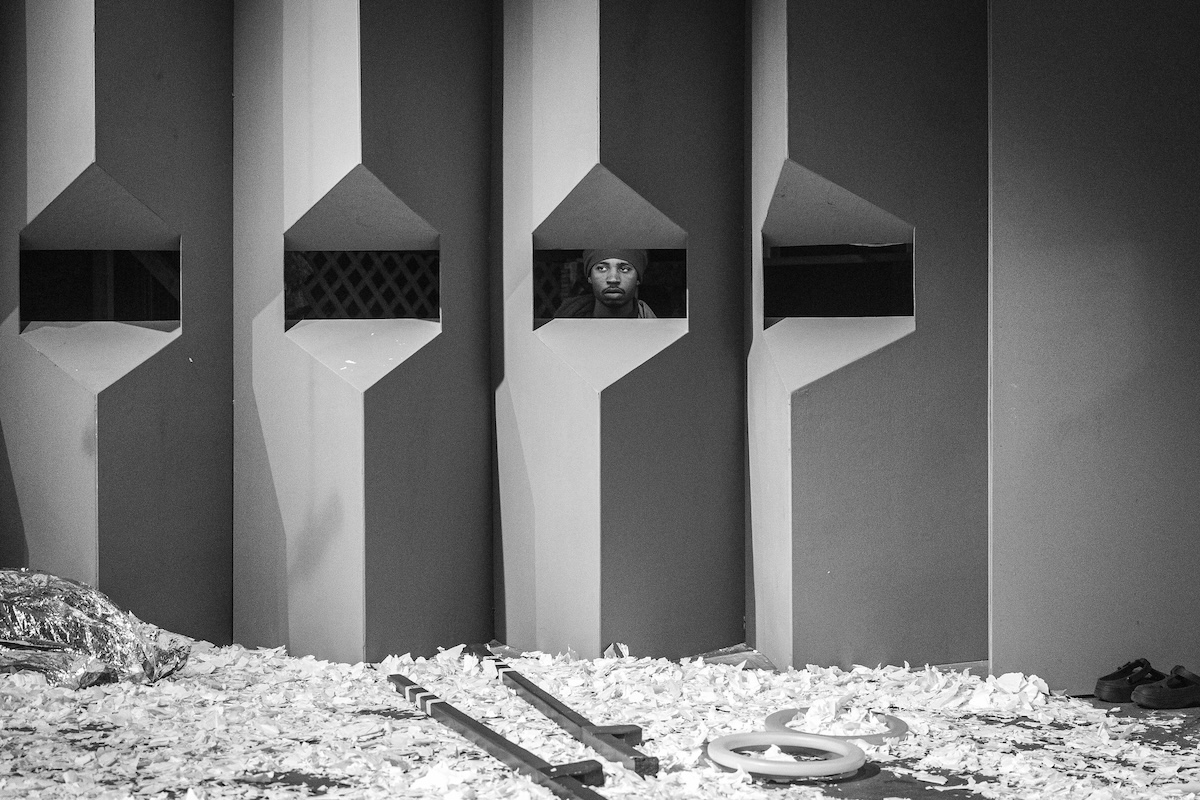
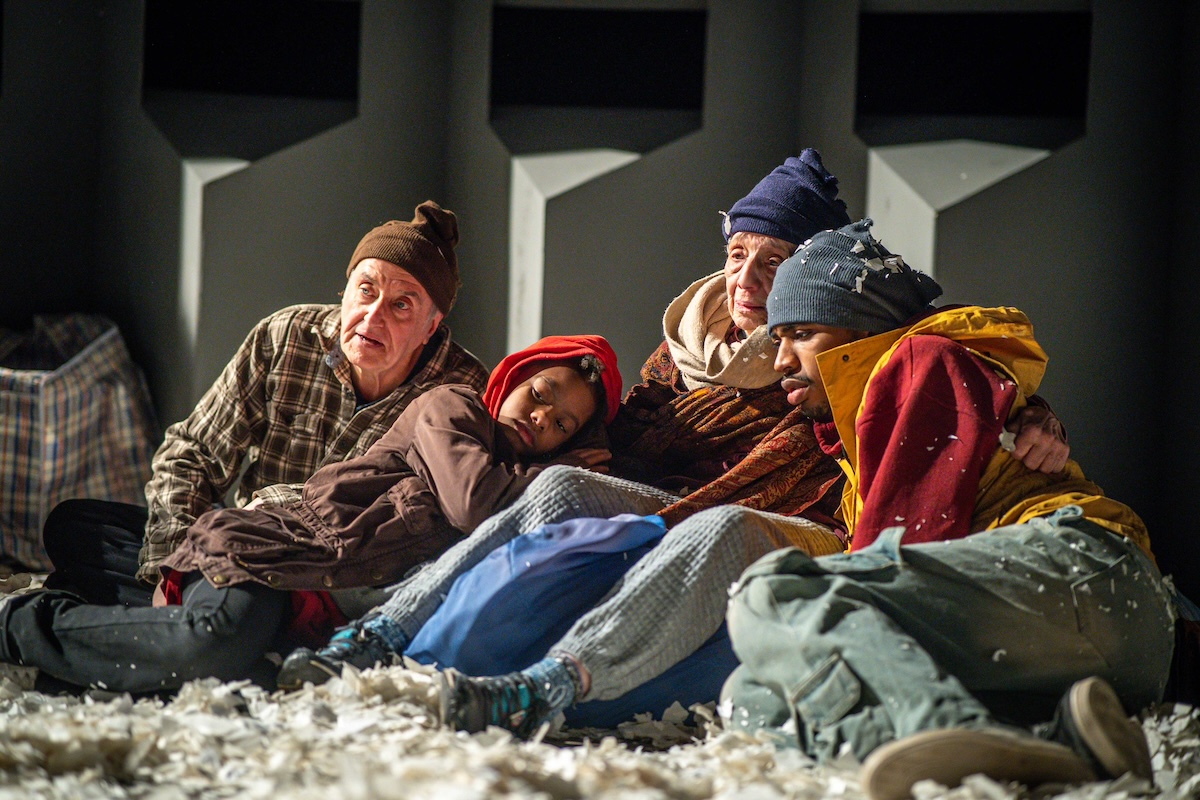
Steven Stoll's set design positions the audience as voyeurs. The set is constructed in-the-round with windows cut out for each member of the audience. The jutting angles and grey tones call to mind the dark and twisted style of Robert Wiene's expressionist film, The Cabinet of Dr. Caligari (1920). Quinn Chisenhall's lighting design enhances the bleak prison-like space. This adaptation is about immigrants being jammed into camps, carrying all of their possessions in polypropylene and nylon bags. The 16-member cast is faceless with balaclavas pulled over their faces, except for one little girl. Nine-year-old Kyndal Keith gives an astonishing performance as the child who will lead them. Her character keeps watch and serves as the group's caretaker. Keith has two soliloquies that reflect the burden placed on children when parents and adults are suffering.
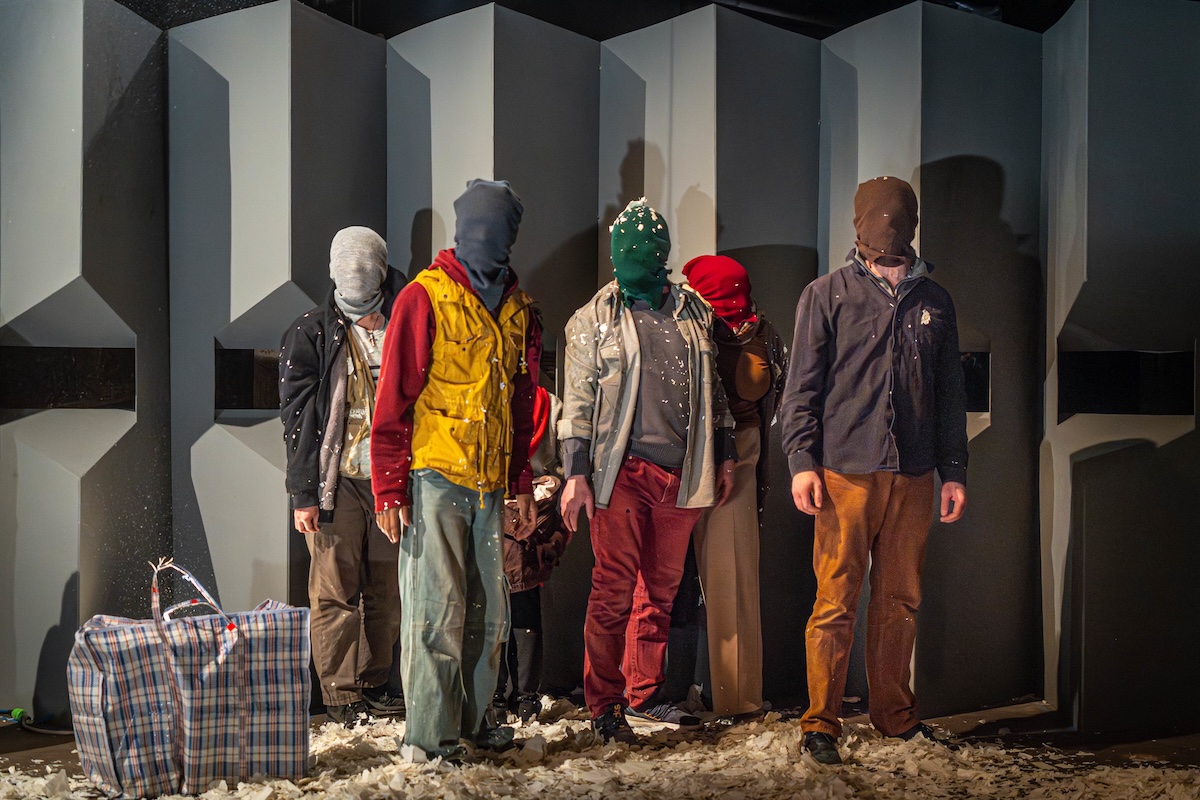
Jelinek's dialogue is translated from German by Gitta Honegger. It is naturalistic and stark, reflecting the harsh conditions of the camps that migrants have endured here in America. One element of Charges (The Supplicants) that gave me the chills was the ensemble's diversity. Today, it is mostly Hispanic and Muslim migrants who are being deemed illegal and dangerous. Next month or year, it could be Black, Asian, or elderly people who are snatched from their homes and families, either because they are not useful or considered a drain on resources. I was thrilled by the ensemble's diversity because it shows that people who band together over a common cause are powerful.
Every member of this ensemble contributed to the story through their dialogue and their diversity. Paloma Lozano brought me close to tears with her supplication in Spanish. Terror and grief are in her voice as she pleads with God to end the suffering and save them. Hayaat Abeba sings a prayer in Ethiopian from the Koran. I do not understand the language, but I knew from the emotion and delivery that it too was a supplication. The migrants speak of the gifts they bring, but the gifts are not tangible and serve as metaphors. The sound design and effects by Kimberly A. Sutton provide an aural backdrop to several of the more harrowing scenes.
Gino Hernandez wears boxing gloves and shows off a punching style. That could be how Hispanics have joined the military to fight for our country and yet are being deported because of how they look. Matt Flemming and Eric K. Roberts both juggle. That can symbolize how the working class has to juggle jobs to care for their families. The metaphors are mine, and I do not know what Jelinek intended, but I think that the actions are universal in intent. Laura Torres assembles a tightrope and walks it; red noses are donned, someone walks on stilts, and others pose as break dancers. The gifts are the sublime circus in which we all exist.
The set also serves as a metaphor with a giant (gold) chandelier standing in for the government power. It descends from the ceiling and immobilizes people. When a woman dressed in black, with a wide-brimmed hat obscuring her identity, enters freely through a door and walks through, she rings a gold-toned bell. She can freely walk through the chaos and depart through a door that automatically opens for her. She doesn't care. Do you? In a post-performance talk, co-director Melissa Lorraine shared that Jelinek wrote the mysterious woman as an amalgam of Boris Yeltsin's daughter and an anonymous world-famous opera singer. I don't know who the singer would be in today's world, but guess who is responsible for economic chaos, corruption, and military conflict on today's world stage.
Charges (The Supplicants) is universal to eras and the atrocities committed within them. Violence and political instability are cyclical, inevitably rearing up when divisive "us versus them" rhetoric is taken as gospel. Visible trust among the ensemble members allows them to be fearless and to project raw emotion. This play is brilliantly directed, staged, and acted. I highly recommend that you see it and tell people about it. This is an important play done by a theater with an important mission. One of the quotes used by Theatre Y is from Friedrich Nietzsche: "One should open one's eyes and take a new look at cruelty." That distills the purpose and meaning of Charges (The Supplicants).
Melissa Lorraine and the late Christopher Markle founded Theatre Y 20 years ago on the north side and moved to Lawndale in 2023. In 2018, Theatre Y joined the Free Theatre Movement; they present their member-supported work free of charge.
Charges (The Supplicants) runs for 90 minutes without an intermission. The play runs Thursdays through Sundays and has been extended thru April 12 at Theatre Y, 3611 W. Cermak Rd., at the crossroads of North Lawndale and Little Village.
Did you enjoy this post? Please consider supporting Third Coast Review’s arts and culture coverage by making a donation. Choose the amount that works best for you, and know how much we appreciate your support!
