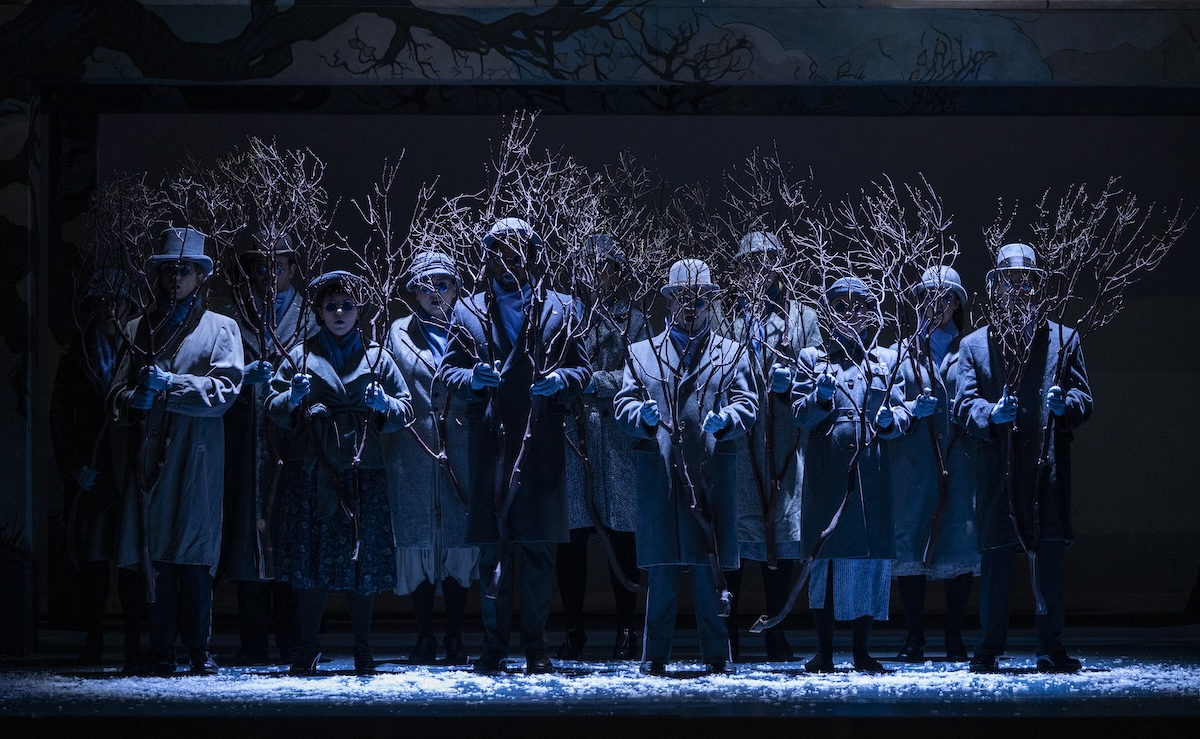

Wednesday was a significant anniversary for Kurt Weill's Der Silbersee, ein Wintermärchen (The Silver Lake, A Winter's Fairy Tale). It was banned by the Nazis on that date in 1933, and Weill fled to Paris, then eventually to America. The Chicago Opera Theater is known for bringing exciting new works to life and giving power and gravitas to works that may be less well-known in the operatic/musical canon. Der Silbersee is beautifully sung and a visually stunning production directed by COT's general director Lawrence Edelson.
Der Silbersee is one of the more elaborate and intricate productions I have seen by COT. It is a story with music—not a traditional opera, but, in my opinion, the scale, music, and acting lean operatic. The cast is on point with flawless singing and acting. Conductor James Lowe leads the orchestra with perfect balance. Weill's music is dramatic with tension, comedy, and sadness, and the libretto by Georg Kaiser does justice to the music. The subtle and the grandiose stand side by side without one overshadowing the other. The orchestra and the singers have a beautiful symbiosis. It is also the most fun I have had at a COT production since The Nose in 2023.
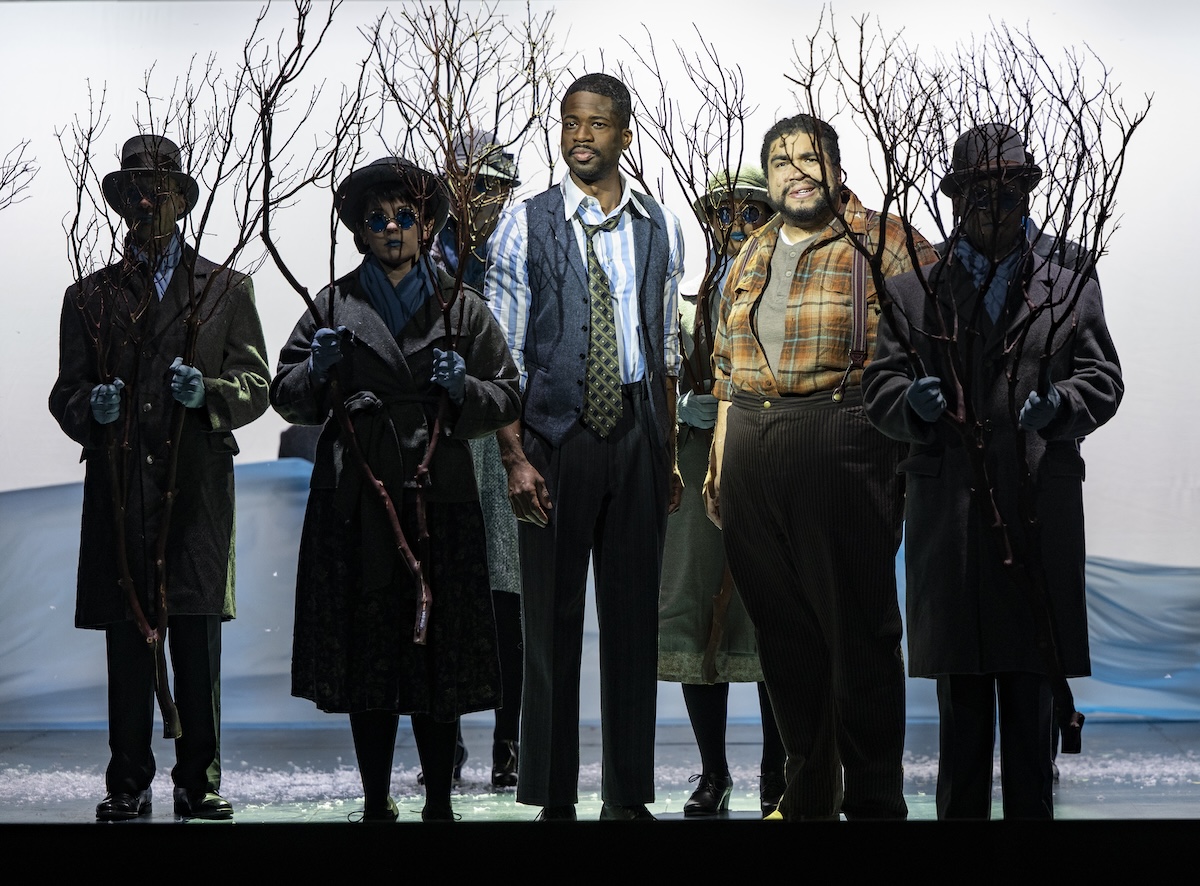
Der Silbersee is a story of compassion, greed, and a driving lust for power. It opens with a duo of vagabonds (Steele Fitzwater and Leroy Y. Davis) digging a grave for an effigy burial of Hunger, which was rampant in Nazi Germany. The burial had both metaphysical and pagan vibes since a nationalist Christianity pervaded in Germany. The upper 1% held the power and wealth, instilling a fear and hatred of "mongrels." Hatred for Jews, LGBTQIA persons, Romani, and others not fitting the Aryan ideal ramped up in 1933. The story shows the extremes between the wealthy and the starving.
The gravediggers are joined by the rest of their gang, led by Severin (Chaz'men Williams-Ali). They wander the country, looking for food and ways to make money without succumbing to an increasingly corrupt regime. Does the idea of getting rid of unwanted ethnic groups and races sound familiar in current times? The answer is emphatically yes, by the way. The contrast between the classes and the ending was firmly against the programming of anti-semitism and other bigotry in Germany and other parts of Europe. That did not please the Nazi party, and thus, the banning of Der Silbersee. There could be no reconciliation between the ruling party and thieving "mongrels."
The gang comes upon a fruit store staffed by two shopgirls, Boya Wei and Sophia Makekawa. This fun duo sings about how slightly bruised fruit is thrown away to keep everything looking perfect. There are no pantries to give the discards to the poor. The image of prosperity is everything. The vagabonds steal as much fruit as they can carry, but Severin sees an exotic pineapple and absconds with it; he is shot by Olim, the policeman (Justin Hopkins). This is where the story segues into Olin's struggle to find redemption and Severin's vengeance for being shot for being hungry and desperate. Williams-Ali participated in Echoes of Excellence, where I heard his fine tenor and also his gospel chops for the finale of that performance. He is great as Severin and the perfect foil to Hopkins' silky bass-baritone. The characters are enemies, but each one grows in wanting to do the right thing and take responsibility for their part in the tragedy.
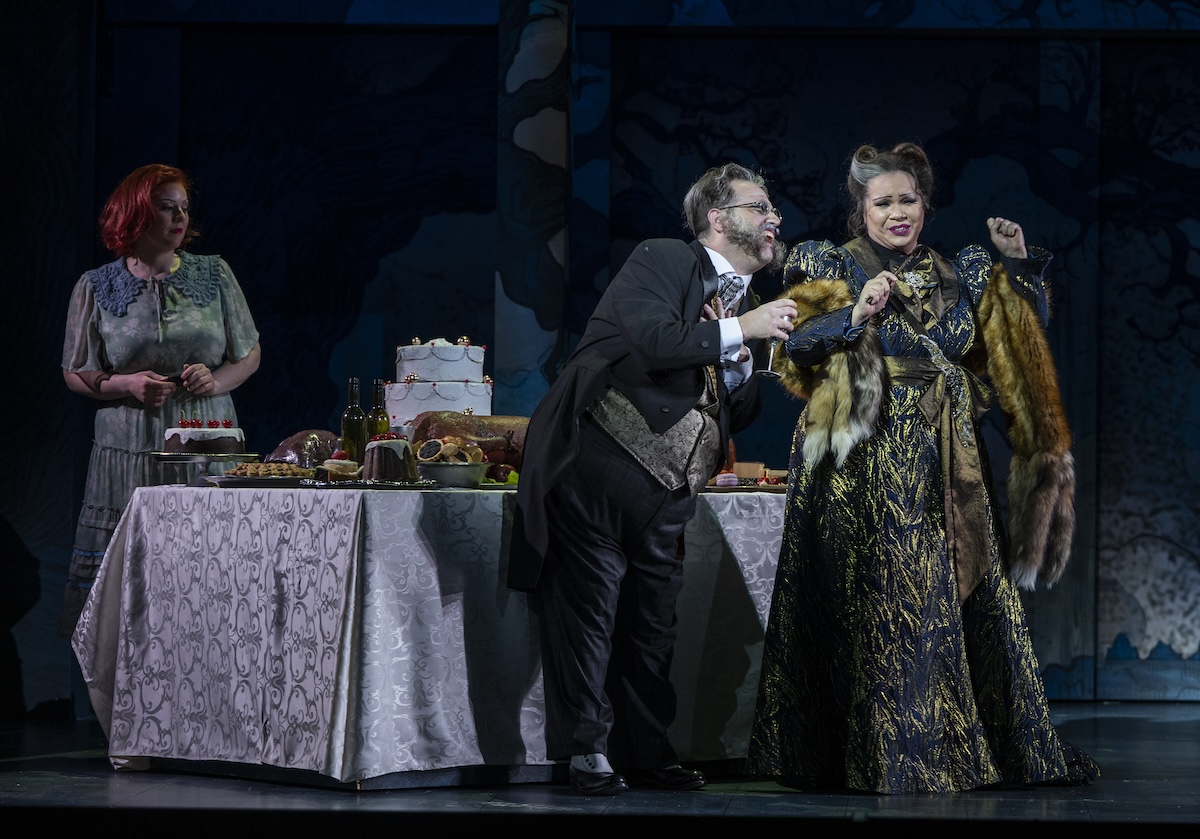
It was delightful to see soprano Leah Dexter as the wicked and hilarious Frau von Luben. I have seen her in Fire Shut Up in My Bones, and another COT favorite, She Who Dared. I liked everything about her character, particularly when she canoodled with Baron Laur (Dylan Morrongiello). Morrongiello also plays the Lottery Agent with great flair. The aria is a highlight of singing and performance. Their singing and interactions were spot on. Dexter has a grand soprano in addition to some Margaret Hamilton and Cloris Leachman stirred in. Morrongiello had that Sergeant Schultz thing going on, and I was there for it. These characters skewer the cruelty and pomposity of the ruling class.
The duo was the perfect example of great costume design by Eric Teague and wig and makeup design by Erin Kennedy-Lunsford. I would sport Frau von Luben's black dress. I would also consider the wig that crossed Gary Oldman in Dracula (1992) with a touch of Elsa Lanchester as The Bride of Frankenstein (1935). The costumes in this show are of that time and yet timeless. Great care was taken with the small details, such as spats, cufflinks, and cravats. Jeffrey D. Kmiec's complex set design is great. The supertitles are projected onto the bridge front, which is much nicer than reading the translation on a television. The moving staircase and decor are intricate without being Baroque. It took some engineering to put together such a complex stage. Also, the ending images are a unique blend of Expressionism and Surrealism. Marcella Barbeau's lighting design accentuates the bare trees and beige attire, making people look like trees. It was Rene Magritte meets Edward Hopper, creating a moving forest.
Der Silbersee begins as a dream, with soprano Ariana Strahl as a child reading a fairy tale, but her role is as Fennimore, the poor relation of Frau von Luben, where she blossoms and shines. I would call her voice a lyrical soprano. She can reach astronomical high notes and flutter back to midrange with a touch of melisma. I would be remiss to not mention Korey Simeone in his first role as Fat Policeman and the Doctor. Both roles are laugh-out-loud funny. Props to the other Youths: Evan Bravos and Sam Grosby. They are excellent singers and have great stage presence. Dietlindle Turban Maazel is the director of dialogue and diction. There was quite a bit of dialogue, and it sounded quite beautiful. The speaking parts were Sprechgesang, which means spoken song. It made perfect sense for continuity and to keep the play with music in balance.
Der Silbersee:ein Wintermärchen is a fairy tale for sentient people who understand the dangers of across-the-board conformity. Kurt Weill used elements of blues, jazz, and classical to create a uniquely surreal sound. Sometimes the score leans into a circus sound, which would have been appropriate for the political scene in 1933 and contemporary times. The world can be a circus, eternally in development with cyclical terror but always hope.
I highly recommend seeing this play with music. Der Silbersee is a story of resistance, courage, and the ability to see enemies as human beings. Weill and Kaiser formed a special bond with this rarely produced play. It was frightening how similar it is to our world here and now. However, there is hope when people come together to put things right and create a peaceful world. One day, we will get it right.
Der Silbersee:ein Wintermärchen runs for three hours with a 20-minute intermission. You can see it this weekend on March 7 and 8 at the Studebaker Theater in the Fine Arts Building, 410 S Michigan Ave. Tickets and information available here.
If you found this post interesting, please consider supporting Third Coast Review’s arts and culture coverage by making a donation. Choose the amount that works best for you, and know how much we appreciate your support!
