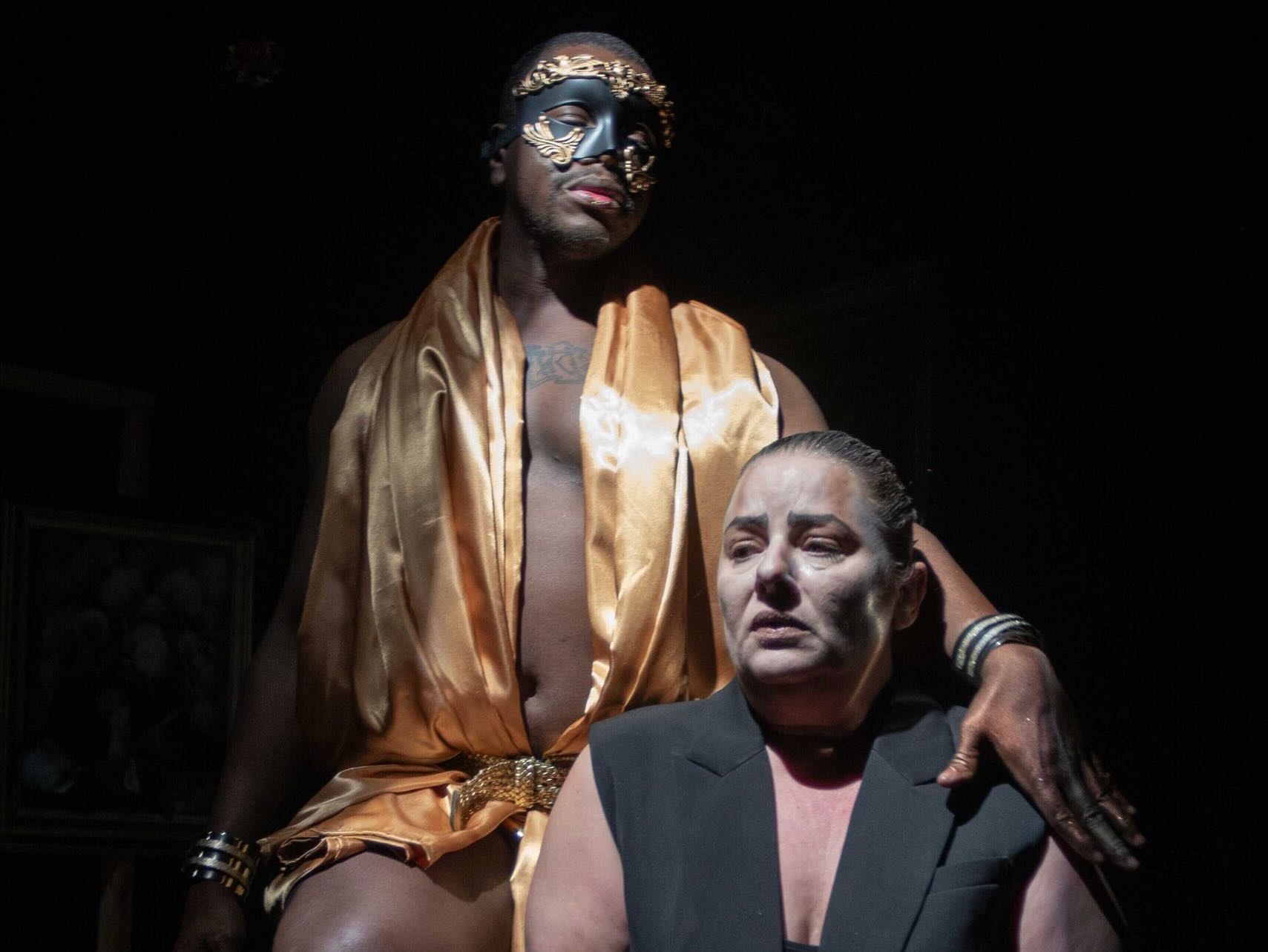

After reading the play The Cuttlefish, or the Hyrcanian Worldview, about an artist driven to despair due to censorship, by the early 20th century Polish avant-garde writer Stanislaw I. Witkiewicz, translated by Daniel Gerould, one could be forgiven for calling it pretentious gobbledygook. Seeing the play live, however, especially when performed by the brilliant cast at Trap Door Theatre, the genius and humor of the work shines, and one (me) owes a big thanks to the storefront company for turning this challenging piece into one of the best productions of the new year.
From the onset set designer Merje Veski’s talent is obvious. The stage’s floor is coated with splatter paint, and along the walls are framed paintings slashed to varying degrees of destruction. Entering the studio theater, the audience sees the cast striking dramatic poses on or around the pedestals spread about the stage, atonal piano playing in the background. It sets an auspicious energy, promising flavor and flash.
At the start of the play, directed by Nicole Wiesner, the Byronic artist Paweł Rockoffer, played by the director, mourns his paintings recently destroyed by an unspecified authoritarian government.
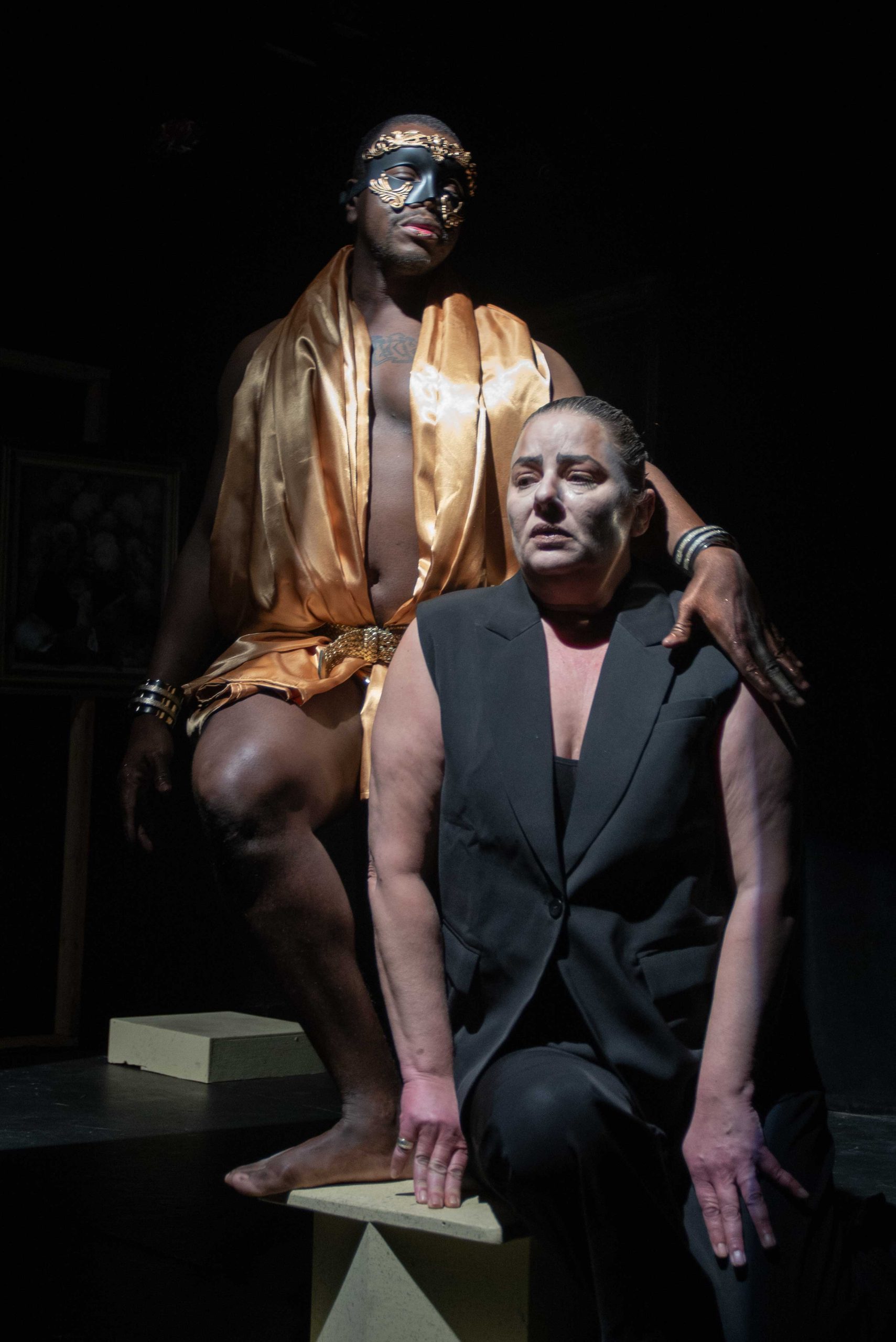
“I’ve wasted my life,” Rockoffer bemoans to the statue of a former lover, played by Keith Surney. “Two wives, working like a madman—and for what—my philosophy and ideas aren’t officially recognized, the remnants of my paintings we destroyed yesterday, by order of the head of the Council for the Production of Handmade Crap.”
Here the two set up the dystopian, anti-creative hellscape author Witkiewicz no doubt predicted based on his experience with European authoritarianism. What should the artist do in a vapid, cruel world? Continue creating? Give into doubt and oppression? Suicide?
These are the stakes, but they don’t exactly change over the course of the show. There’s no progression, just discussion, though the entertaining cast of interlocutors, including a pope and a king, delivered to the audience at an engaging pace, adds excitement to a stagnant story. Intense flashing light cues by lighting designer Merja Veski and sound effects provided by a foley artist, Venice Averyheart, also lend playful drama.
Weisner as Rockoffer is more or less our straight man. He’s grumpy, dissatisfied, with the pallor makeup of a sad clown. Wiesner plays self-pity perfectly, and her intellectual discussions or meanderings are always inventive. As far as the cast goes, there is not a weak link in the bunch. Everyone brings their A-game, which is to say they commit to the bit, which is to say they are outrageous.
Special attention should be paid to Emily Lotspeich as Pope Julius II. Speaking with magnanimous detachment, she delivers some of show’s cleverest lines.
“To tell you the truth—in Heaven they think I really belong in Hell. But you see, as the Pope they can’t decently do . . . that to me . . . you know?”
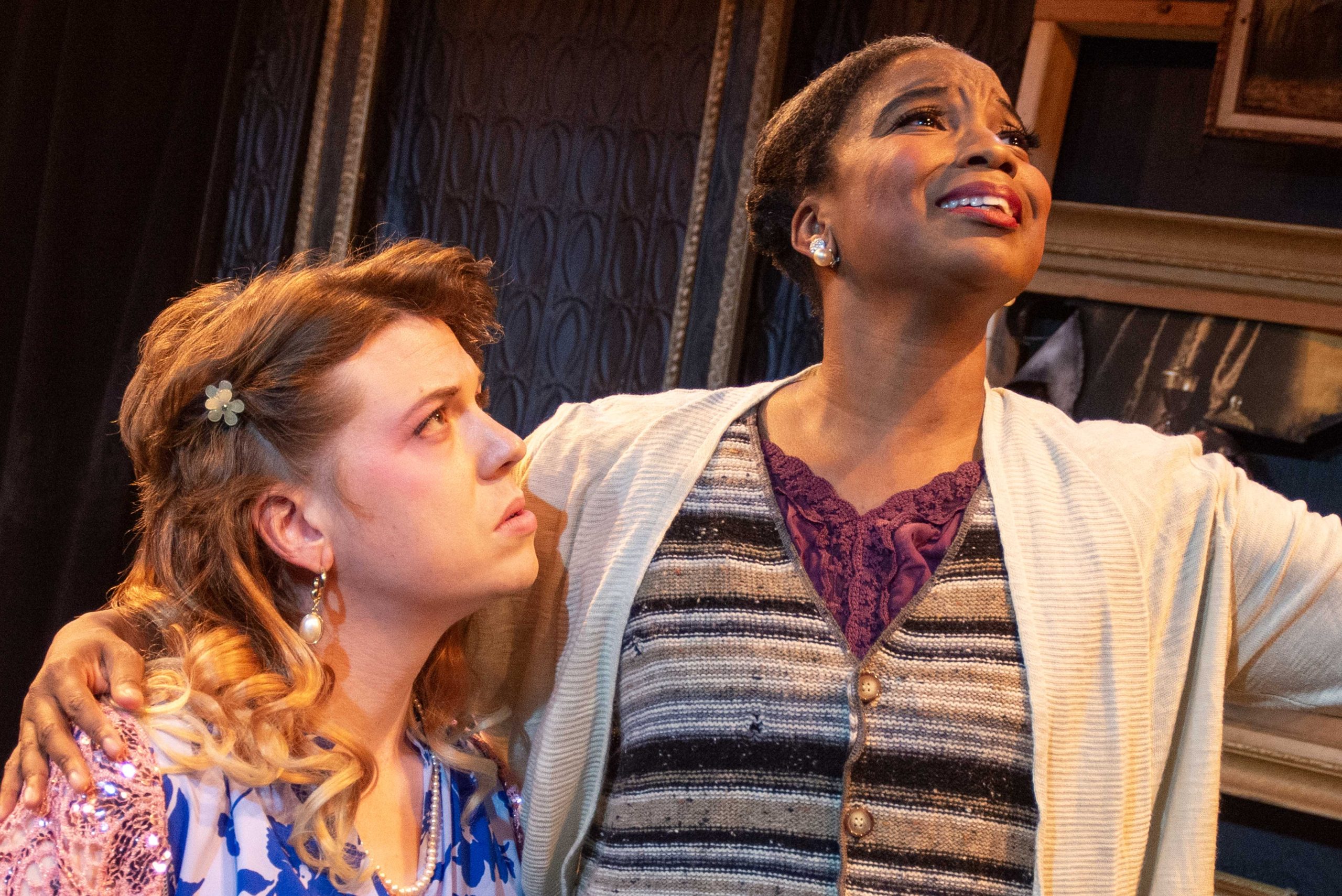
Gus Thomas as Ella, Rockoffer’s fiancé, is revelatory. She is a hopeless romantic, attached to Rockoffer no matter how much he pushes her away. Witkiewicz doesn’t necessarily give her the funniest material, but at any time during the production, if I wanted a laugh, I turned to Gus Thomas and found him moping or mugging with delightful melodrama.
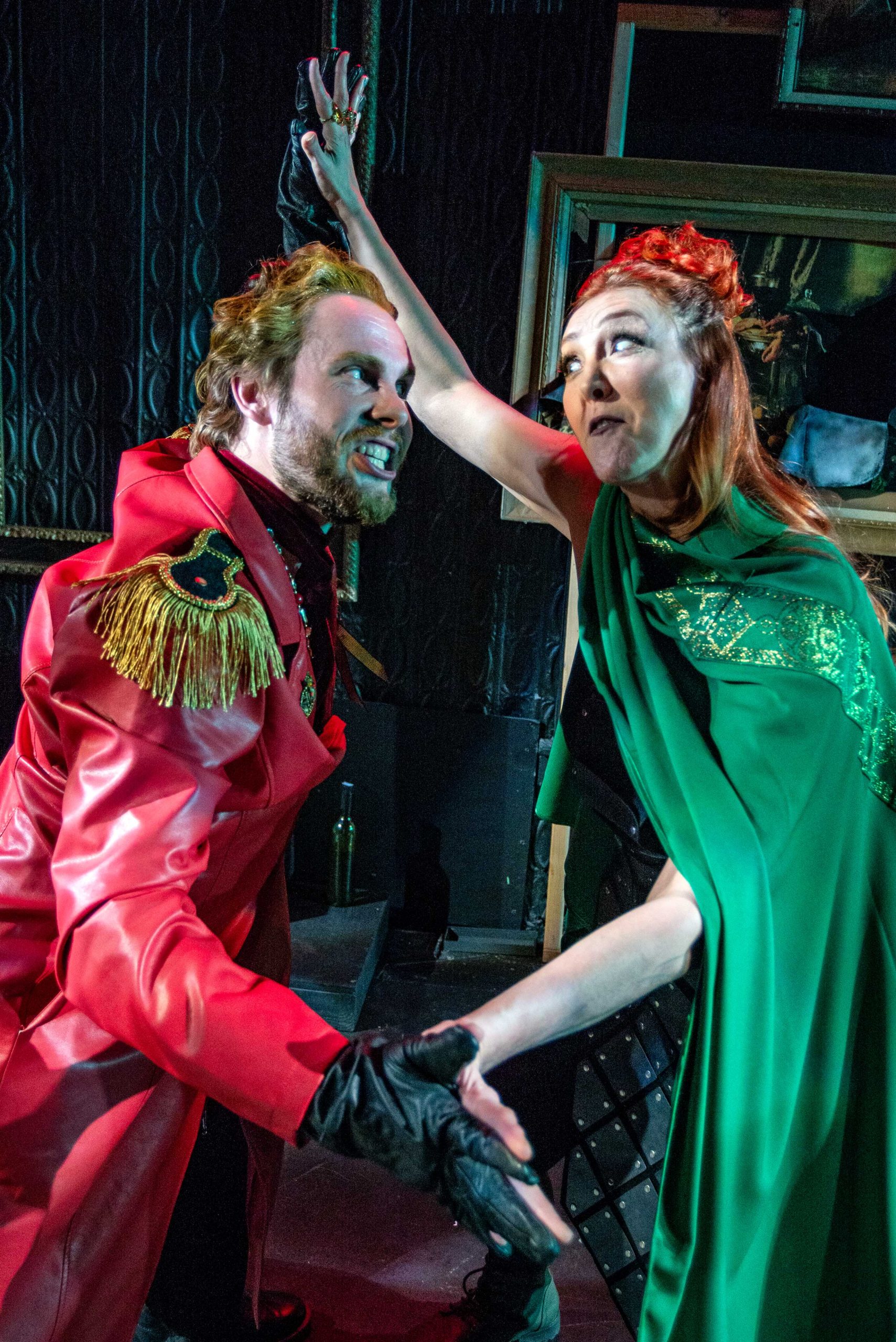
The production’s zaniest character is King Hyrcan IV, played by David Lovejoy. He is the embodiment of fascism, promoting an absolutist lifestyle which, it appears, involves a lot of power and a lot of narcotics. Lovejoy has a wonderful vein on his forehead that pops prodigiously when he becomes manic. At one point he breaks into song.
“Power, we get drunk on power!” he sings.
In the past I’ve criticized non-musical shows that add musical numbers. To me it often seems like an apology. “We’re sorry if Shakespeare or Wilder is a little slow. Here, enjoy some song and dance.” But the overall vaudevillian attitude of the production matches the musical decision. Also the song, made from lyrics taken from the script, is plainly good and catchy.
Other additions to the show are less successful. Modern references to Venmo and an in-show shoutout to Trap Door Theatre reminds me of the cringier moments we endured this past awards season. Also, some slapdash audience participation comes off unnecessary and humorless.
Some theater attendees, no doubt, will call the show incomprehensible and noisy. But people searching for weirdness once again find their home at Trap Door Theatre. It may take several viewings to understand what exactly the playwright is trying to say, but you only need one viewing to appreciate the play’s energetic silliness.
The Cuttlefish, or the Hyrcanian Worldview continues at Trap Door Theatre, 1655 W. Cortland St., thru April 25. Running time is 1 hour and 20 minutes without an intermission. Tickets are $32 with two-for-one admission on Thursdays.
For more information on this and other productions, see theatreinchicago.com.
Did you enjoy this post? Please consider supporting Third Coast Review’s arts and culture coverage by making a donation. Choose the amount that works best for you, and know how much we appreciate your support!
