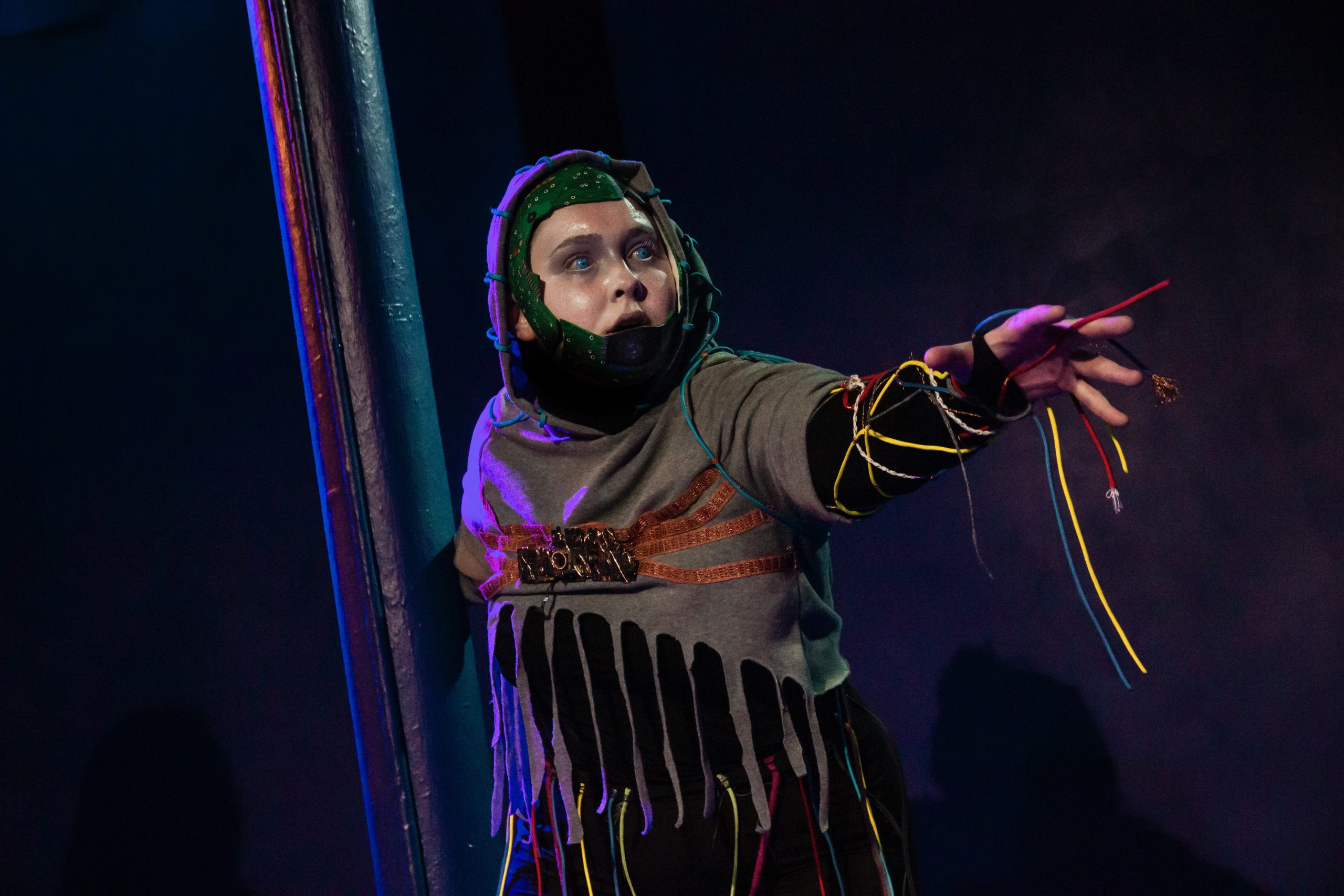

Static-Head, the new science fiction play by Impostors Theatre Co., lectures about the cost of artificial intelligence: it strips creativity, it combines old ideas without contributing anything new. Yet the show, written by Ryan Stevens, directed by Stefan Roseen, playing now at the Den Theater, is blind to its own unoriginality, and proves that, even without the aid of machine learning, humans are perfectly capable of regurgitating tired tropes.
In the near future, students at the Osman-Haskill University of Technology are queasy. They can’t separate from the internet, stitched to an app Sensor-E, invented on campus, which is essentially TikTok except its users experience whatever sensations scroll onto their screens. Aimee, played by Eliana Deckner-Glick, suspects the app had something to do with her twin sister's mysterious disappearance. Teaming up with other students Paige, played by Kati Yau; and Dorothy (Cayla L. Jones); Aimee unravels a conspiracy that goes all the way to the dean (Jaclyn Jensen).
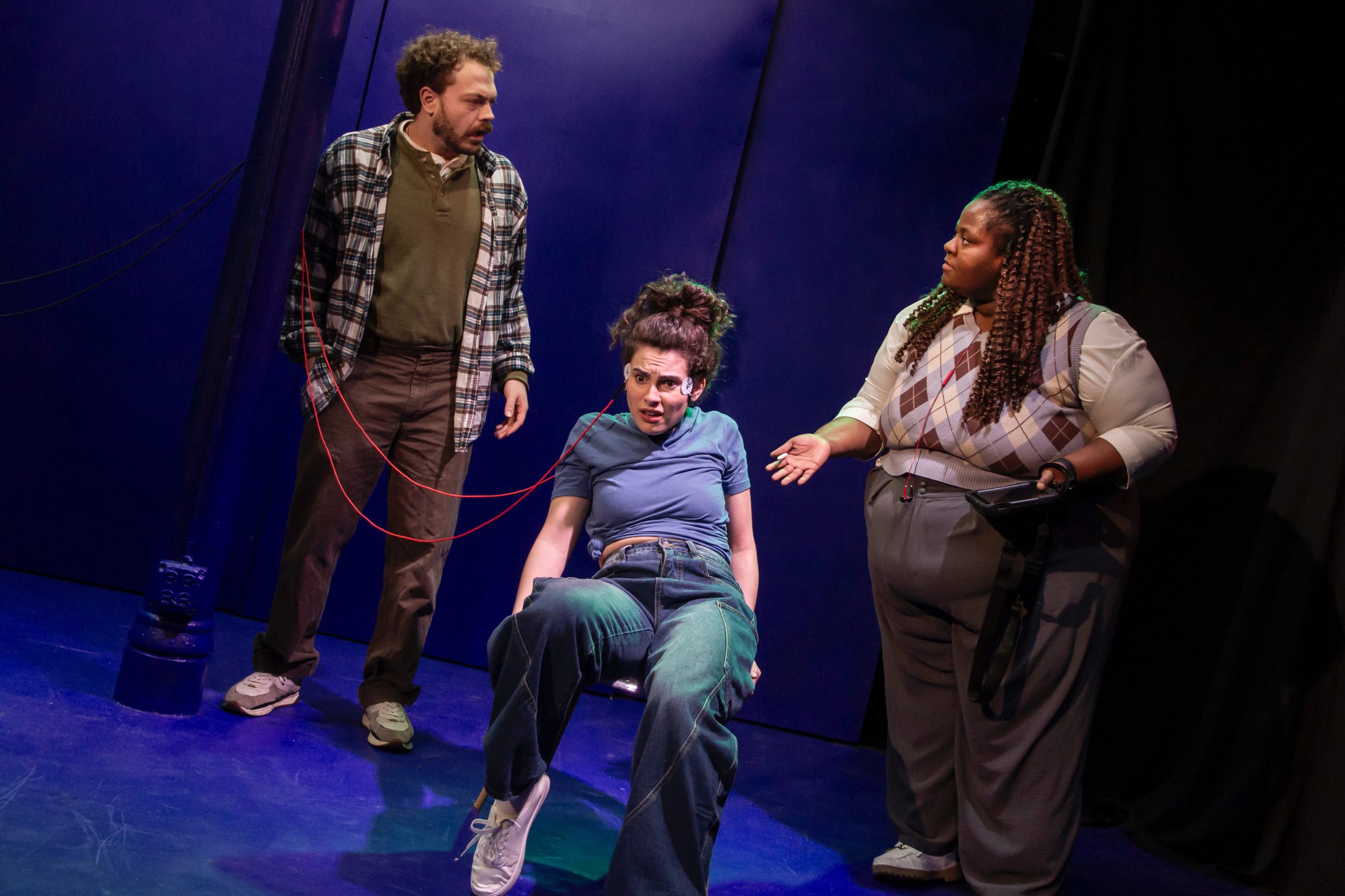
Conceptually the play is kind of cool. Sensor-E is a realistic-enough prediction and raises attractive questions about virtual reality. It’s a bummer playwright Ryan Stevens loses the thread of their own idea. We're told Sensor-E replicates sensations but see little evidence of that in the story. Mostly, Sensor-E is exactly TikTok but, like, more addictive, I guess?
For example, one thinks Sensor-E, an app built on sensations, would generate content centered on sensations. Pornography is the obvious application, and Static-Head is toothless for ignoring it completely. But, putting that aside, when the show provides a peek at the app’s content—presented through a rather impressive but long video segment—we get pastiches of common TikTok trends: unboxing videos, podcast clips, alpha-male influencers. It’s not clear how one would personally experience these videos using the app, or even what experiences the videos provide. Does the user feel what it’s like to open a box? To make a podcast? Stevens sets up a cool technology but abandons it for obvious parody.
The performances, though admittedly based on a flawed script, do not improve the situation. To put the problem simply, the actors, like their characters, are stuck in a bad habit: They play each scene the same. When we meet Deckner-Glick’s Aimee, she is bitter and frustrated, and so she remains for the entire play. Bryce Lederer as Blair, a wannabe influencer, has a sort of stagnant Shaggy from Scooby-Doo nervous energy that only alters at the end of his arc.
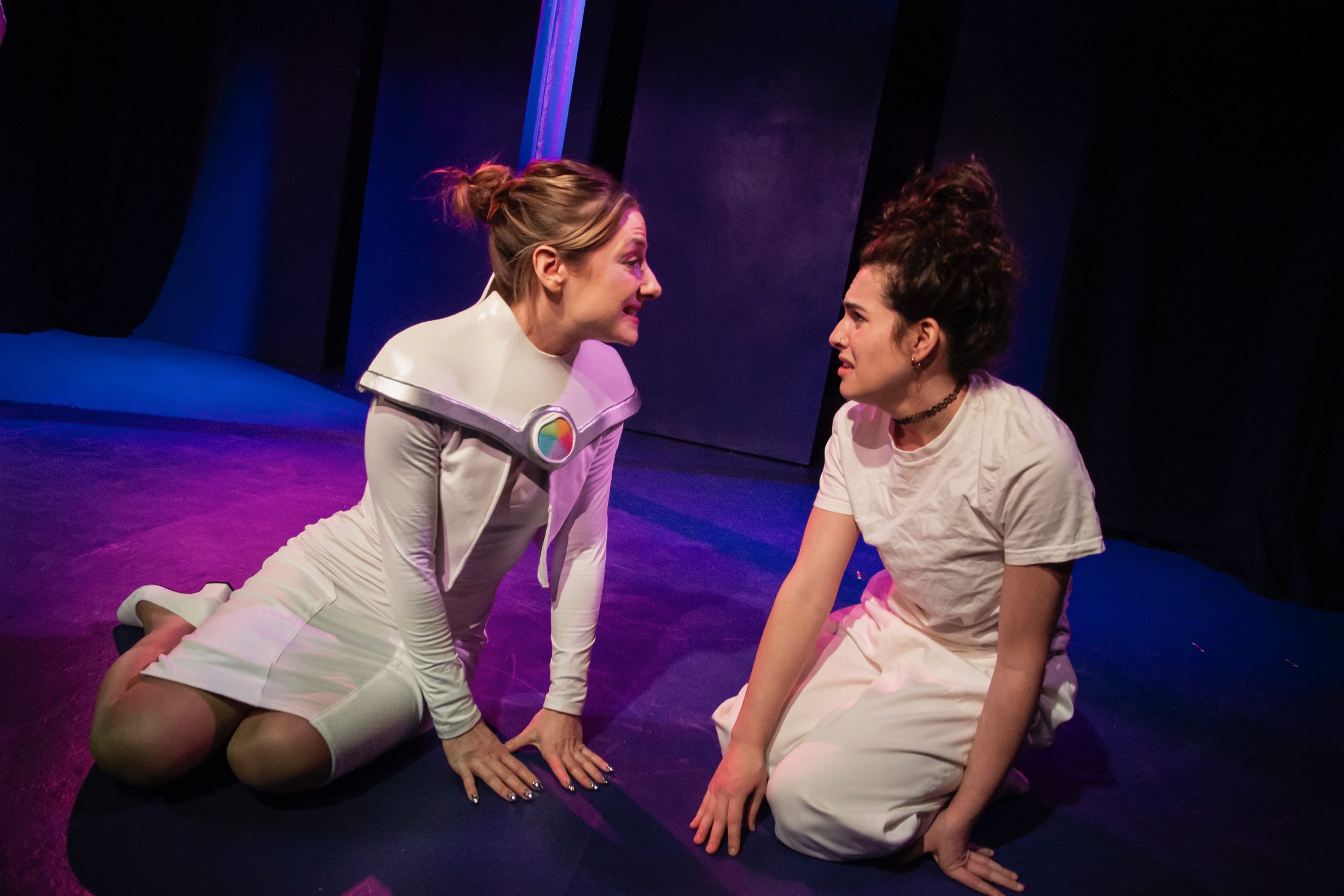
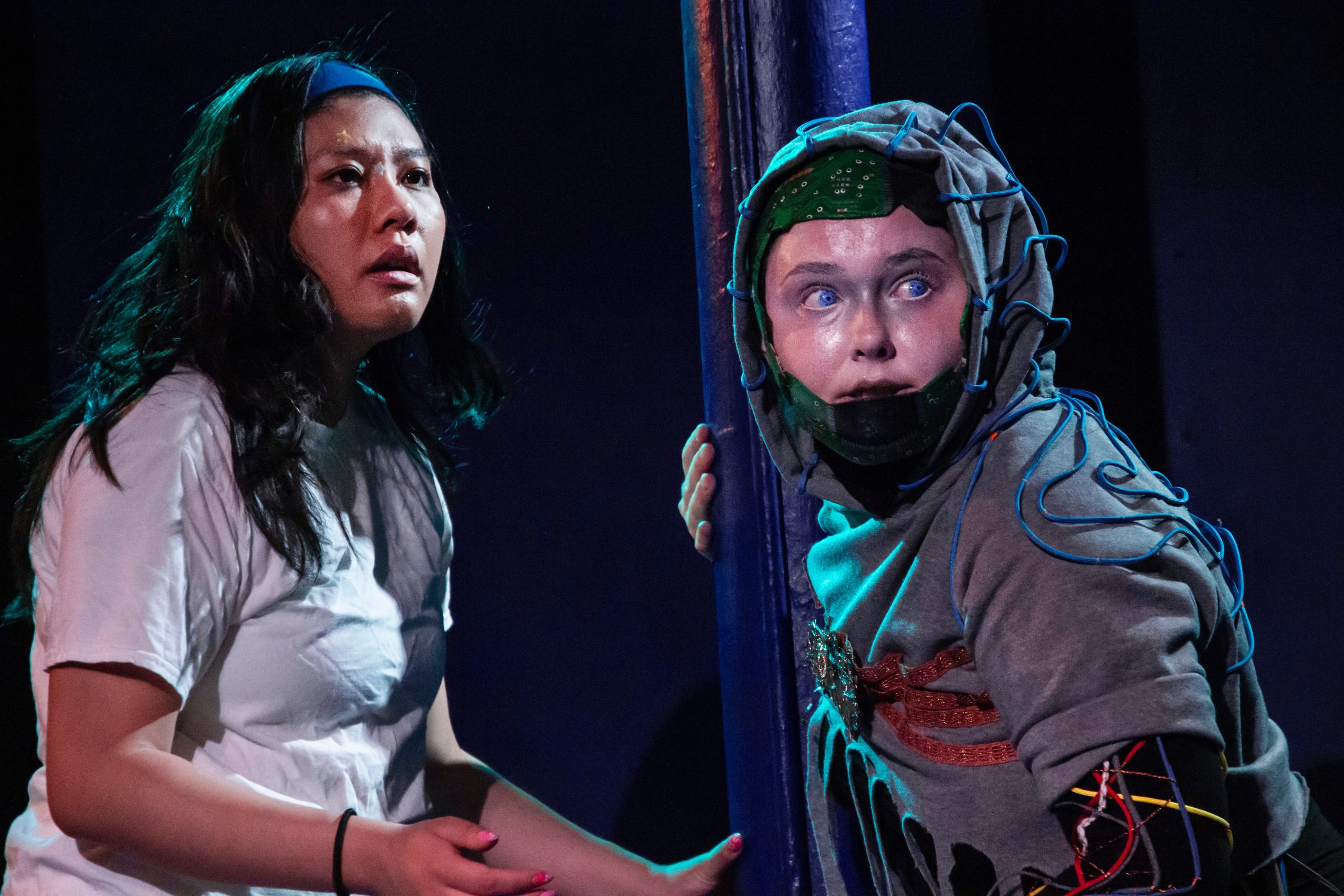
Two performances deserve praise, but with caveats. Keaton Stewart as .Exe is a ghostly embodiment of the app in the form of a Stepford Wives-esque smiling robot. Lexy Hope Weixel as //Bad-Gateway// is a glitchy scarecrow-walking representation of data. Both performances showcase impressive physicality. Stewart especially, using a Siri voice, holds a stiff, eye-twitching smile that gives one the heebie-jeebies. Impressive work, certainly, but there's nothing new here. the characters are recycled cliches and represent Static-Head’s greatest sin. It rips off other artists.
As a critic, I tire of repeating myself. I’ve made this critique many times. But the obvious and obviously uninspired ghost of David Lynch is a cancer on Chicago theater, and nearly every show claiming to be “weird” or “avant-garde” seems convinced those approaches are, essentially, whatever Lynch divined 30 or 50 years ago. Stewart’s creepy smile: that’s Lynch. Hope Weixel’s glitchy voice is eerily similar to Lynch’s backward dialogue. Yau, during one of the parody TikTok videos, does the Wild at Heart thing where she covers her face with lipstick. One could argue these are callbacks or references, but to what end? They don’t comment on Lynch’s work but instead farm it for cheap Easter eggs. The echoes of Beckett and The Matrix are also obnoxiously loud.
Later in the show we learn Sensor-E’s content is primarily the work of artificially intelligent bots. The app exploits human experience for self-cannibalizing entertainment. Moreover, manipulations to the algorithm diminish creativity, compel conformity, and eliminate inconvenient history. The terrible irony, that the show itself recycles ideas from better artists, is obvious to anyone paying attention. Hypocrisy is a nasty taste, and I left the theater not just unsatisfied but a little angry.
The single unqualified success of Static-Head is its set. Scenic designer Ethan Gasbarro creates narrow blue walls that shift horizontally, framing small bedroom sets, or opening the stage for Sensor-E’s white abyss. It’s dynamic and interesting. I suppose lighting designer Alex Branka deserves some attention for the glitzy brouhaha. There are exciting strobes and changing colors throughout. Though it may be a case of a lot of lighting more than good lighting.
Static-Head takes a big bite commenting on art in today's technological tornado. It's a sad, difficult state of affairs when amoral tech giants control systems that every day more and more become the primary source of culture. I've often felt, and Static-Head seems an example, that artists critiquing this dangerous status quo are susceptible to its influence, and commentary on apps like TikTok often come off just as lazy and uninspired as the app itself. I don’t know if anyone yet has made an artistic statement to enlighten the moment, but Static-Head, for all its flash, certainly is not that.
Static-Head by Impostors Theatre Co., continues at the Den Theater, 1331 N. Milwaukee Ave., thru May 2. Running time is 2 hours with a 15-minute intermission. Tickets are $20.
For more information on this and other productions, see theatreinchicago.com.
Did you enjoy this post? Please consider supporting Third Coast Review’s arts and culture coverage by making a donation. Choose the amount that works best for you, and know how much we appreciate your support!
