

For more than 40 years, Raven Theatre has been a cornerstone of Chicago’s intimate, actor‑driven drama. Over its long history, the company has built its reputation on revivals of modern classics and premieres of new work, but never a musical. That changes with the Chicago premiere of Dave Malloy’s Octet, the first musical in Raven’s history and a bold, beautifully realized leap into new territory.
(Note: The production closes at Raven Theatre on June 28 and is being remounted at Goodman Theatre in July. See details below.)
Best known for Natasha, Pierre & The Great Comet of 1812, Malloy has long been a composer of restless imagination. But Octet may be his most formally daring work: an a capella chamber piece for eight voices and pitch pipes, built around a church‑basement support group for people struggling with internet addiction.
When Octet premiered in New York in 2019, critics were nearly unanimous in their praise—celebrating its intellectual rigor, its emotional clarity, and its astonishing musical architecture. Its reputation has only grown in the years since, and Octet now stands among the most original musicals of the last decade.
Raven’s production, sensitively directed by Keira Fromm, shows just how timely Octet has become since its 2019 debut. The premise—a circle of strangers gathered in a drab basement to share confessions that move between the mundane and the metaphysical—feels tailor‑made for Raven’s artistic ambitions. Fromm’s direction leans into the show’s intimacy, and soon the audience feels like another member of the support group.
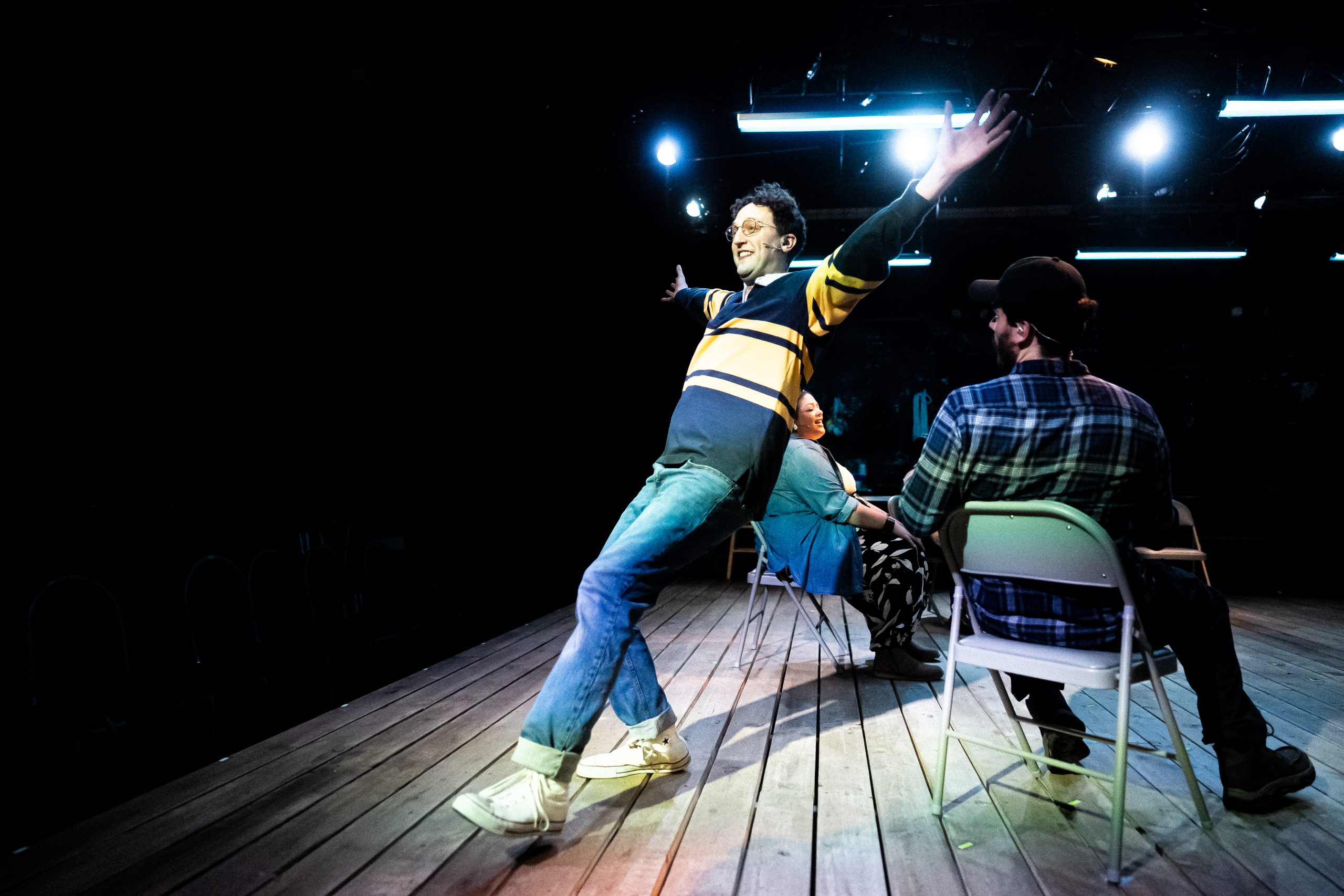
The themes of Octet—our compulsive pull toward screens, the erosion of identity online, the longing for connection in a world of constant distraction—feel more urgent than ever. In the years since the show premiered, generative AI, accelerating algorithms, and the erosion of digital authenticity have pushed Octet’s questions into sharper relief. Malloy’s decision to frame the show as a secular liturgy—a series of hymns, testimonies, and ritualized moments of silence—remains a stroke of genius. The show’s church basement setting becomes a sanctuary for people trying to reclaim their dignity and sense of self.
Musically, the production is a triumph. Malloy’s score is notoriously complex—rhythmically intricate, harmonically dense, and vocally demanding. Raven’s ensemble meets the musical challenge with a technically precise and emotionally transparent blend of voices. The sound is often breathtaking, and there are passages that continue to linger and shimmer even after the music has ended.
The cast is uniformly excellent, each singer bringing a distinct vocal color and emotional temperature to the circle. But two performances deserve special mention.
Sam Shankman, as Henry, begins his performance shyly—but when he begins to sing, that soon changes. Shankman suffuses his solo, “Candy,” with a rock‑star burst of charisma that never loses sight of the deeper ache beneath the humor. Shankman captures the paradox of gaming addiction: the way a simple, brightly colored distraction can become a refuge from unarticulated fear.

Joryhebel Ginorio, as Velma, is equally remarkable. As the group’s newcomer, she carries the delicate arc of someone who desperately wants to be seen and to be understood, to be beautiful in a world that constantly distorts those desires. Her performance of “Beautiful” is a heart‑tugging highlight—sung with a clear, luminous soprano that hovers between vulnerability and hope. Ginorio’s presence deepens the emotional stakes of Octet’s final moments, grounding the show’s spiritual questions in something deeply human.
Octet culminates in “The Field,” a closing hymn that feels like a benediction and an invitation—a sort of Ite, missa est that sends us back into the world with a little more clarity and capacity to resist the “digital monster” that threatens to devour our sense of self. It’s a moment of astounding energy—beautifully staged and exquisitely sung.
Raven’s Octet shows why the company chose to produce its very first musical—it’s a landmark and a reminder that even in an age of digital noise, eight human voices in a shabby church basement can still feel like a revelation.
Octet is being staged through June 28 at Raven Theatre, 6157 N. Clark St. Tickets are available at www.raventheatre.com. Octet will be on stage at Goodman Theatre July 15 thru August 2. Buy tickets for the Goodman performances. The show lasts a little over 90 minutes, with no intermission.
For more information on this and other productions, see theatreinchicago.com.
Did you enjoy this post? Please consider supporting Third Coast Review’s arts and culture coverage by making a donation. Choose the amount that works best for you, and know how much we appreciate your support!
