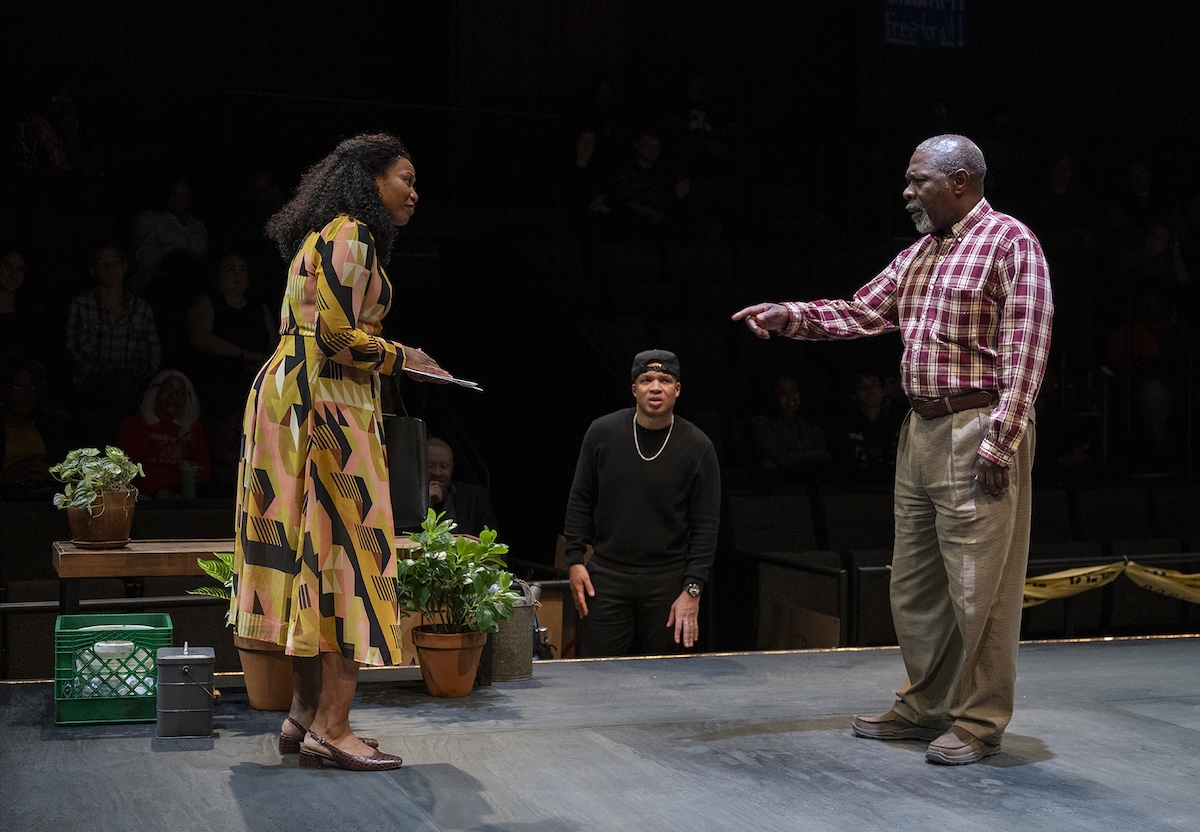

Does money buy justice for Black lives lost? In Windfall, his world premiere play commissioned by Steppenwolf Theatre, Tarell Alvin McCraney asks us to consider this question. Director Awoye Timpo casts a starry crew of four Steppenwolf ensemble members, plus two newcomers—Michael Potts and Esco Jouléy—who bring real power to telling this story, set in Chicago.
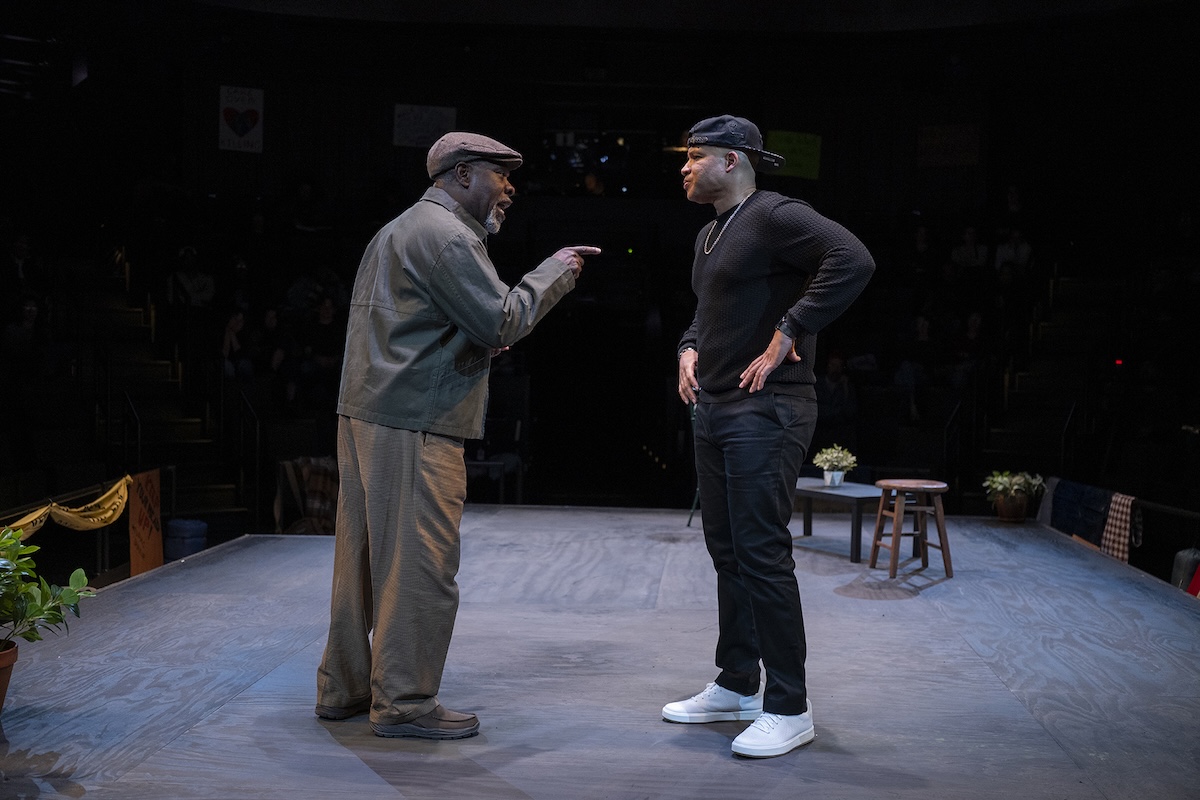
Michael Potts plays Mr. Mano, a man who has already lost his son Marcus (Glenn Davis), who lingers and loiters around the perimeter of the stage for much of the play. Marcus encourages his dad to take the money being offered him to compensate for Marcus’ death. You can invest it, draw interest, and live off of it, he tells him.
“That’s blood money though,” Mr. Mano says. And Marcus replies, “It’s all blood money. That’s what I’m telling you. All money in order for it to be worth a squirrel fart got blood on it.”
Earlier, as the play begins, Mano’s daughter Eli (Esco Jouley) is protesting police action with Cori (Jon Michael Hill) and Brother 1 (Namir Smallwood). They move around the perimeter of the Ensemble Theater, with placards, using their phones as flashlights and encouraging the audience to do the same—to shine a light on injustice. (There’s a lot of fourth-wall breaking in Windfall.)
The three also form a band that performs occasionally during the play—Eli and Cori on guitar and Brother 1 on percussion—sometimes on a cajon, sometimes on a tambourine.
Eli is shot during the protest and so Mr. Mano loses another child. The money argument with Marcus continues.
Spectral elements haunt this play. Marcus is an apparition. And Eli appears to her father as an apparition too. A nurse (played by Hill) talks with Eli and points out that the dead may move, but they don’t disappear. Windfall is a bit dreamlike, as McCraney intended.
The offers of money become personal. First Lady (Alana Arenas) arrives as a representative of the city to ask Mr. Mano why he hasn’t responded to their letters and offers of recompense for the loss of his child. They converse; he’s a bit flirtatious. Later two more city reps, all played by Arenas, visit. Miss Second tells him that he may lose his house because he hasn’t paid his taxes. She describes the city’s plans for what will be built in its place. But taking the city money offered would allow him to settle his tax debts and keep the house, she points out. And then The Last One makes the same pitch to Mr. Mano, asking him to please take the money.
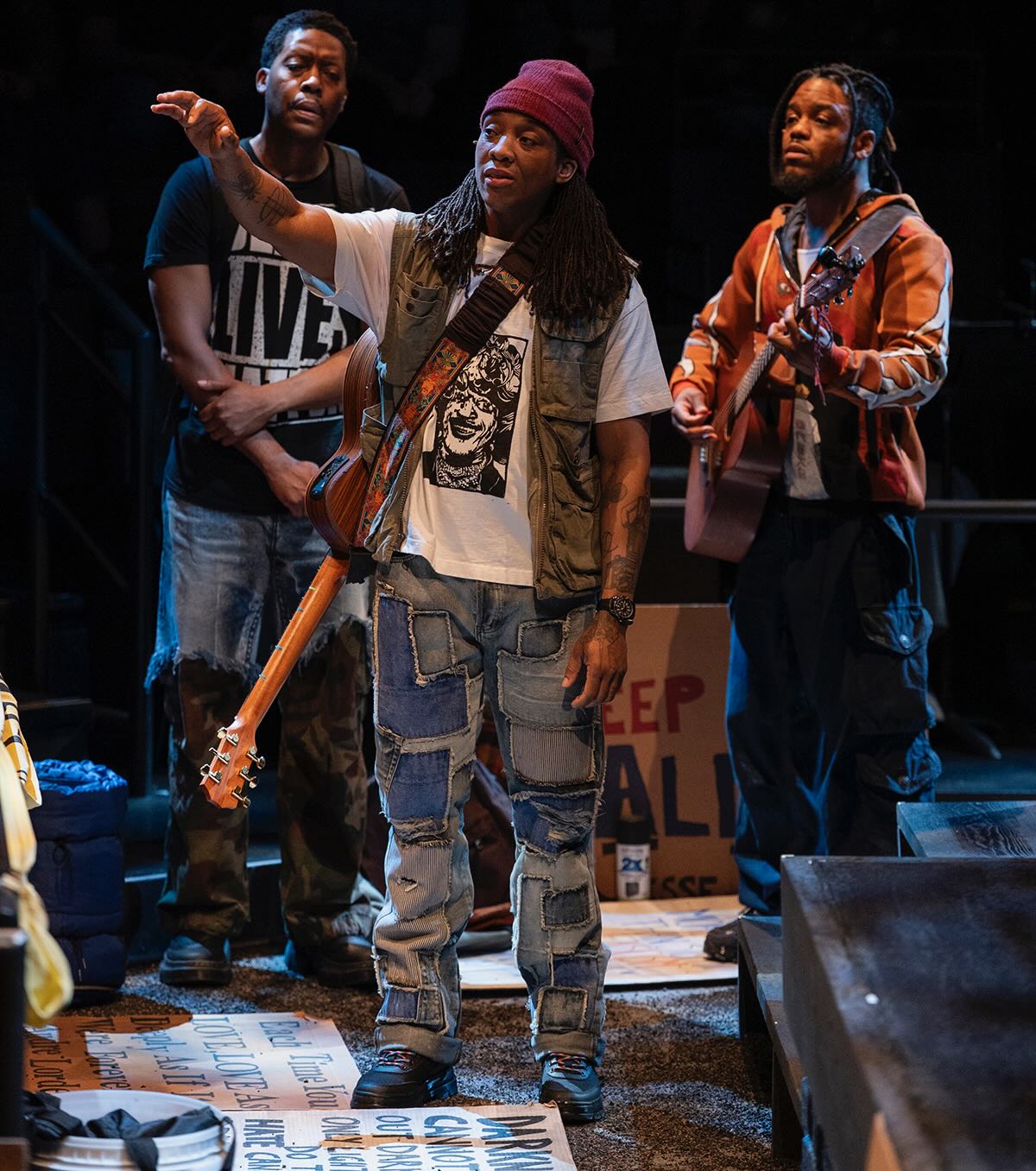
Director Timpo makes the best use I have seen of the features of the Ensemble Theater. Actors strew protest signs around the seating area. Stairs and entrances are used with great drama. And protest posters appear around the upper seating area late in the play to protest against the attempt to take Mr. Mano’s house.
Scenic design is by Andrew Boyce with Jason Lynch’s lighting adding drama, both real and spiritual. Costumes are by Qween Jean. Mahmoud Khan is music director with sound design by Willow James. Michelle Medvin is production stage manager.
McCraney is artistic director of the Geffen Playhouse in Los Angeles. His script for the Oscar-winning film Moonlight, written with director Barry Jenkins, won an Oscar for best adapted screenplay. The film was adapted from McCraney’s script, In Moonlight Black Boys Turn Blue. He is also known for his trilogy, The Brother/Sister Plays and Choir Boy.
Windfall continues at Steppenwolf Theatre, 1650 N. Halsted St., through May 31. Running time is two hours including one intermission. See the website for tickets ($80-$148.50) and more information. For each performance, Steppenwolf offers 20 tickets for $20 (no added fees); use promo code 20FOR20 to redeem the offer online.
For more information on this and other productions, see theatreinchicago.com.
Did you enjoy this post? Please consider supporting Third Coast Review’s arts and culture coverage by making a donation. Choose the amount that works best for you, and know how much we appreciate your support!
