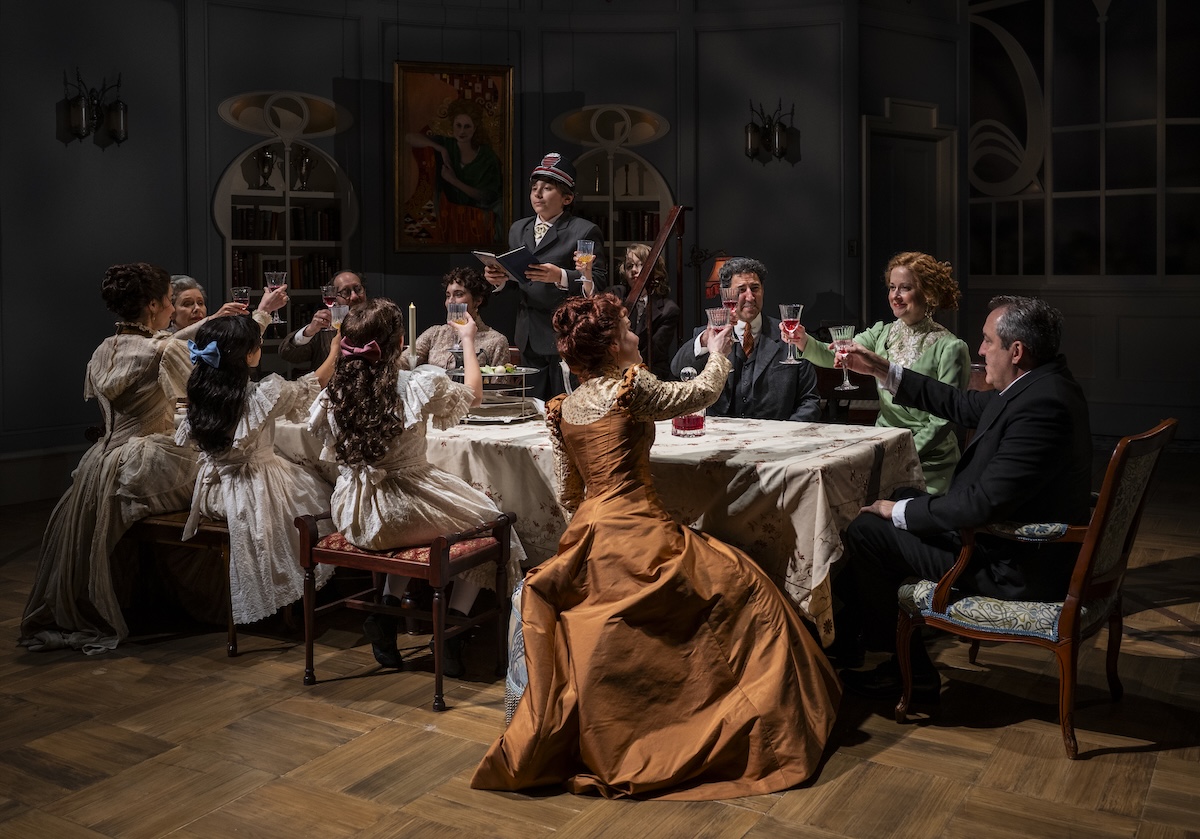

Tom Stoppard’s last grand masterpiece, Leopoldstadt, gets a dynamic staging at Writers Theatre, featuring an all-Chicago cast of some of our finest actors, directed by Carey Perloff. The play concerns the times and tragedies of a mixed Jewish/Christian family in Vienna between 1899 and 1955, with scenes set in 1899-1900, 1924, 1938 and 1955.
The symbolic nature of that religious mix is illustrated in the celebratory first scene, set in the grand drawing room of the Merz home on Christmas Eve 1899. The Christmas tree is being decorated by the children, because, Grandma Emilia Merz says, “We only have a tree for you little papists.” Young Jacob is allowed to place the star on top of the tree and he chooses a large golden Star of David. To which Grandma Emilia (Barbara Robertson) can only say “Oy! …. Baptized and circumcised in the same week. What can you expect?”
Jacob, now 8 (played on alternate days by Levi Charney and Theo Clark Leber) is the son of Hermann Merz (Ian Barford) and Gretl, his Catholic wife (Kate Fry). Hermann converted to Christianity, thinking it would help him with business and social success. But as his brother-in-law and mathematician Ludwig Jakobowicz (Joey Slotnick) says, “Assimilation doesn’t mean to stop being a Jew ….It means to carry on being a Jew without insult.” Off and on during the Christmas Eve scene, the men discuss Theodor Herzl’s new article proposing the establishment of a Jewish homeland.
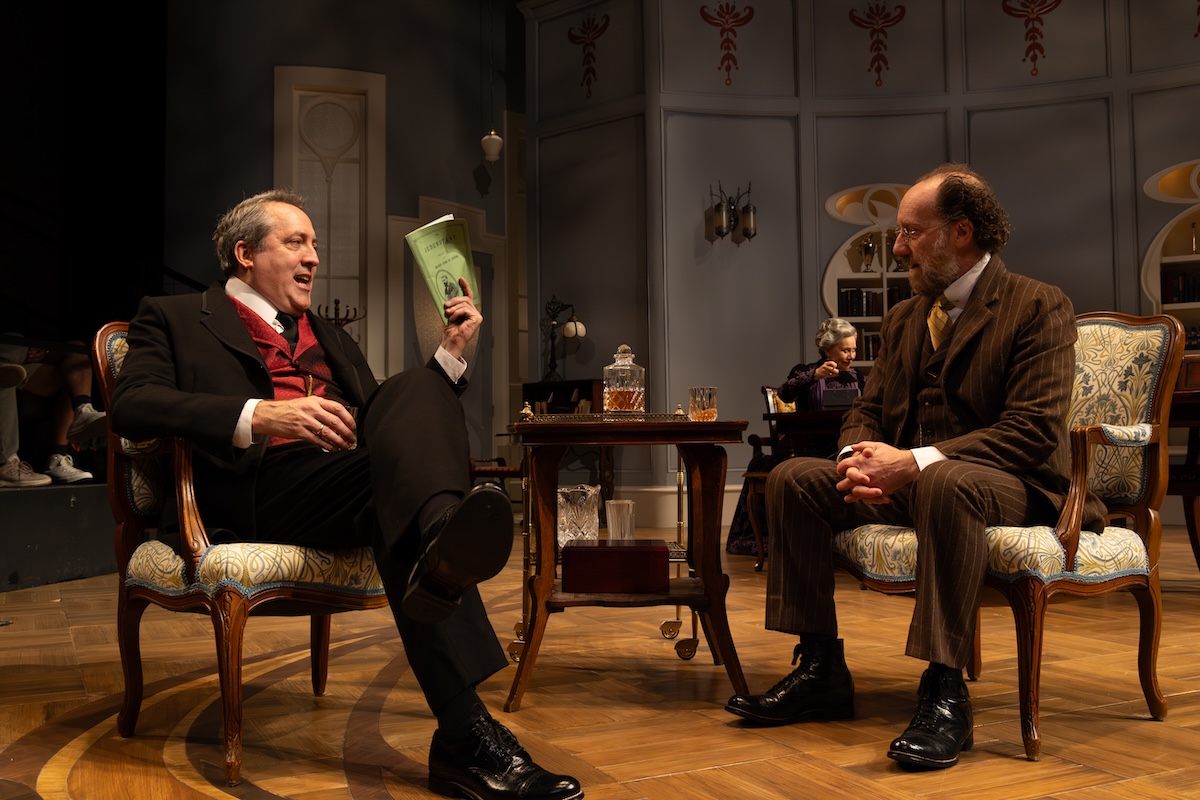
Stoppard’s play was written after he learned in middle age about his own Jewish heritage. His play asks us to consider a question relevant for today: Who is a citizen? Who gets to belong?
Director Perloff, a frequent collaborator with Stoppard on earlier productions of his work, also directed the 2024 US productions of the play in Boston and Washington DC, for which she made script revisions. That version, plus some amendments made to suit the smaller Writers stage, is used here. The play's title refers to the name of the traditionally Jewish area of Vienna.
The Jakobowiczes is the other family present, joined to the Merzes by Ludwig’s marriage to Eva (Emma Rosenthal), Hermann’s sister. Wilma (Sarah Coakley Price) married to Ernst (Sean Fortunato), a Protestant, and Hanna (Brenann Stacker) are Ludwig’s sisters.
In later scenes set in that era, Gretl’s portrait by artist Gustav Klimt is finished but not hung, Hermann considers challenging an officer (Fritz, the dashing dragoon played by Erik Hellman) to a duel because he believes he insulted Gretl, and the families celebrate a seder. All that and much more happens in 1899-1900. And we’re just getting started.
I’ll pause here and note that Leopoldstadt is a compelling play but can be difficult to follow because there are so many characters and so many topics under discussion. In act one, 17 actors perform, including four children. I’ll say more about this later but I recommend doing some advance preparation if you are not familiar with the story of, and the story behind, Stoppard and Leopoldstadt.
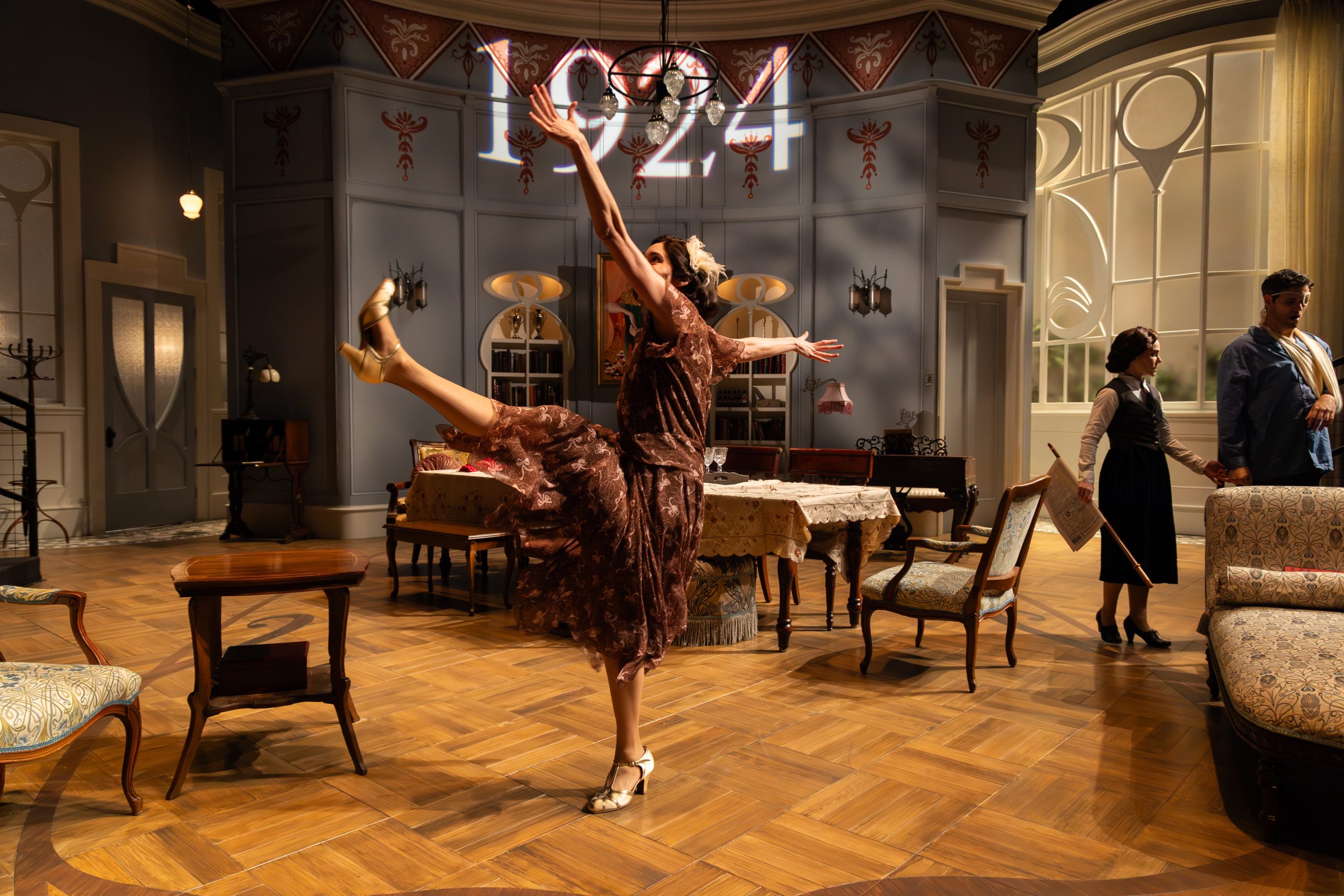
The play proceeds in 1924 with Jacob (now played by Sam Bell-Gurwitz), who has some comments on the possibility of a Jewish Holy Land. Jacob was badly injured during WWI, including losing an eye and an arm. The day is another family celebration—a bris or circumcision for the baby boy of Sally and Zac Fishbein (Grainne Ortlieb and Justin Albinder.) The bris is being performed in Grandma Emilia’s bedroom; she’s now too sick to leave her bed.
In 1938, the Merz family home is changed, with less finery and décor (Gretl’s portrait has been removed); family members wear shawls and sweaters because of lack of heat. The time is eight months after the Anschluss, when Nazis invaded Austria and annexed it to Germany. The night is Kristallnacht.
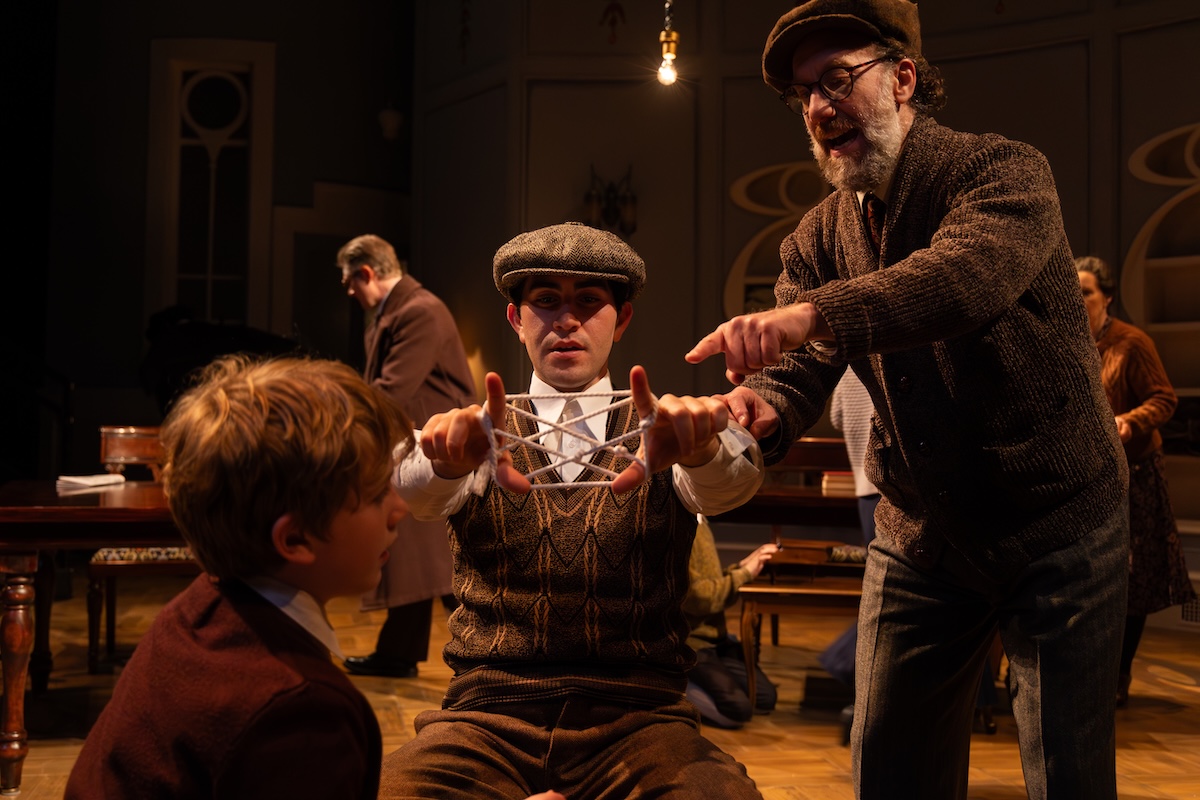
Ludwig is showing young Leo (Sebastian Rus and Caleb Scherr, alternating) and Nathan (Justin Albinder) how to make a cat’s cradle. (The cat’s cradle is a symbolic element in Stoppard’s story and an example of how he often uses scientific and scholarly elements in his plays.)
Percy Chamberlain (Erik Hellman), an English journalist, is wooing Nellie (Emma Rosenthal) to bring her young son Leo and move with Chamberlain to England, where “you and Leo will be British,” he tells her, and she can bring her parents, Ludwig and Eva, to England too (if they are willing to leave).
The final and devastating 1955 scene is set in the stripped Merz apartment with three characters present. Rosa (Jessie Fisher) and her nephew Nathan greet a visitor, an adult Leo (Sam Bell-Gurwitz). He’s a middle class Englishman; his name now is Leonard Chamberlain and he is clueless about his family's history. Leo is a stand-in for young Tom Stoppard, whose story is similar.
I was disappointed in the way the final scene is performed, apparently related to the recent script changes. There’s a moment that reminds us of the past with music and merriment (even if ironic) that I thought minimized the stark nature of the way the 1955 scene was performed in the original Broadway production. I won’t add any spoilers here.
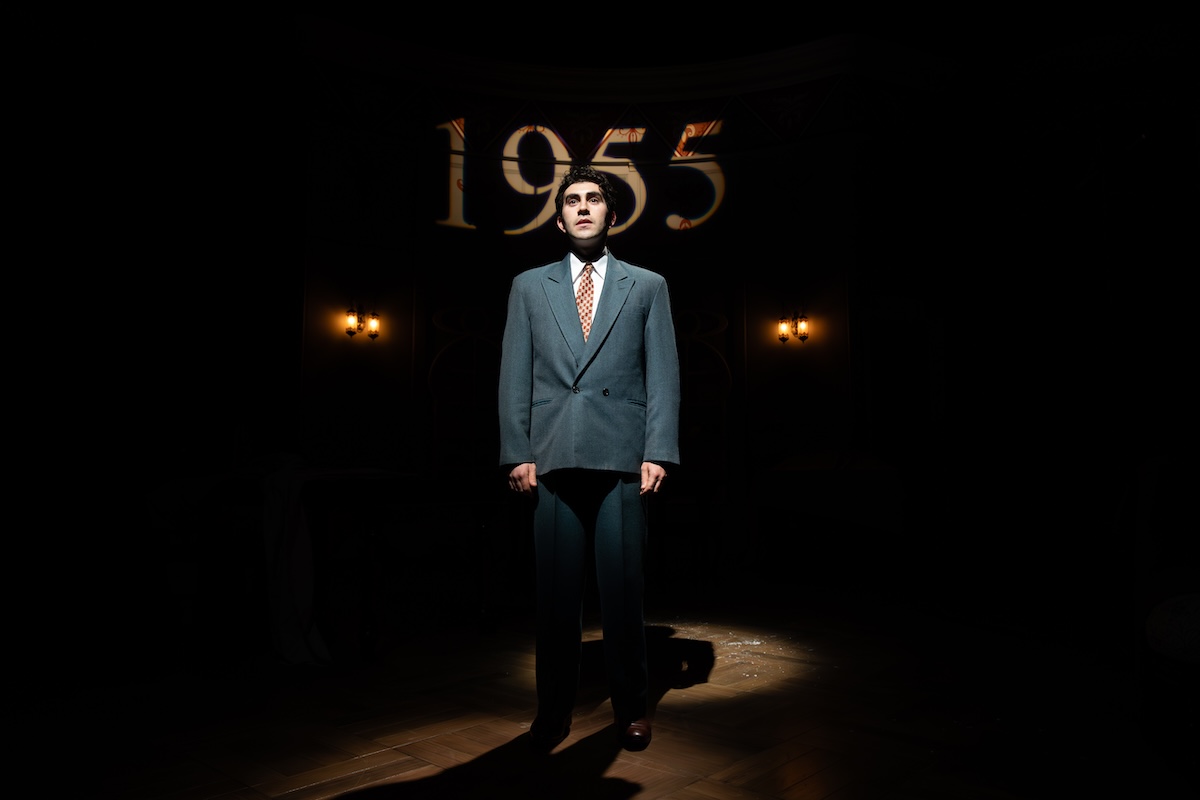
Director Perloff does a superlative job of keeping all these pieces moving smoothly with her Chicago cast. Barford’s Hermann and Slotnick’s Ludwig are the standout performances, both emotionally potent and draining. They’re matched by Fry’s Gretl and Stacker’s Hanna. The children’s roles, all double cast as required by state labor laws, are handled well.
The very large creative crew for Leopoldstadt includes Ken McDonald, scenic designer; Keith Parham, lighting designer; and Jane Shaw who provides sound design and original music. Costumes are by Alex Jaeger with wigs and makeup design by Tom Watson. Props are by Rae Watson. Jewish cultural consultants are Rabbi David Chapman and Jonathan Chapman. Katie Klemme is stage manager.
Tom Stoppard tells his own story of his Jewish heritage, which he learned about in 1989 when he was in his 50s. You can read his essay, “On Turning Out To Be Jewish,” via the Writers Theatre digital program. He was born Tomas Straussler in Zlin, Czechoslovakia, in 1937 and he was raised an English boy. He died in November 2025. Your preparation for seeing the play could also include this “Who’s Who in Leopoldstadt.” The onsite playbill includes the Merz/Jakobowicz family tree, which I strongly suggest you study.
Leopoldstadt has been extended through August 16 at Writers Theatre, 325 Tudor Court, Glencoe. Running time is almost three hours with one intermission. Tickets ($35-$95) and more information are available on the website. Tickets for the regular run are nearly sold out. Best ticket availability is during the recently added performances, July 22–August 9.
For more information on this and other productions, see theatreinchicago.com.
Support arts and culture journalism today. This work doesn't happen without your support. Contribute today and ensure we can continue to share the latest reviews, essays, and previews of the most anticipated arts and culture events across the city.
