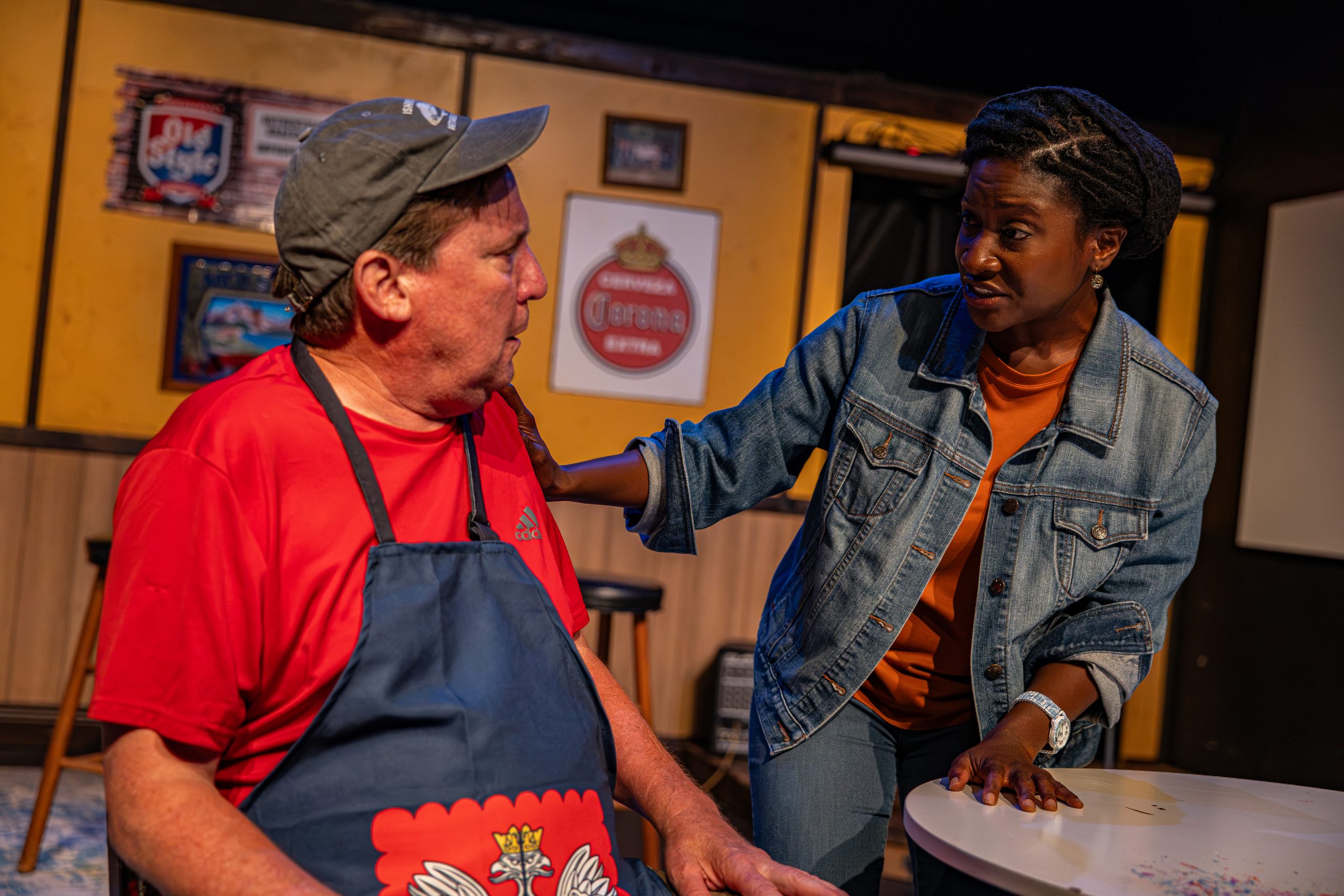

Authentic Chicago Ensemble’s Safe Landing: Coyote Embrace, written by Tim Kough, directed by Jordan Ratliff, playing at Theater Wit, begins with a video slideshow of coyote facts played over a clumsy interpretive dance performed by people in coyote masks. Did you know coyotes mate for life? Did you know they gnaw off their legs to free themselves from traps? It’s a setup for extended metaphors but also sort of bizarre and unnecessary. One realizes soon, however, that that’s a trend with this show, things being bizarre and unnecessary.
At the play’s center is Anj (Heather Elaine Abbott), a young woman who, after a run-in with human traffickers a year befoe, faked her own death and now, in witness protection, is lying low in a Northern Illinois cabin under the auspices of Jax (Danielle Lorae Byas), a federal agent and amateur comedian. Jax runs Jax n’ Jack’s Bait n’ Bistro shop, a witness protection front and the play’s setting, alongside her business partner Jack (Tim Kough). With only a week before her testimony, Anj, concealing her identity, invites her musician sister Casey (Sarah Kough) to the bistro promising a lucrative gig; meanwhile, a criminal husband and wife duo Riley Ray (Joey Chelius) and Rio (Emma L. Anderson) are in town planning Anj’s abduction
It’s a lot of characters, a lot of relationships. Constructing this pile of facts for the audience is an expositional challenge that Kough doesn’t quite pull off. Exposition must be invisible and interesting. The audience should be so dazzled by the characters and action, they don’t notice the breadcrumbs of helpful data shown (not told) throughout. It’s that show-not-tell issue where the play fails. Safe Landing: Coyote Embrace has far too many lines starting with phrases like, “Remember what happened . . .” or “Don’t forget that you . . .”
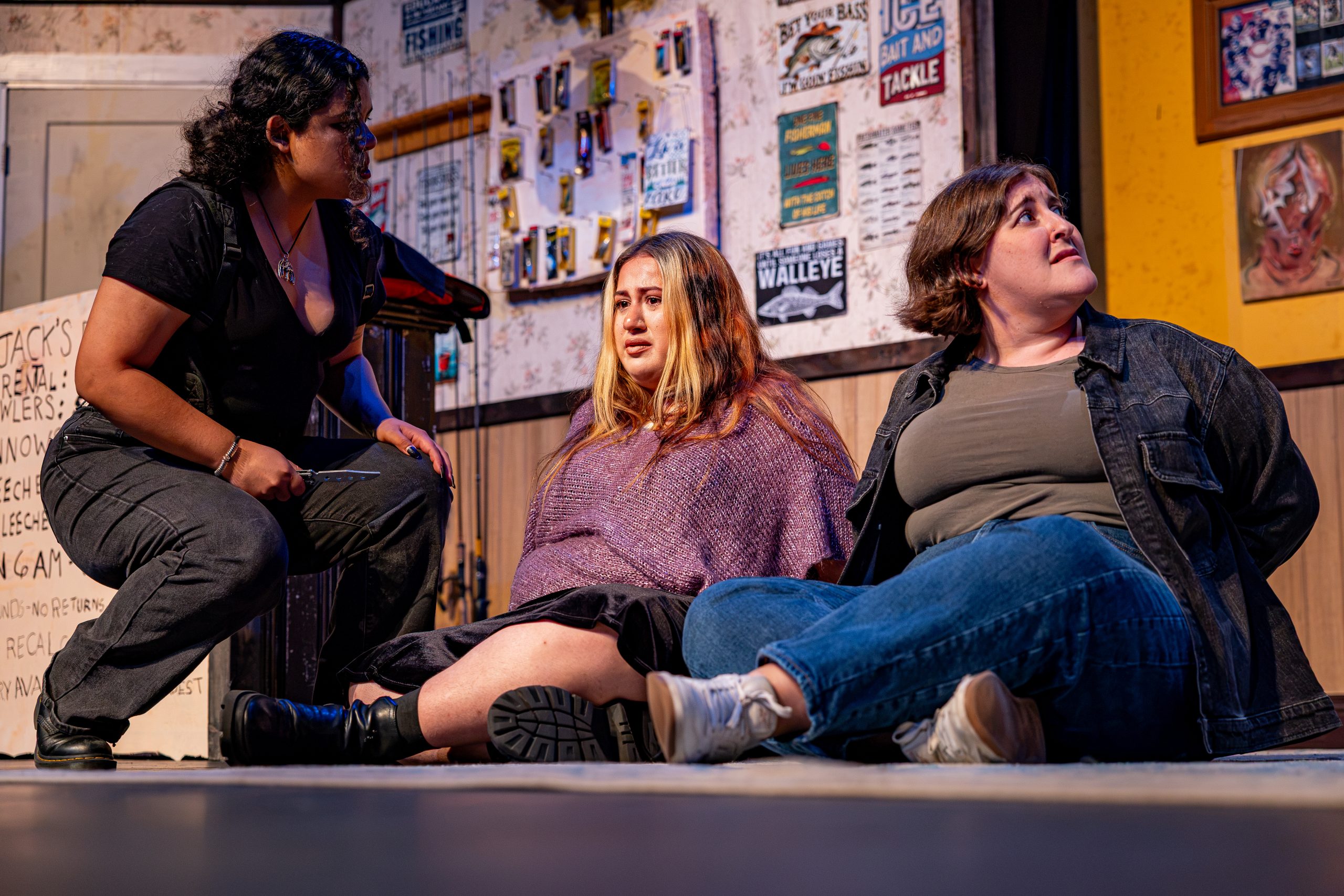
Like when Rio tells her husband, who’s having severe guilt-ridden doubts about their life of crime, to toughen up, “Just keep our circle small. Don’t share anything. Remember Miami? Your last source had a moral crisis and confessed our plan to her spiritual adviser who went right to the cops.”
Of course he remembers Miami! It’s difficult to appreciate characters when one senses they are conduits for information. Moments like these remove the audience from the action. We can see the author straining to make everything fit. We can see the corners Kough cuts.
In another example, Jax reminds Anj of her experiences this past year, “You’ve been on the run from human traffickers for over a year. You faked your death and are living under a new identity, and now you had me book your sister to play all the way out here, and she doesn’t know?”
One can forgive a single line like this, maybe two, but three or more and, I’m sorry, you’re out. Furthermore, this exchange, where Jax questions Anj’s motives, reveals a plot hole the size of the Grand Canyon.
Why would Anj, with only one week before her testimony, after which normal life could resume; why would Anj, who spent the last year in hiding; why at the very end of all that, when risks could jeopardize the whole plan; why would she decide that now was the time she must reconnect with her sister? It makes zero sense, and Kough might be aware of this, because when Anj is confronted with that question, her answer is shockingly weak.
Anj says, “I know, I just needed to see her.”
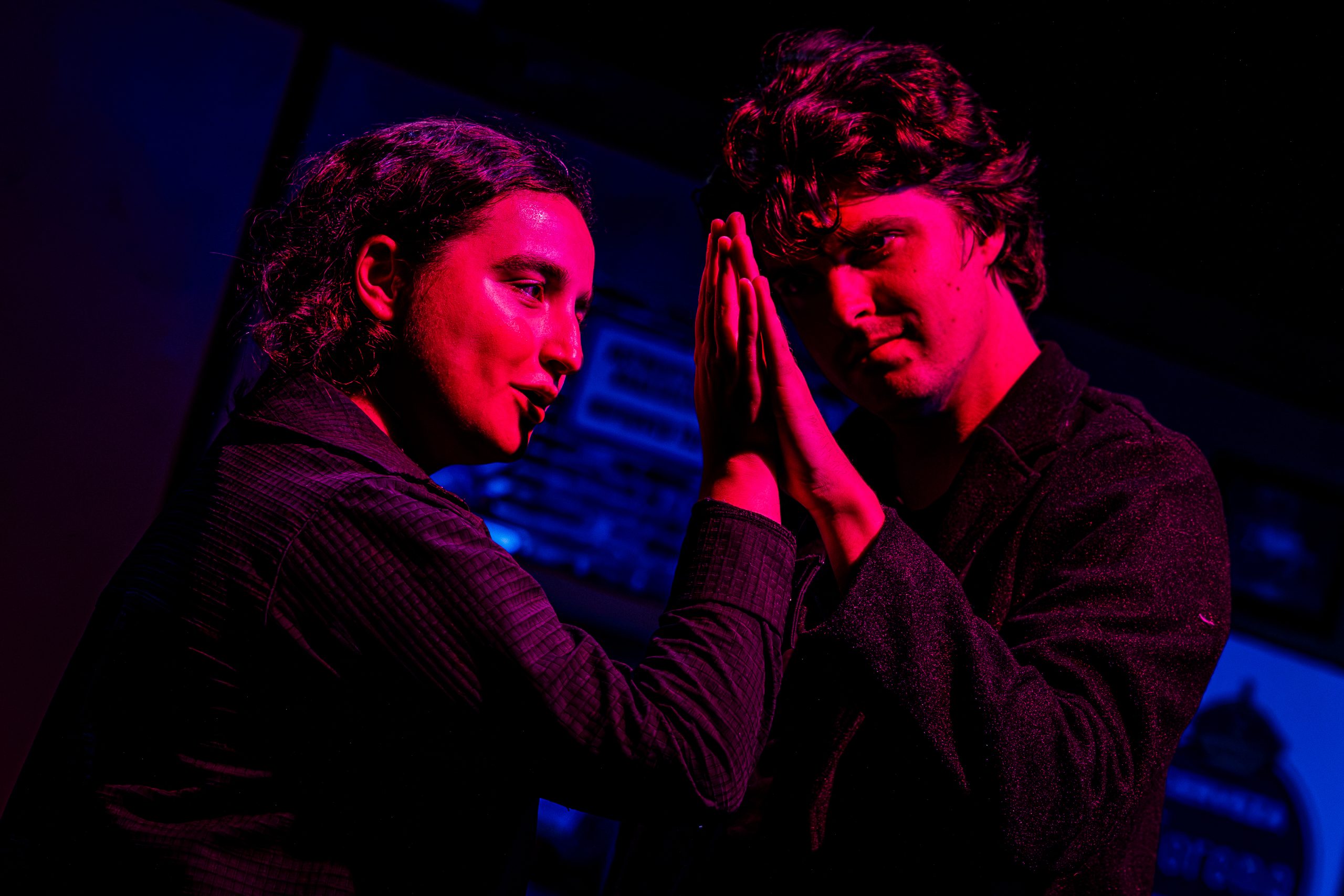
This reads as terribly, horribly lazy. Kough could have concocted some explanation. What if Anj was nervous about the trial and wanted her sister’s support? What if Anj didn’t want her sister to find out she was still alive through televised trial coverage and decided to break it to her in person?
The play is full of bizarre and unnecessary bugs that should be squashed. For instance, on several occasions the action stops entirely so characters can deliver soliloquies to the audience. And what do they talk about? Trauma, of course.
Trauma, trauma, trauma. It seems the entire world is obsessed with the topic. Kough is dead-set on reminding us of the obvious, that when people do bad things it’s usually because someone did something worse to them, that, essentially, hurt people hurt people. It’s a snore, a cliché and, at least in one case, ruins a character completely
Angel (Melody Contreras) is the toughened, sociopathic criminal sent in to assist Rio and Riley Ray. Contreras plays her cold and stealthy, a menacing presence, one of the better performances, for a little while, at least. Toward the end it’s all obliterated, as she goes on an exposition binge soliloquizing about her sad childhood.
“My hardness saved me,” she explains. “Love can only lead to pain and vulnerability. I need to be hard to survive. I am a survivor. This is simple.”
Do we need this? Does it matter that deep down, beneath it all, Angel is really, very sad? Angel was mysterious, murderous. Extensive backstory, especially delivered through such a transparently lazy method, does nothing to improve her. Moreover, it ruins the intrigue. Perhaps it should be left to the audience to wonder, or not wonder, how she became this way. Contreras’ delivery of the soliloquy, shaky, with obvious mistakes, further digs her hole, though it isn’t inconsistent with the rest of the show.
Performances, generally, in Safe Landing: Coyote Embrace are weak. I saw wide gestures, a lack of subtlety: approaches that signaled a high-school level of stagecraft. There is only one notable exception.
Susan Payne Anderson as Dede, a member of Casey’s band, does an excellent job. In a show where, by didactic design, we are led to believe everyone is traumatized, Dede is the only one I truly believed. She’s shaky, she mumbles, and carries a true-to-life weariness. Payne Anderson is only in a few scenes, but she always leaves an impression, and I was eager to see more. Everyone else onstage could learn from her approach, though performance improvements can only do so much with a script as flawed as this one.
Safe Landing: Coyote Embrace by Authentic Chicago Ensemble continues at Theater Wit, 1229 W Belmont Ave., thru July 26. Running time is 105 minutes with an intermission. Tickets are $25.
For more information on this and other productions, see theatreinchicago.com.
If you found this post interesting, please consider supporting Third Coast Review’s arts and culture coverage by making a donation. Choose the amount that works best for you, and know how much we appreciate your support!
