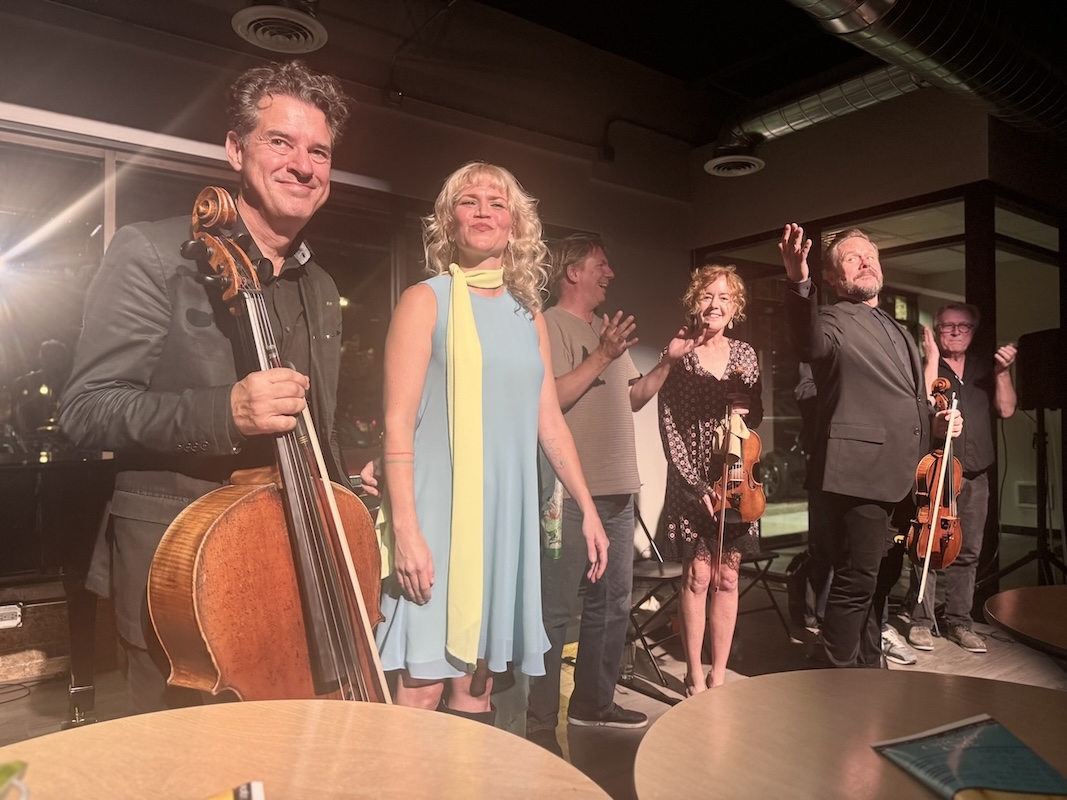

The opening festival of the CheckOut continues, featuring a diverse array of Chicago composers, musicians, and those who have documented the inner life of the citizens who live in this "toddlin' town." Friday, September 19, was a continuation of stories about Chicago told through original music commissioned by Access Contemporary Music (ACM). The evening featured the Black Oak Ensemble, audio journalist Bill Healy, and educator and author Mark Larson. It was a dazzling evening, all about the Chicago author and raconteur Studs Terkel, hosted by ACM founder Seth Boustead.
Terkel listened to and wrote the stories of every social stratum in Chicago. His books Division Street and Working are considered classics in urban journalism and storytelling. Larson knew Terkel and is an oral historian who has published two books about Chicago. In Ensemble: An Oral History of Chicago Theater and Working in the 21st Century, Larson has recorded and transcribed stories about Chicago in much the same way that Terkel did. Bill Healy was also an educator who has since become an award-winning audio journalist. The evening featured four pieces with a theme of work and education, reflecting on Studs Terkel and the diverse kinds of work the host and guest had done over the years.
The Black Oak Ensemble is a soulful classical string ensemble that I first encountered at Nova Linea Musica. Letters From Home was an evening of music from several composers, each of whom explored the meaning of home. The Black Oak Ensemble featured violinist Desirée Ruhstrat, violist Doyle Armbrust, and cellist David Cunliffe. Ruhstrat is also the Artistic Director of Nova Linea Musica, which sponsored the stage at the CheckOut. Armbrust has played with several groups, including the Grossman Ensemble. Cunliffe, a founder of the Lincoln Trio, has performed with several orchestras in his native country, the United Kingdom. All three of these outstanding musicians are also educators, committed to sustaining both new and classical music.
The first piece was composed by Shanan Estreicher, titled I Give Them Music about a music teacher, Rose Hoffman. It is about connecting with children through music and how she viewed it as a gift to those students, knowing that it would impact the rest of their lives. I was deeply moved by the passion and energy the Black Oak Ensemble put into playing Estreicher's composition. It had the feel of an urban landscape with the depth and expanse of joy. It struck me that the members of this group were once students whom a teacher must have inspired, who gave them that spark of passion for making music.
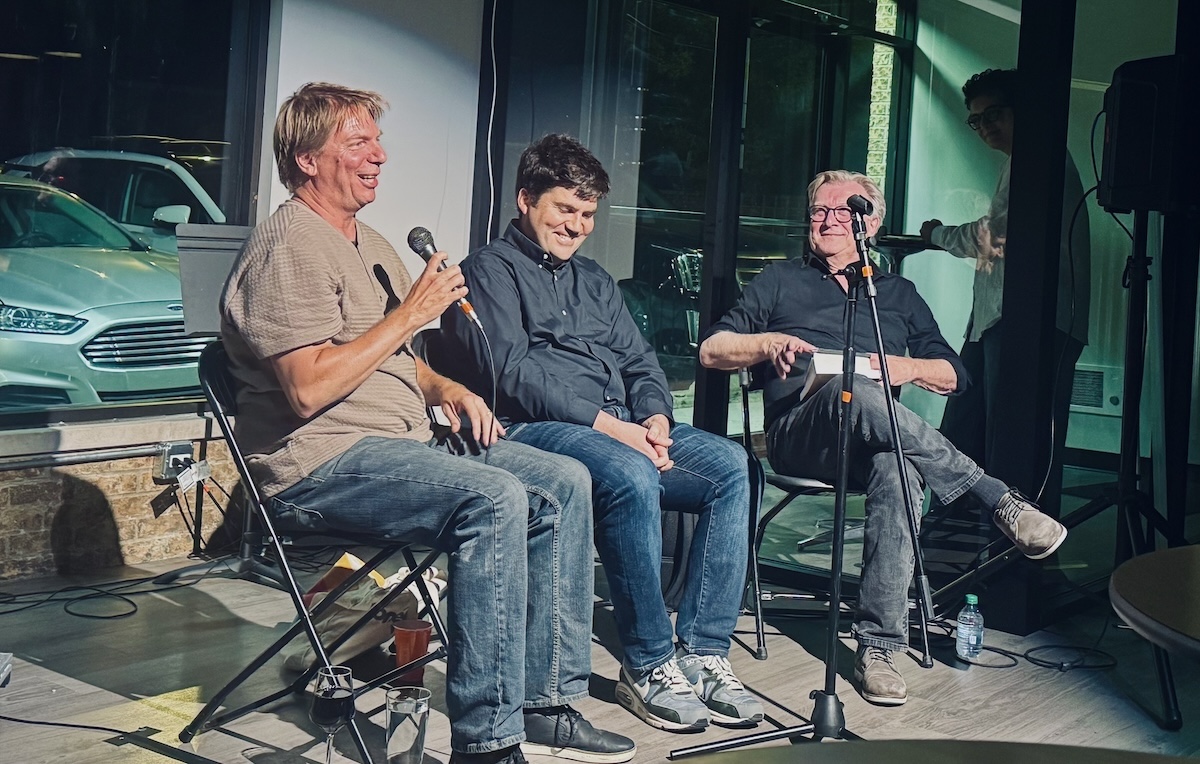
The panel reminisced on how Terkel was able to get such depth in his stories by asking the right questions and then truly listening. In this era of artificial intelligence and device fascination, listening is marred by distractions. Terkel used a tape recorder, and his ability to listen allowed people to open up and be authentic in their feelings and attitudes towards work. Work was a means to an end, and a person could make a living wage to buy a house and a car. Nothing flash, but dependable on the cross-country vacations that you loved or dreaded.
Natasha Bogojevic wrote the second composition, titled hi-ho! The composer introduced her piece and said that it drew inspiration from Disney's Snow White and the Seven Dwarfs. There was a thread of the "Hi-ho! It's off to work we go" chorus. Music has been used as a rhythmic means of completing physical tasks, such as mining or fieldwork, to make the time pass more quickly. Bogojevic's piece was short but energetic and spirited. It brought a smile to my heart.
The host, Seth Boustead, contributed another composition to the evening, titled Hardly Working. It was during his early twenties, when he was working at a sandwich shop, that a regular customer would have a liquid lunch of beer and ask the dreaded question, "Working hard or hardly working?" The customer was "that guy" that every service worker has encountered.
Boustead's compositions are richly textured with surprise bursts of rhythm changes and fugue-like phrases. The ensemble played it beautifully, and one of the things I like best about Black Oak is how they are physically tuned in to what they are playing. I dig the way they play new classical or chamber music like a jazz player would. It was a dance between the instruments and the player, with the notes bending and twisting them. It is one of the best aspects of chamber music. The audience gets to be on an intimate level with the music, players, and, in this case, the composer.
The final piece came from singer and composer Alicia Walter, whose grandfather was Norman "Hots" Michel, a piano player at the Sherman House. Studs Terkel also interviewed him for Working. Walter's composition was titled Work Cycle, and she joined the Ensemble on piano and sang. It was a joyous and nostalgic journey bolstered by Walter's rich contralto voice. It felt like a flashback to places like the Back Room, Mister Kelly's, or the venerable Gold Star Sardine Bar that would feature musicians in regular residency-type appearances. I was not old enough to get in during the heyday of the classic places, although I did manage to get into the Playboy Club on prom night in 1978. A Playboy Bunny served us omelets!
The panel was both educational and entertaining. I was in my happy place when discussing Chicago during what I call the golden age of Chicago journalism and literature. The names of my writing inspirations and heroes hit their stride in the midcentury. I cut my reading and writing teeth on the works of Studs Terkel, Mike Royko, Nelson Algren, Lorraine Hansberry, and Richard Wright. Healy and Larson spoke about the authenticity of Terkel and how he captured an era when work meant something tangible. A house to remember when you grew up, and a car for the loved or dreaded summer cross-country drive.
This evening of original music at the CheckOut gave me a genuine Chicago vibe. The speakers and the music spoke to my Chicago soul. Studs Terkel's Working was next to the dictionary and encyclopedias in our apartment. The things I saw every day were brought to life through the stories of Chicago people. This was a working town. The Union Stockyards, Nabisco, Holsum Bread, Campbell's Soup, and four daily newspapers delivered by a paperboy on a bike. My beautiful, gritty, loud, and wonderful Chicago.
I highly recommend keeping an eye on the CheckOut schedule. The music space provides a home for new music by Chicago composers, and they also offer music instruction. Come on over, get yourself a Slushie with or sans alcohol. This is a treasure that you won't want to miss.
Tonight the CheckOut is hosting their resident ensemble, Palomar Trio performing music of Schostakovich, Joan Tower, Astor Piazzolla and others. 4116 N. Clark St., September 24, 7:30.
Tomorrow night they are presenting the trio Max Bessesen: Love Call. Thursday, September 25, 7:30pm. For more info, click here.
If you enjoyed this post, please consider supporting Third Coast Review’s arts and culture coverage by making a donation. Choose the amount that works best for you, and know how much we appreciate your support!
