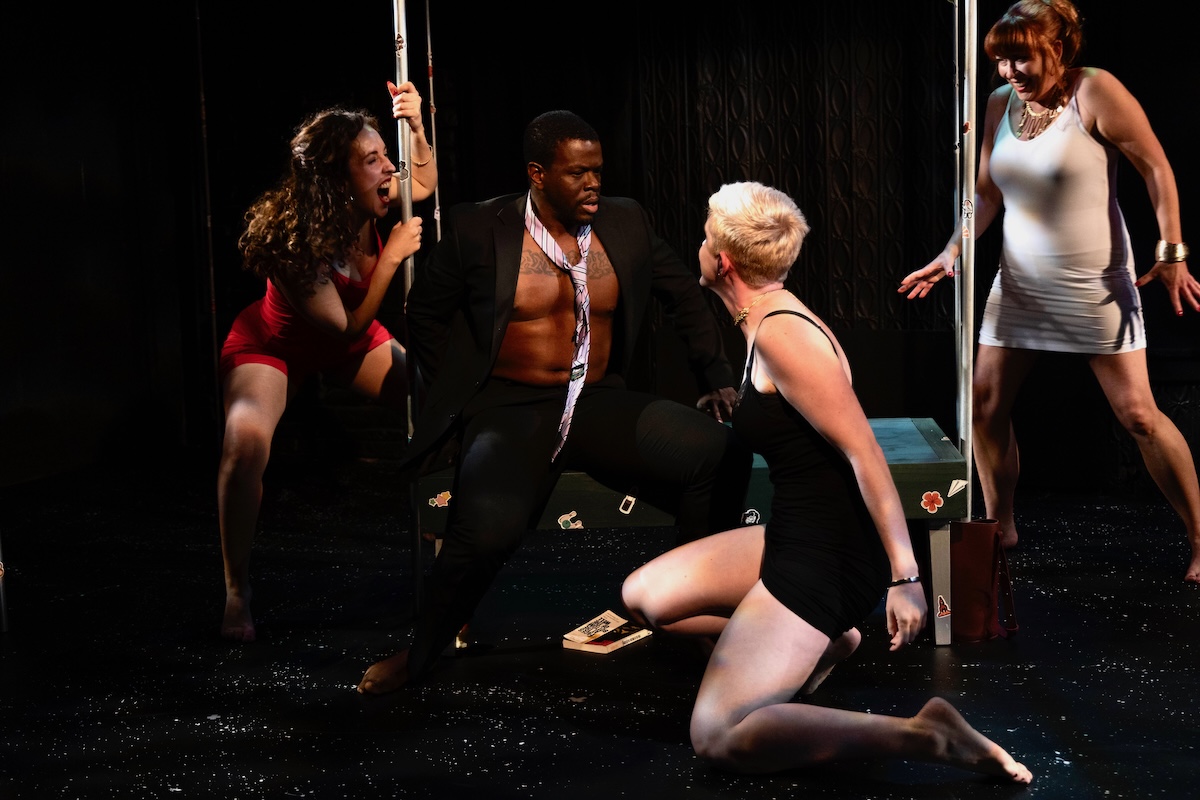

Amiri Baraka was still LeRoi Jones when he wrote Dutchman in 1964. The play, now being staged by Trap Door Theatre, is an early dialogue on race, class and power. Keith Surney directs and stars in the two-character play (more on that later), which takes place on a New York City subway train on a steamy afternoon. Dutchman is exciting, political, racist and not for children or the faint of heart.
Trap Door’s small stage is tricked out like a subway car with a bench and half a dozen poles suitable for a sexy woman to dance around. (Set design by Viscaya Wilson.) The plot of this one-act play revolves around a white woman who accosts and seduces a younger Black man on the subway car. The woman—Lula, played by three different actors—seems to know a great deal about the life of the young Black man named Clay (Keith Surney). The first Lula (Carolyn Benjamin) slithers into the subway car, where Clay is reading a book. Lula is eating an apple in a seductive Eve-like way; apples play an ongoing part in Dutchman, adding biblical symbolism.
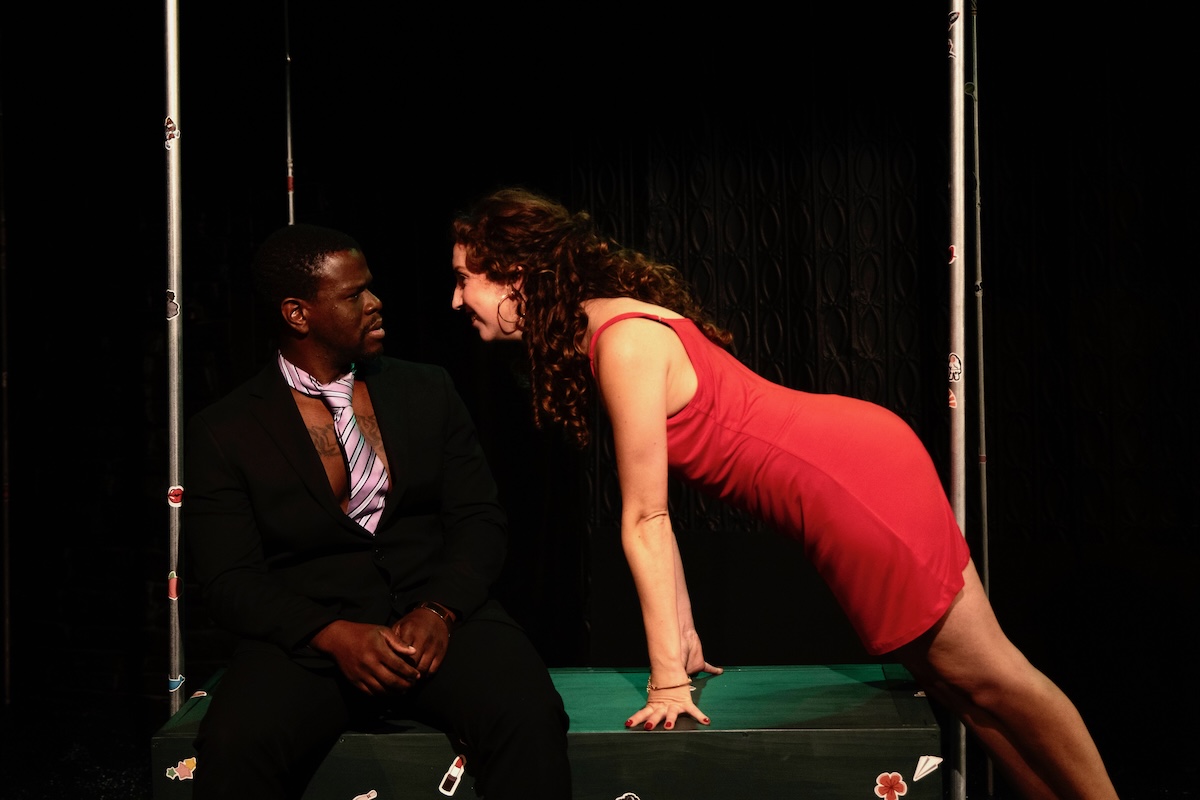
Lula 1, 2 and 3 (Benjamin, joined by Ali Foley and Genevieve Corkery) continue to taunt Clay, touching him, groping him, ridiculing his clothes and his heritage. “What right do you have to be wearing a three-button suit and striped tie? Your grandfather was a slave, he didn’t go to Harvard.” She suggests Clay should invite her to the party he’s going to that night … and then describes what they’ll do when they climb five flights of stairs to her apartment.
Clay is mostly passive, sometimes interested, sometimes responds to her touches. But finally, toward the end of the play, he breaks out in a powerful monologue, threatening Lula, threatening the other (invisible) passengers In the subway car. He tells her, “ You great liberated whore! You fuck some black man, and right away you're an expert on black people. What a lotta shit that is. The only thing you know is that you come if he bangs you hard enough.”
The scene ends violently. And then a young Black man carrying a book gets on the subway car, sits down and reads. Lula slinks toward him, eating an apple. And—blackout.
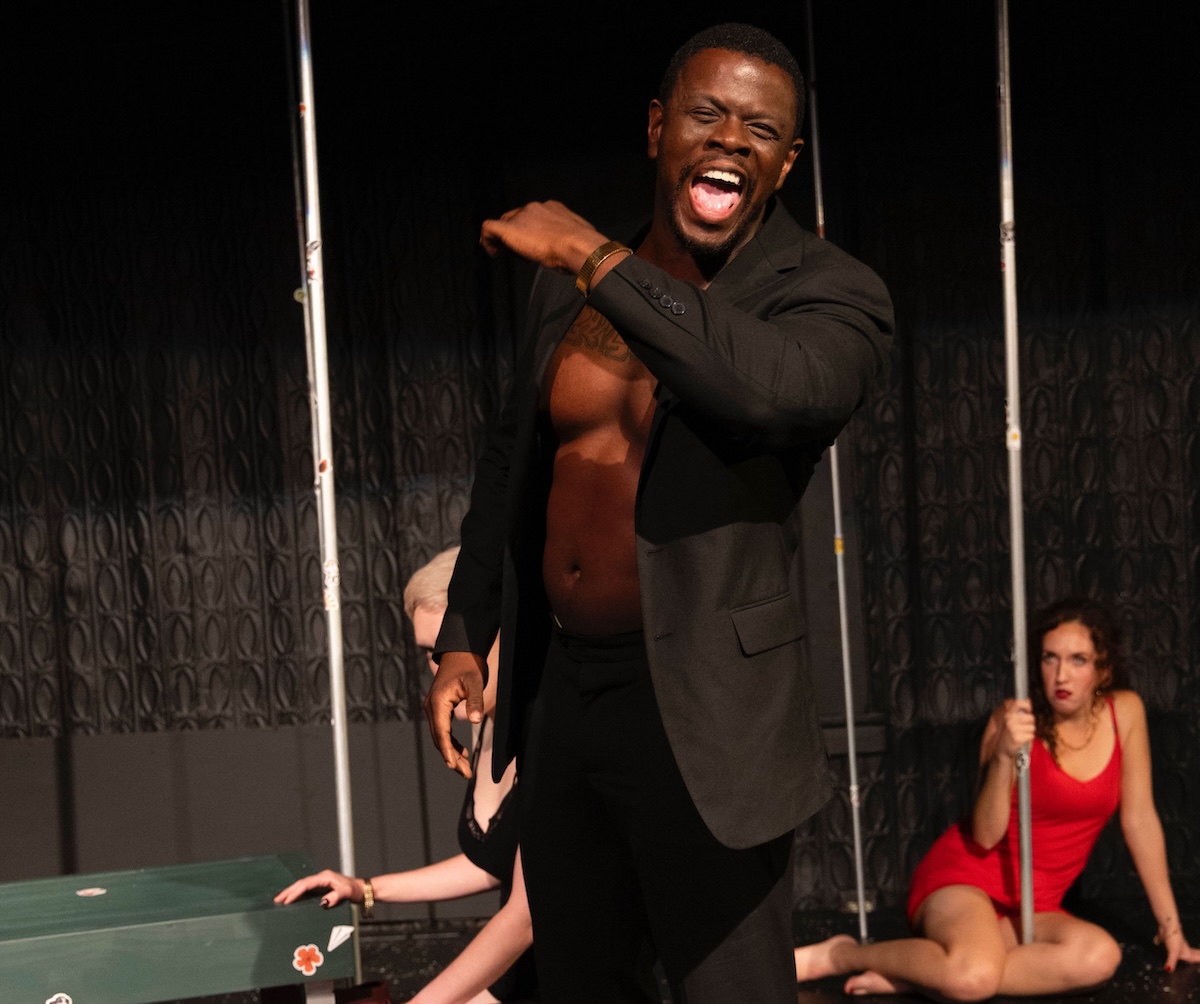
Surney does a skillful job in his directorial debut; he and the other actors keep the pace of this short, thrilling drama. Surney has often proved his acting mettle, most recently playing a Jewish man in a totally different kind of play, Female Ashkenazi, With a Sewing Machine. The three Lulas also convince us they are one woman. Baraka’s original script did not specify more than one performer as Lula so this is a clever directorial and casting choice by Surney, which makes the action more dynamic.
Lighting design is by Gary Damico. Rachel Sypniewski is costume designer. Stage manager is Kayci Johnston.
LeRoi Jones was a poet and author of novels and dramas. He was a voice of the Beat Generation, and then went on to become a major player in the Black Arts Movement of the 1960s and ‘70s. After the assassination of Malcolm X in 1965, Jones changed his name to Amiri Baraka. Baraka died in 2014 at the age of 79.
Dutchman, part of the Trap Open Series of short-run plays, continues through October 25 at Trap Door Theatre, 1655 W. Cortland. Running time is about 50 minutes. Tickets and more info about the Trao Open Series available here.
For more information on this and other productions, see theatreinchicago.com.
If you found this post interesting, please consider supporting Third Coast Review’s arts and culture coverage by making a donation. Choose the amount that works best for you, and know how much we appreciate your support!
