

Over the last few years, Chicago’s young Gwydion Theatre Company has proven itself a reliable protectorate of great literature. In October, I favorably reviewed its production of Death of a Salesman, the first in Gwydion’s “Season of Class” series, and was eager to return for the second entry, The Lower Depths, a 1902 Russian social realist play by Maxim Gorky about the depravity of boarding house life. Under the direction of Danny Kapinos, Gwydion creates a mostly well-acted production that mirrors the despair of our troubled times.
Similar to Death of a Salesman, the set is simpler than what’s described in the script's descriptions. For his boarding house, Gorky asks for windows, thin boards denoting rooms, a stove, a bunk. Instead of that scenic designer Haley Wallenfeldt gives us red. Lots of red. A red stage and red slats and red boxes and red chairs.
This barebones set serves no clear purpose (outside the obvious financial one) but is workable enough in the first acts when the actors, through dialogue, clearly establish the boarding house setting. I wonder, however, if audience members new to the play can discern when we change locations to a waste yard. With such a sparse set, lighting designer Sam Bessler and sound designer Rick Reid should do more to suggest these shifts.
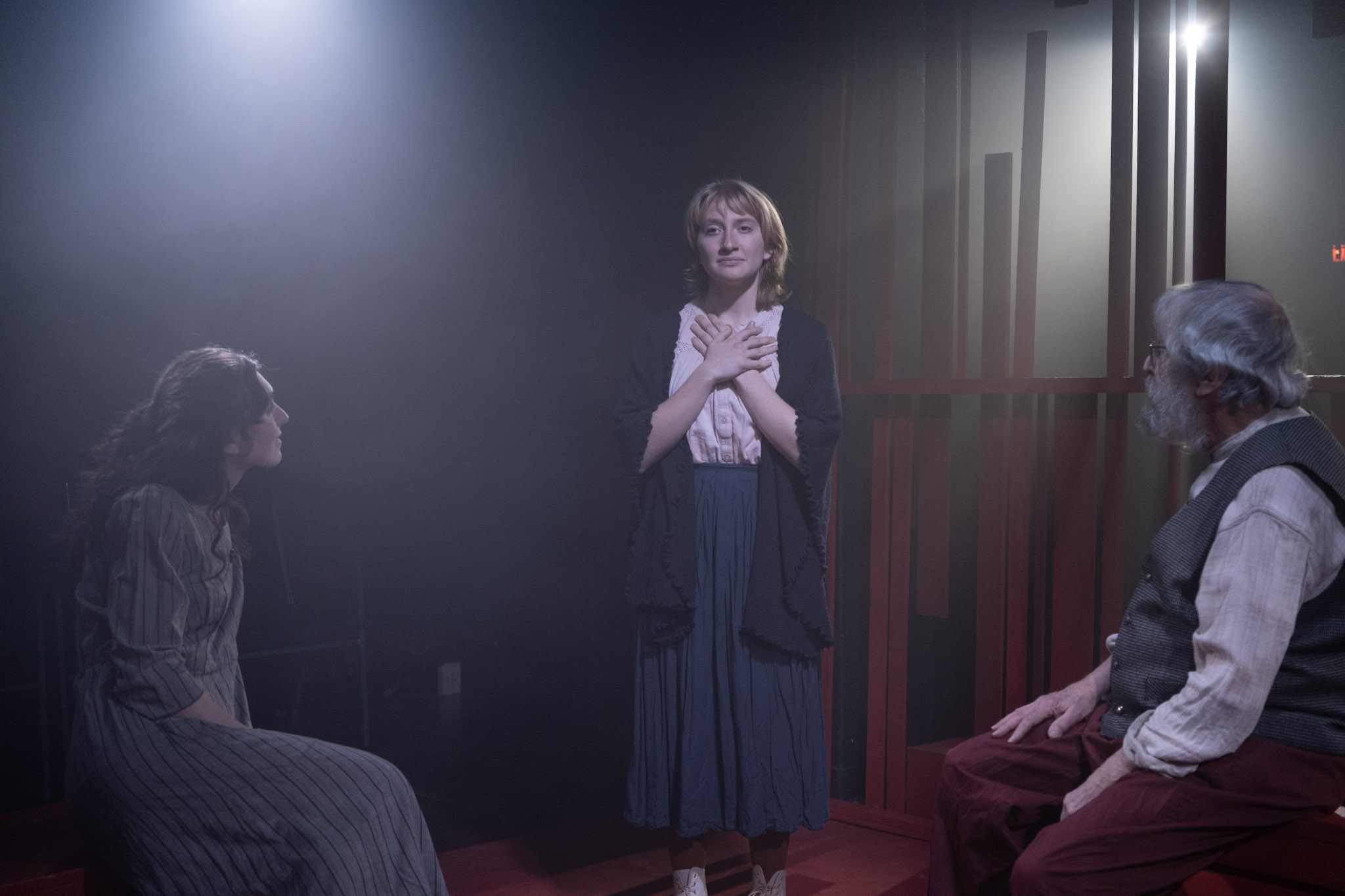
Nitpicking technical work, however, is kind of beside the point. The Lower Depths through-and-through is an actor’s play, an ensemble piece. It’s full of dense conversations and dramatic monologues. For the play’s length we’re strapped into a cast of desperate characters, and their believability, more than anything to do with sounds or lights, makes us believe the story. At the start, overlapping dialogue exposes the boarding house occupants as they wake up to another day in poverty hell.
Throughout a frenzied opening sequence of overlapping dialogue, we meet The Actor (Evan Bradford), a young artist already ruined by his alcohol addiction. There’s the locksmith Andrei Kleshtch (Tommy Thams), shockingly unconcerned about the slow death of his wife Anna (Hannah Freund) from consumption. And Satine (John Nicholson), a cards player whose nihilistic attitude generates some of the play’s most interesting lines. That's just a few; there are more.
The audience is overwhelmed by well-orchestrated chaos that bends into a story with the introduction of The Lower Depths’ main character Luka (Howard Raik), a wise old man new to the boarding house whose kind heart inspires the other to imagine a better future. Raik’s performance lacks the qualities we critics usually attach to “greatness.” He is not dynamic, hot and cold, loud and quiet, but rather gentle and plain. He’s an unchanging grandpa. Maybe this isn’t great character work, but Luka isn’t so much a character as he is a calming vibe, like Santa Claus or Jesus. He’s a lot like Jesus, actually.
Luka is a dispenser for the writer’s philosophy. Throughout the show he reflects on matters of kindness: “All I said was that if a man isn’t good to you, then he’s acting wrong”; on matters of religion: “If you have faith, there is (a God); if you haven’t, there isn’t . . . whatever you believe in, exists”; on matters of love: “Listen: take the one you like by the arm, and march out of here—get out of here—clean out.”
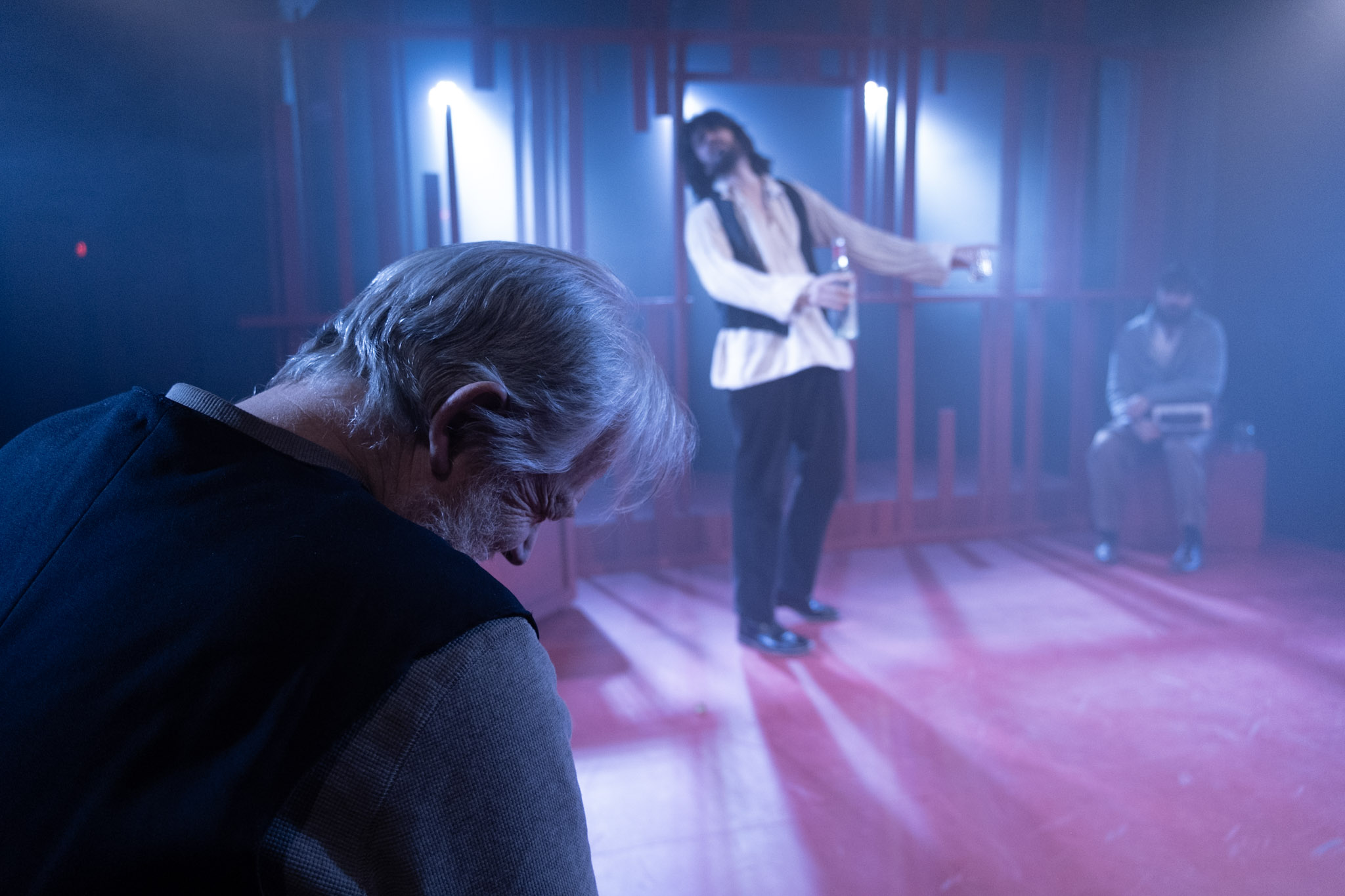
Raik’s Luka, unadorned and candid, tugs at our hearts. So far as acting goes, however, the show’s real star is John Nicholson as Satine. While most of the cast attempts naturalistic acting, Nicholson’s Shakespearean, Ian McKellen voice commands attention. Compared to Raik, Nicholson’s mind seems more activated by the character, and in every line I see deliberate choices that make his presence stronger. He has a small but noticeable part in the beginning, and I think audience members are grateful to see his character expanded in later acts.
Of the main characters, Alex Levy’s performance as Vaska Pepel, the thief in love with Natasha (Brynn Aaronson) but in a physical relationship with her abusive sister Vassilis (Katherine Schwartz), is the weakest. Like many young actors going for gasps, Levy can be very loud. Especially with a room as intimate as the Chopin Theatre's basement space, actors must know that a raised voice can be jarring, even violent. That’s all well and good if your intent is to jar us with violence, but less so when you’re trying to establish yourself as a leading man we should understand as appealing. In the scenes where Levy plays opposite the female characters, perhaps because they require more tenderness, he mellows out.
It’s a male-dominated cast, definitely, but all the female characters shine bright. Nastia Goddard as Nastya, the sex worker, is especially charismatic. Some of her line deliveries, like when she’s resigned, “I’ll drink—then I cry again—that’s all there’s to it!” or full of rage, “My love was real honest-to-God love!” stay with one more than many of the erudite pieces of dialogue. Brynn Aaronson as Natasha is a constantly engaged wonder. Without spoilers, a brutal scene between Natasha and Luka calls for emotional devastation, which I think is always visible and believable on her face.
There’s not much point, I figure, in criticisms aimed at the writing of a long-dead, much-loved writer. But I would ask Gorky’s ghost to consider an occasion where Luka acts way outside his character. In one scene he clumsily tries to convince Natasha of something that seems against her interests, which raises eyebrows. Maybe that bit needs a second draft.
Anyone looking for parallels between the show and modern life will find plenty. The repeated sentiment, “All honest men have passports,” feels especially prescient. The Lower Depths argues that people cast aside by society need our attention, our love. Walking out of the show, one feels a little closer to whatever cure will work on this sick world. Also, importantly, one feels entertained.
The Lower Depths by Gwydion Theatre Company has been extended through March 8 at the Chopin Theatre’s basement space, 1543 W Division St. Running time is 2 hours with an intermission. Tickets are $30 or $20 for students with IDs.
For more information on this and other productions, see theatreinchicago.com.
Did you enjoy this post? Please consider supporting Third Coast Review’s arts and culture coverage by making a donation. Choose the amount that works best for you, and know how much we appreciate your support!
